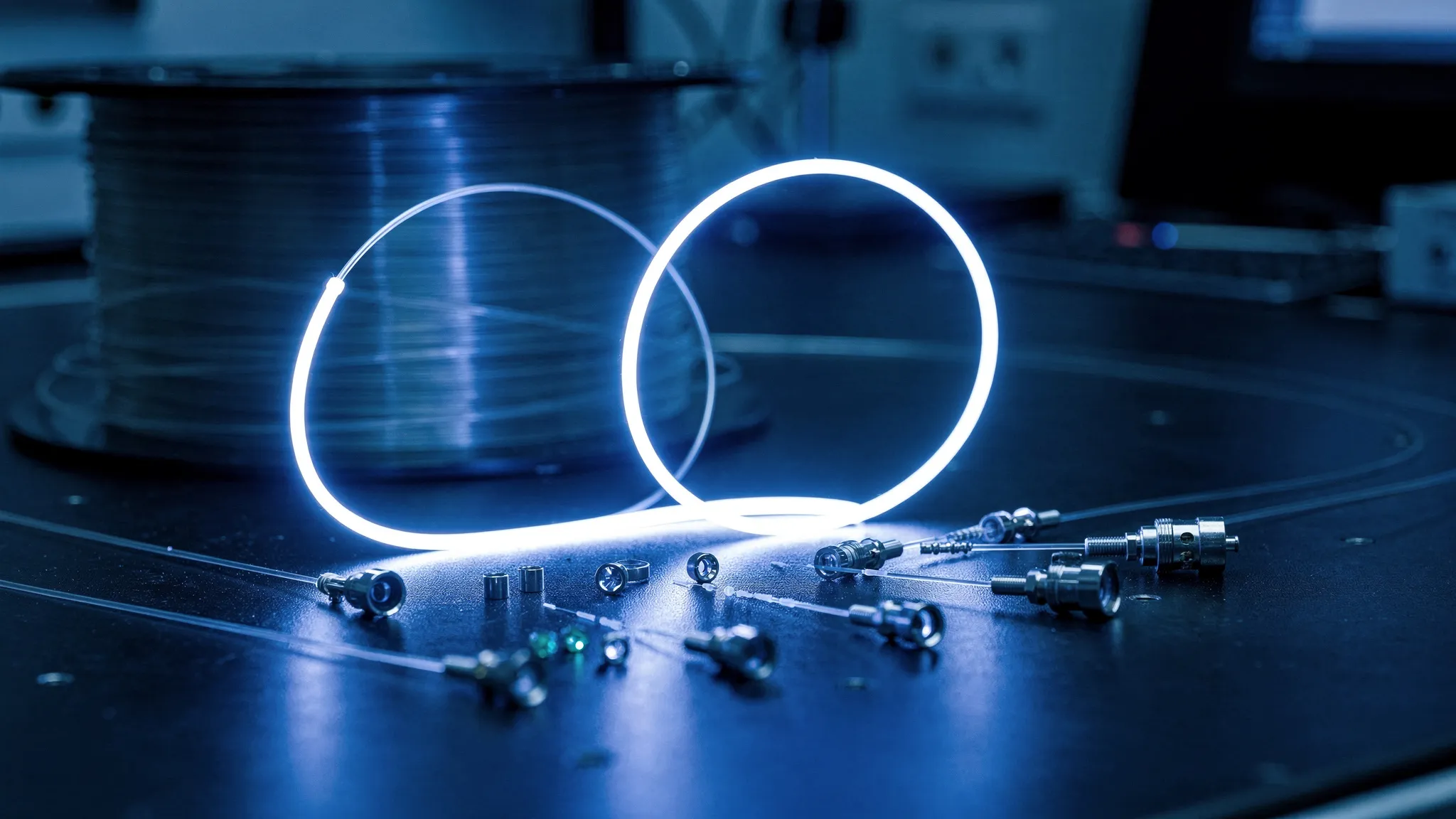
A BLACK HOLE'S RING OF LIGHT, INSIDE AN OPTICAL FIBRE
A perturbed black hole does not fall silent at once. It emits damped oscillations, called quasinormal modes, whose frequencies depend on the black hole’s geometry. Measuring them — “black-hole spectroscopy” — gives access to properties that cannot be seen directly. But these modes depend on the whole of spacetime, from the horizon out to infinity, which makes them hard to analyse and to observe.
A useful shortcut is the light ring: the unstable circular orbit on which light can circle a black hole. In the right limit, the properties of that orbit are directly linked to those of the quasinormal modes. A wave sitting on the ring oscillates at a definite rate and slowly leaks away from it.
A black hole made of light pulses
Analogue systems, in which ordinary waves obey similar equations, can reproduce the mathematics of curved spacetime. R. Terrier, J. Fatome, B. Kibler and Théo Torres, at the Carnot Interdisciplinary Laboratory of Burgundy (Université Bourgogne Europe and CNRS, in Dijon), use an optical fibre.
The “black hole” is an intense, very short laser pulse that keeps its shape as it travels: a soliton. A weak, continuous probe wave travelling at the same speed sees the soliton as a barrier, playing the role of the region around a black hole. In optics, unlike around a real black hole, light is dispersive — different colours travel at different speeds — so the concepts first had to be reformulated.
From an orbit to a caustic
The team’s theoretical step is to link the light ring to a caustic: the edge where many light rays bunch together. Tracing rays through the soliton shows that it acts like a diverging lens in space and time. The outer edge of the resulting caustic can be traced back to the top of the barrier — the light ring. Its speed gives the ring’s oscillation; how quickly the rays spread apart gives the rate at which waves leak away. This picture also works when the barrier changes as it travels, a case where the usual definition of a light ring fails.
The prediction is concrete: the probe’s spectrum should show a plateau, whose edges are set by the oscillation of the light-ring mode and whose fall-off beyond the edges is set by its decay.
The measurement
The setup is, in the authors’ words, “rather minimalist”: a commercial fibre laser delivering pulses about 0.7 picoseconds long, a continuous probe laser, and a 5-kilometre fibre whose dispersion vanishes at 1,543 nanometres. The pulse’s peak power oscillates slowly along the fibre, so the team identified the steady soliton whose caustic best matches the real one — about 5.2 watts and 780 femtoseconds wide, for a pulse injected at 1,560 nanometres.
The experiment was run at two pump wavelengths, 1,555 and 1,560 nanometres. In both cases the measured spectrum shows the expected shape: a sharp peak at the probe wavelength, a plateau between the predicted edges, and a fall-off that matches the theoretical light-ring mode.
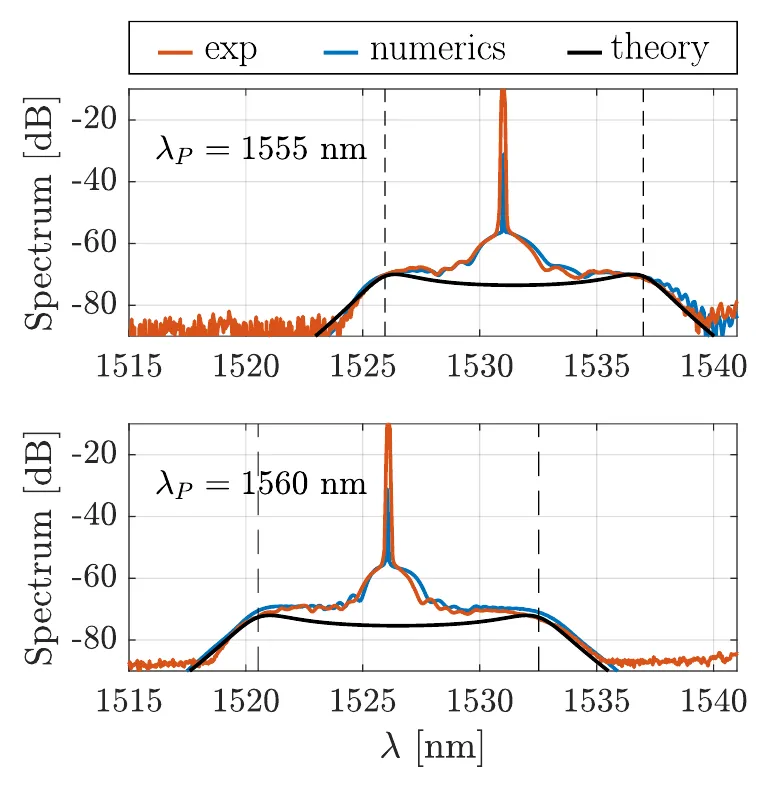
Measured (orange), simulated (blue) and theoretical (black) spectra for two pump wavelengths; the dashed lines mark the light-ring wavelengths that bound the plateau. — Figure 4, Terrier et al. (2026), arXiv:2610.01706.
The agreement relies on both parts of the light-ring frequency: its oscillation and its decay. Earlier work had measured only the oscillation, so the authors describe their result as “the first complete observation of an analogue lightring resonance”.
A bench for black-hole spectroscopy
The fibre is not a black hole, and the analogy comes with extra physics of its own, such as dispersion. But it offers a cheap, controllable bench on which the links between light rings, caustics and quasinormal modes can be tested — including in situations where the “black hole” changes over time. The authors see it as a step toward an analogue form of black-hole spectroscopy.