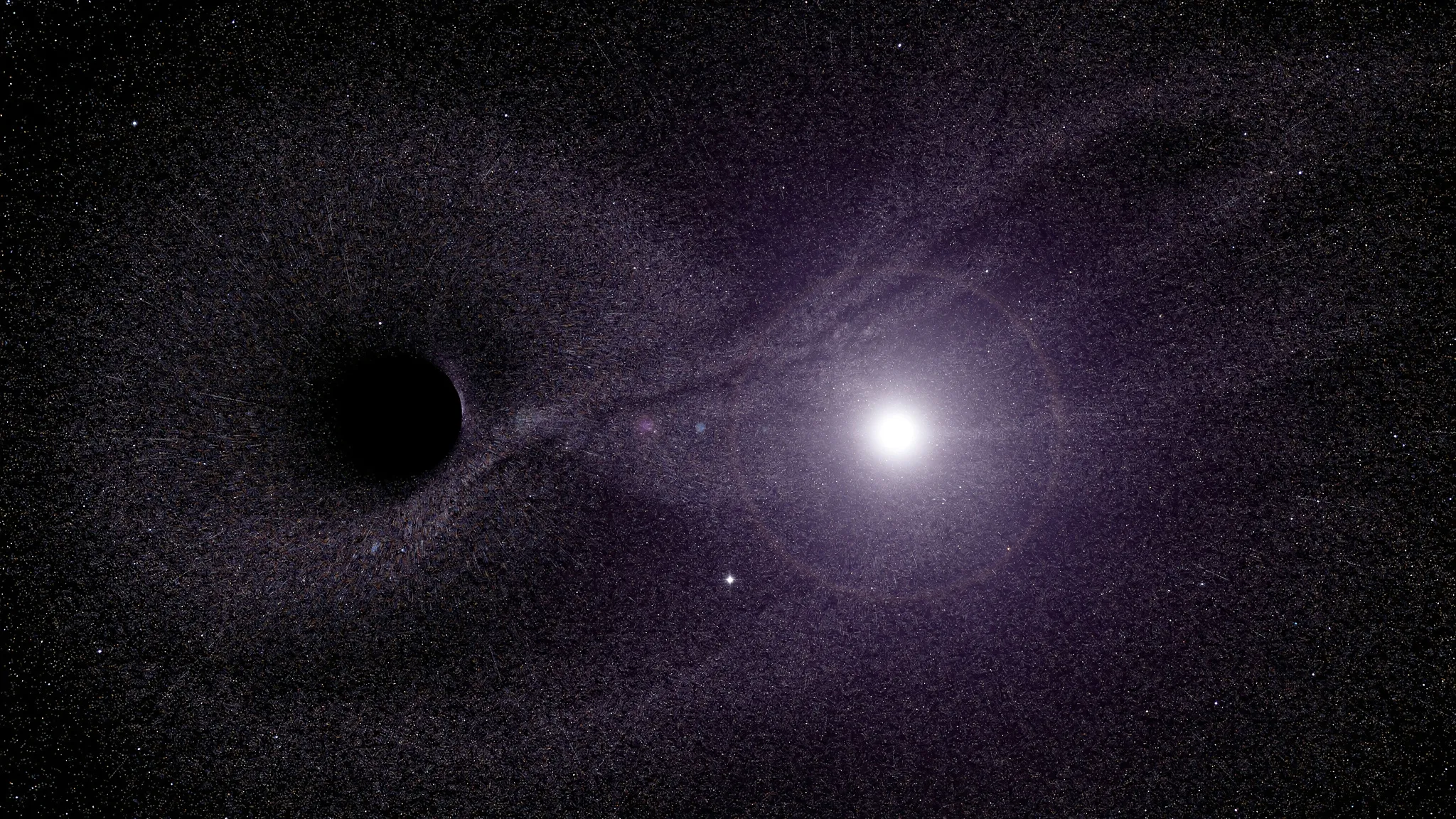
A PULSATING STAR BETRAYS AN INVISIBLE PARTNER
Black holes and neutron stars that are not swallowing matter are almost impossible to see directly. One way to find them is to watch the visible star they orbit with. Astronomers have found a growing number of such “dormant” candidates this way, the paper notes, and the mass range between the heaviest neutron stars and the lightest black holes remains sparsely observed.
TIC 160582982 offers an unusual route: the star itself is a clock.
A star that keeps time
TIC 160582982 is a δ Scuti star: a hot, rapidly rotating star of type A that vibrates in many pressure modes at once. A team led by Chenglong Lv, of the Xinjiang Astronomical Observatory of the Chinese Academy of Sciences and the Institute of Astrophysics of Andalusia in Granada, analysed about 352 days of measurements from the TESS space telescope and extracted 128 frequencies from its flickering light.
When such a star orbits a companion, it is sometimes slightly farther from us, sometimes slightly closer. Its light takes longer, then less time, to arrive — so the pulsations seem to drift early and late in a regular cycle. Measuring that drift traces the orbit. This is called phase modulation.
An 89-day orbit with a heavy partner
Six stable pulsations, used together as clocks, give a consistent answer:
- Orbital period: 89.29 ± 0.19 days, on a very elongated orbit (eccentricity 0.54).
- The projected size of the visible star’s orbit (its semi-major axis) is about 146 light-seconds, or 0.29 astronomical units.
- The resulting “mass function”, a combination of the two masses, is 0.416 solar masses — large for a star of this type.
A second, independent method, based on the side peaks that the orbit creates around the two strongest pulsations, gives the same orbit: 89.36 days.
The visible star weighs about 1.93 solar masses, lies about 263 parsecs away and shines 37.6 times as bright as the Sun. Combined with the orbit, this means the companion weighs at least about 1.8 solar masses — the minimum, reached if we see the orbit exactly edge-on. If the companion were an ordinary star, the best estimate would be about 2.2 solar masses.
The missing light
An ordinary star that massive should be easy to spot. The team calculated how much light it would add: for a companion of 1.70 to 1.86 solar masses, about 18 to 26% of the system’s light in visible and infrared bands; at 2.3 solar masses, about 43%.
But the system’s light, measured from the visible to the mid-infrared, fits a single type-A star perfectly, with no infrared excess. Archival spectra show no obvious second set of lines either, though the star’s fast rotation blurs its lines. An ordinary single companion is therefore “strongly disfavored”, the authors write.
Two suspects left
Two explanations remain, and the present data cannot tell them apart:
- A hidden pair. The companion could itself be a tight pair of stars, for example two of about 0.9 solar masses each. Together they would supply the required mass while adding only around 4% of the visible light and 8 to 9% in the infrared.
- A dead star. A compact remnant — a neutron star or even a stellar-mass black hole — would add little or no light at all.
The team also spotted a slower signal, repeating every 0.544 days, whose strength rises and falls with the orbit, peaking near the closest approach between the two bodies. It may be a pulsation disturbed by tides from the eccentric orbit, but the authors classify it only as a candidate.
Spectra over a full orbit
The decisive test is spectroscopy: high-resolution spectra taken repeatedly over a full 89-day orbit would check the orbit independently and look for faint lines moving with a companion or with the two stars of a hidden pair. Future measurements from the Gaia space observatory, which should see the star wobble by about a thousandth of an arcsecond, could pin down the tilt of the orbit and the companion’s total mass.
According to the arXiv listing, the paper has been accepted by The Astrophysical Journal; the version read here is the authors’ manuscript.