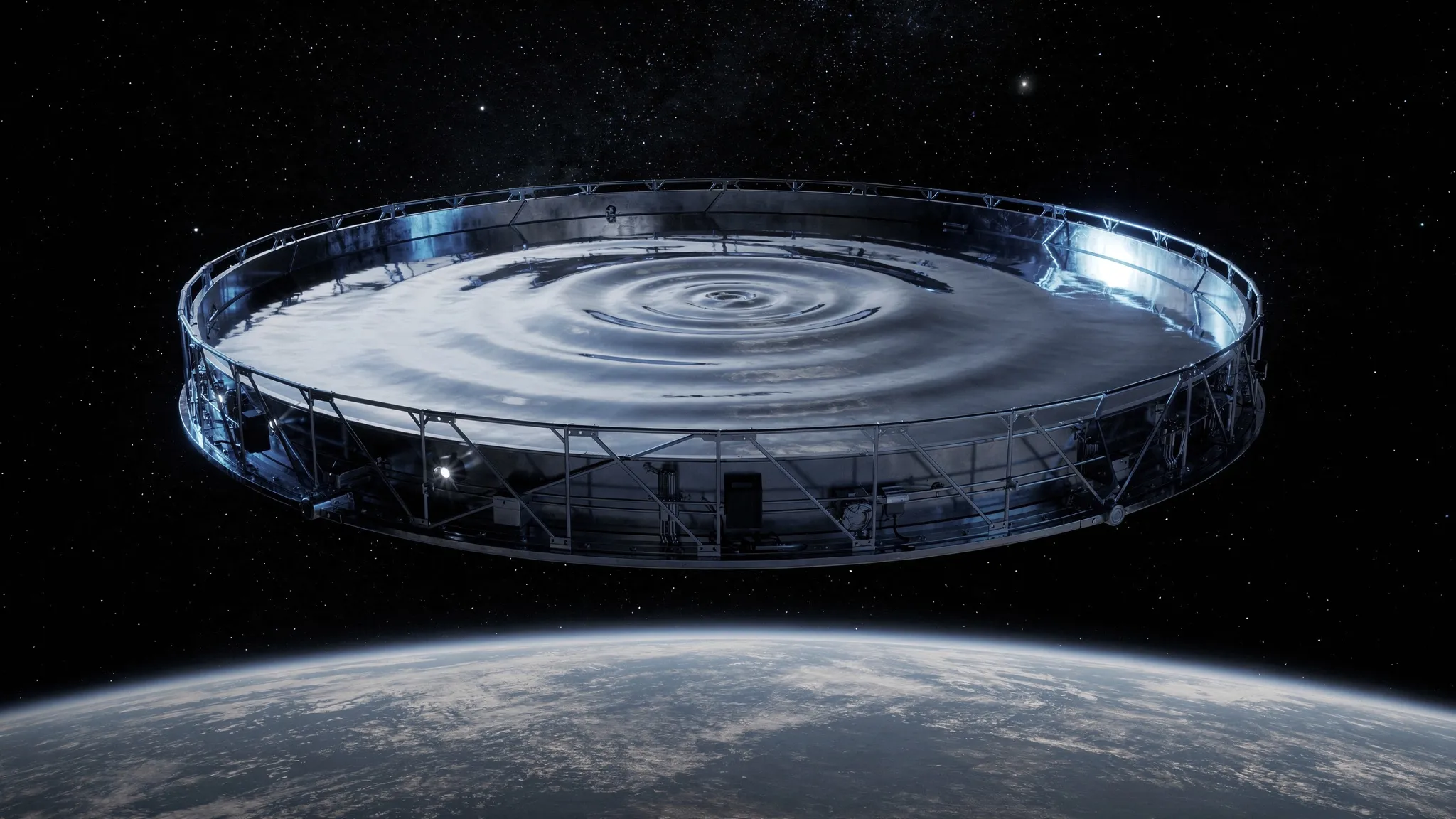
A LIQUID TELESCOPE MIRROR, SMOOTHED BY HEAT
Seeing a planet directly next to its star takes a telescope mirror tens of metres across. The James Webb Space Telescope, the largest observatory in space, has a 6.6-metre mirror made of 18 hexagonal segments that had to be folded to fit inside its rocket and then aligned with nanometre precision. According to the references the authors cite, that alignment challenge is what capped Webb at 6.6 metres.
Liquid mirrors offer another route. On the ground, a reflective liquid spun around a vertical axis takes the shape of a parabola, with no polishing at all — but such a telescope can only look straight up.
A mirror that shapes itself
Ryan Engle and Valeri Frumkin, of Boston University’s mechanical engineering department, work within a project called FLUTE (Fluidic Telescope). Its idea: in the weightlessness of space, coat a large curved support with a reflective liquid a few millimetres thick. With no gravity pulling on it, surface tension alone pulls the layer into a smooth spherical shape — whatever direction the telescope faces, and without spinning.
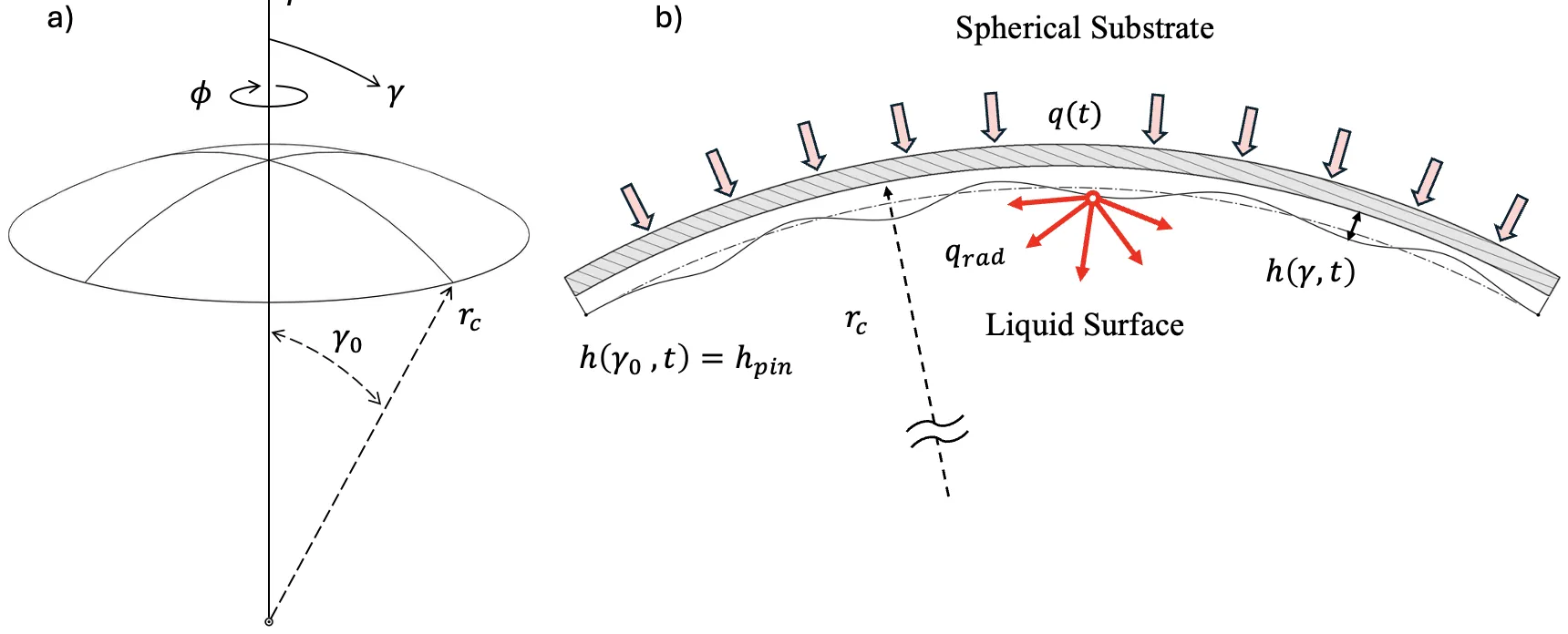
The model: a thin liquid layer coats a spherical support, uniform heat q(t) is applied from behind and the free surface radiates into space. — Figure 1, Engle & Frumkin (2026), arXiv:2610.08654.
There is a catch. Surface tension acts through the local curvature of the surface. It quickly erases small wrinkles, but it is very slow to flatten broad, gentle ripples — the kind left after the mirror is deployed or when the telescope turns towards a new target. For a large mirror, waiting for them to fade on their own becomes, in the authors’ words, prohibitively slow.
Heat that destabilises, pauses that heal
The authors turn to another force: the thermocapillary effect. Surface tension drops as a liquid warms, so temperature differences across a surface make it flow, from warm towards cool.
Heating a thin film steadily is usually a bad idea: thinner spots get hotter, liquid drains away from them, and the film can tear. The team’s answer is to heat the mirror uniformly, but in pulses. During each pause, the surface cools by radiating its heat into space — and thin spots cool faster than thick ones. Liquid is then drawn towards the thin spots. These back-and-forth flows cancel the instability caused by the heating and let the surface relax towards an even thickness.
Radiation does the damping: hotter patches emit more energy than cooler ones, which wipes out temperature differences over time.
Days for some ripples, months for others
The authors derived equations for the slow evolution of the surface over many heating cycles, then a criterion for when it stays stable. It goes unstable if radiation is too weak or if liquid is moved around too fast. For each ripple size, there is an ideal surface temperature at which it fades quickest.
They then simulated a 6.6-metre liquid mirror, the size of Webb’s, with a heating cycle that swings by 5 kelvins:
- For every ripple tested, pulsed heating smoothed the surface faster than surface tension alone.
- A ripple about 3 metres long shrank sharply within 4.5 days and is predicted to lose 95% of its height in 8.6 days.
- The broadest ripple, about 6.9 metres, lost only about 6% over the same period. Its predicted fading time is 9.1 months.
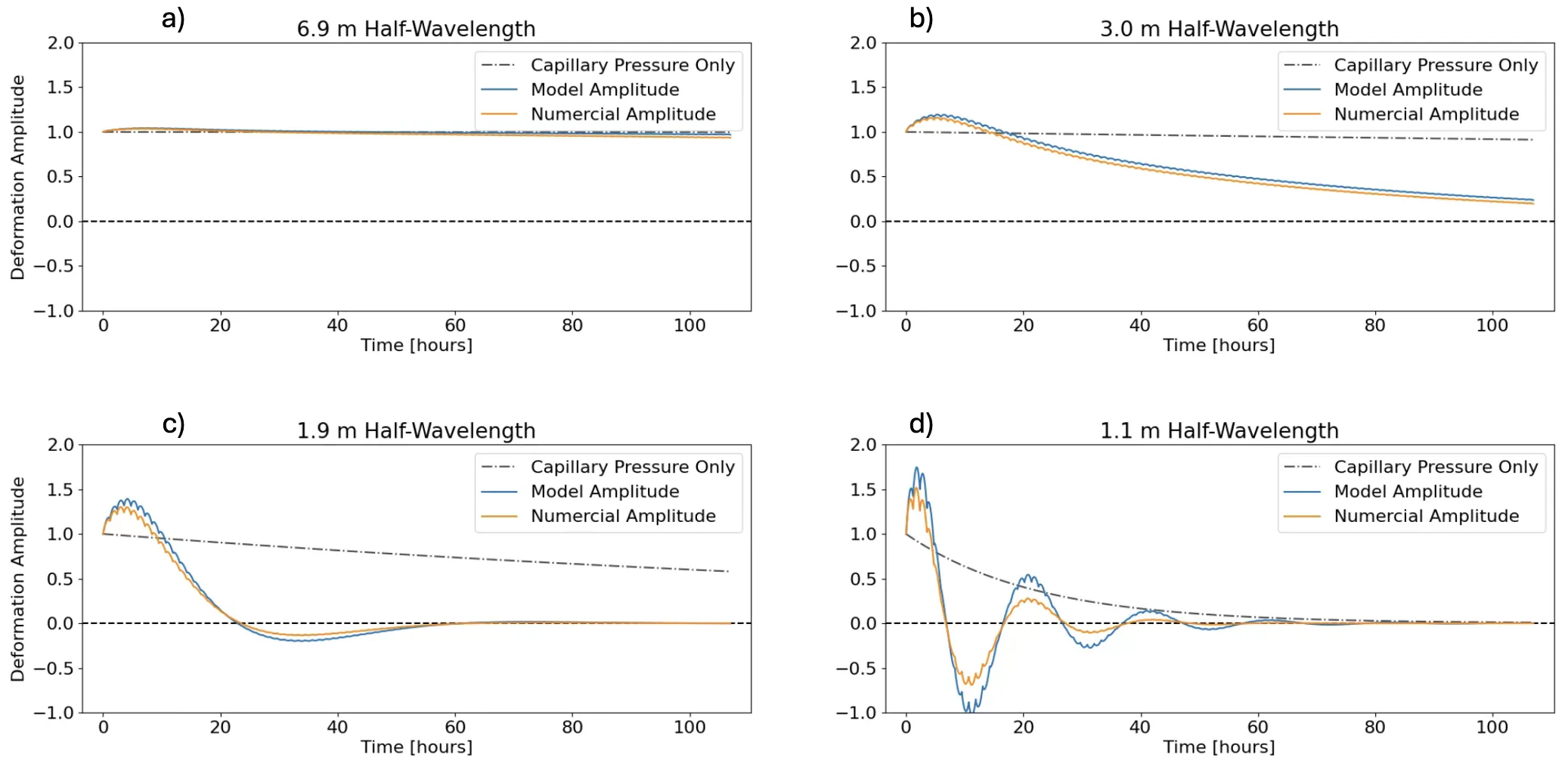
How ripples of four sizes evolve over about 100 hours: the analytical model (blue) and the simulation (orange) agree, and both fade faster than with surface tension alone (dashed) — except the broadest ripple, which barely moves. — Figure 6, Engle & Frumkin (2026), arXiv:2610.08654.
The widest wave remains the hardest
The work is purely theoretical and numerical: no liquid mirror has been tested this way. To bring the broadest ripples down to days rather than months, the authors say a larger temperature swing or a more elaborate heating cycle will be needed — the subject of their next study. They also note that the same mathematics could apply to other heated liquid films whose cooling depends on their temperature.