A PLANET BORN FROM ITS STAR'S ASHES
When a star like the Sun runs out of fuel, it swells into a giant, blows its outer layers into space and leaves behind a white dwarf: a dense, slowly cooling core. Many white dwarfs show heavy elements in their atmospheres that should sink out of sight within days. The explanation is now well established: they are swallowing the debris of shattered planetary bodies. That debris varies, but overall it looks like the rocks of our own Solar System.
Planets usually form at the same time as their star, in the disc of gas and dust around it. These are first-generation planets. In principle, a planet could also form after its star has died, out of the matter the star threw off. Planets around pulsars are generally thought to be of this second generation. None had been identified around a white dwarf.
A hundred unexplained lines
HS 0209+0832 is a hot, young white dwarf, about 35,800 degrees at the surface and only around 5 million years into its cooling, some 82.6 parsecs from us. It has long been odd. Its hydrogen atmosphere holds about 1% helium, which at this temperature should sink within months. And an ultraviolet spectrum taken by the Hubble Space Telescope in 1999 showed carbon, aluminium, silicon, calcium, titanium, nickel and zinc — plus about a hundred lines nobody could identify.
Jamie Williams, Boris Gänsicke and colleagues from the University of Warwick and eight other institutions re-analysed those archival spectra from Hubble, from the FUSE ultraviolet satellite and from the Very Large Telescope. With up-to-date atomic data, most of the mystery lines turned out to be copper and niobium — 62 lines of niobium alone. None of 33 other hot, polluted white dwarfs observed by FUSE shows niobium.
Rich in rare metals, poor in rock
The team then worked out what is falling onto the star. Some elements are partly held up by the star’s own light, which complicates the bookkeeping, so they focused on those that are not. The result matches no known white dwarf and no meteorite:
- Trans-iron elements — zinc, copper, niobium — are strongly enriched. Relative to calcium, niobium is more than a thousand times more abundant than in the Sun.
- Iron is not detected, and silicon appears only in traces, whereas the two make up about 48% of the Earth’s mass. There is more than twice as much nickel as iron, whereas in the Earth nickel amounts to about 5% of iron.
- Nitrogen, oxygen, phosphorus and sulphur are scarce: this is not an icy comet.
The fingerprint of a dying star
Giant stars near the end of their lives make most of the universe’s elements built by slow neutron capture, the “s-process” — niobium among them. Using 138 models of such stars, the authors show that their winds can be enriched up to a hundredfold in niobium and strontium, moderately in nickel, copper and zinc, and not at all in iron or silicon.
Their scenario: a close companion of the original star was engulfed during its giant phase. The star’s envelope was ejected and formed a disc rich in s-process elements, where a giant planet then grew, close to the newborn white dwarf. In an ordinary planet, by contrast, no known process could produce this much niobium: among 100 stars with measured niobium, the highest ratio to calcium is more than 200 times lower than here.
A planet caught evaporating
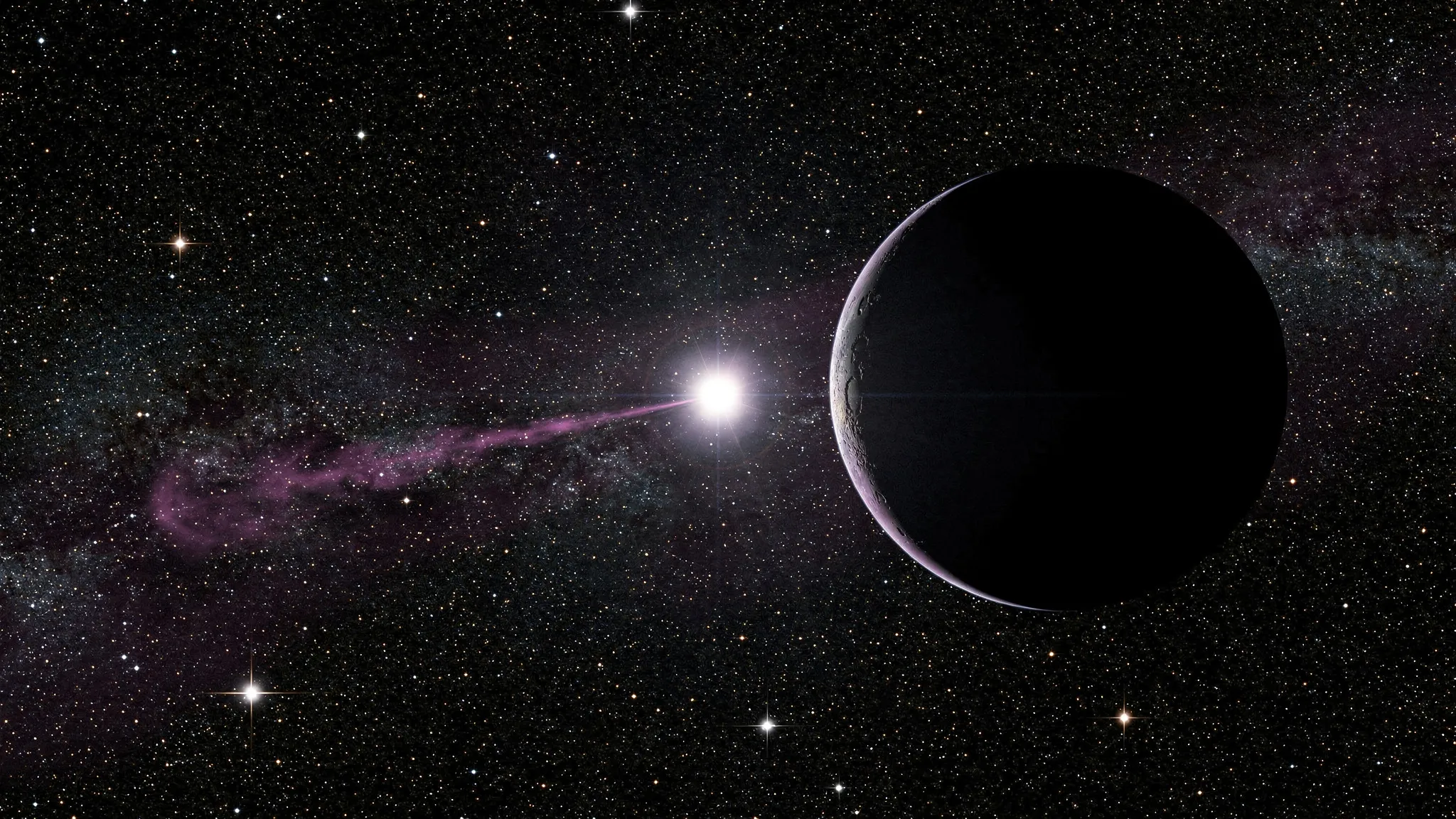
Helium is also arriving, and rocky bodies do not supply helium. The authors conclude that the white dwarf is most likely feeding on the atmosphere escaping from a giant planet heated by its intense ultraviolet light.
Data from NASA’s TESS satellite add a clue: the system’s brightness varies by 0.12% with a period of 4.4 days, far slower than white dwarfs usually spin. That would match a planet orbiting at 0.044 astronomical units. Two readings are proposed: the day–night cycle of a young, still-hot giant planet with a hazy day side, or a comet-like tail of evaporated gas passing in front of the star — which could also explain why the measured helium varies.
What does not fit yet
The authors flag several puzzles. Strontium is missing: every model predicts more strontium than niobium, yet strontium is over a hundred times scarcer here. Niobium even exceeds the highest value in their models, and the excess of nickel over iron is hard to explain. Some stars enriched by giant-star material also show more niobium than strontium, hinting at a process the models miss; chemistry in the planet’s atmosphere may also reshuffle the elements. No one has yet modelled the atmosphere of a second-generation planet.
The object remains a candidate. To find others, the team suggests looking in the ultraviolet spectra of hot white dwarfs for the same signature: lots of carbon and s-process elements. A detection of lead would pin down the original star’s makeup.