WATER ON GRAPHENE LEANS ONE WAY BEFORE ANY CHARGE ARRIVES
Positive and negative charges of the same size often have very different effects in water. The paper lists striking examples: water on some insulating surfaces responds differently to positive and negative voltages; supercooled water freezes at a higher temperature on a positively charged crystal surface than on a negatively charged one; negatively charged particles in water attract each other at long range, while positively charged ones repel. Proteins, too, react differently to dissolved anions and cations.
Part of the explanation could lie in the water molecule itself. It is lopsided: it points a hydrogen atom towards a negative ion, but its oxygen towards a positive one. So one might expect water at a charged surface to respond in a fundamentally non-linear way, differently for each sign. The difficulty is to test this, because at most surfaces, chemistry and adsorbed ions blur the picture.
A surface that stays out of the way
Yair Litman, Yongkang Wang and Mischa Bonn, at the Max Planck Institute for Polymer Research in Mainz, with Stephen Cox at Durham University, chose graphene: a single layer of carbon that is chemically inert and interacts only weakly with water and with the sodium and chloride ions of ordinary salt. They placed it on a calcium fluoride window, in contact with concentrated salt water, and used it as an electrode whose charge they could tune.
To see which way the water molecules point, they used a laser technique called heterodyne-detected sum-frequency generation spectroscopy. It is sensitive only to the first one or two layers of water at the surface, and the sign of its signal tells whether the molecules’ hydrogens point towards the surface (“H-up”) or away from it (“H-down”).
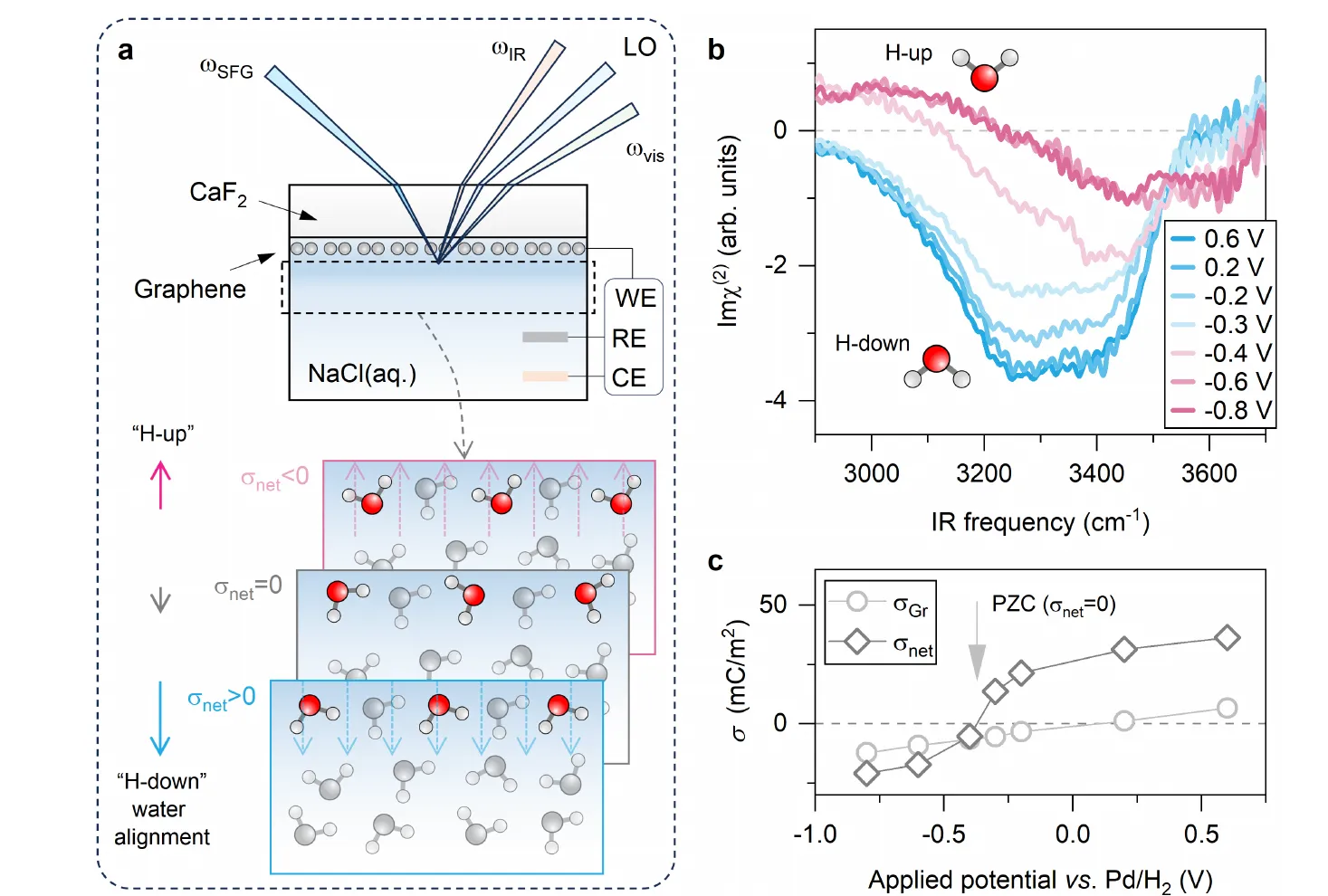
The experiment: laser beams probe water at a graphene electrode (a); the water signal changes with the applied voltage (b); the net surface charge, extracted from the spectra, compared with the charge on graphene alone (c). — Figure 1, Litman, Wang, Cox & Bonn (2026), arXiv:2610.09705.
A hidden charge in the substrate
At first sight, the water’s response to voltage looked strongly non-linear. The team traced this to the calcium fluoride underneath, which is positively charged at neutral pH and loses that charge as its surface reacts with hydroxide during the experiment. Through the graphene, that substrate charge also acts on the water. Once the team counted the total net charge felt by the water — which went from about +36 to −21 millicoulombs per square metre — the picture became simple.
Linear, yet lopsided
Two findings stand out:
- At zero net charge, the water is not randomly oriented. It keeps a net “H-down” orientation, hydrogens pointing away from the graphene into the liquid.
- On top of that offset, the change in orientation is linear in the charge and symmetric when the sign is reversed. Varying the charge through the voltage or through the acidity of the solution gives the same line.
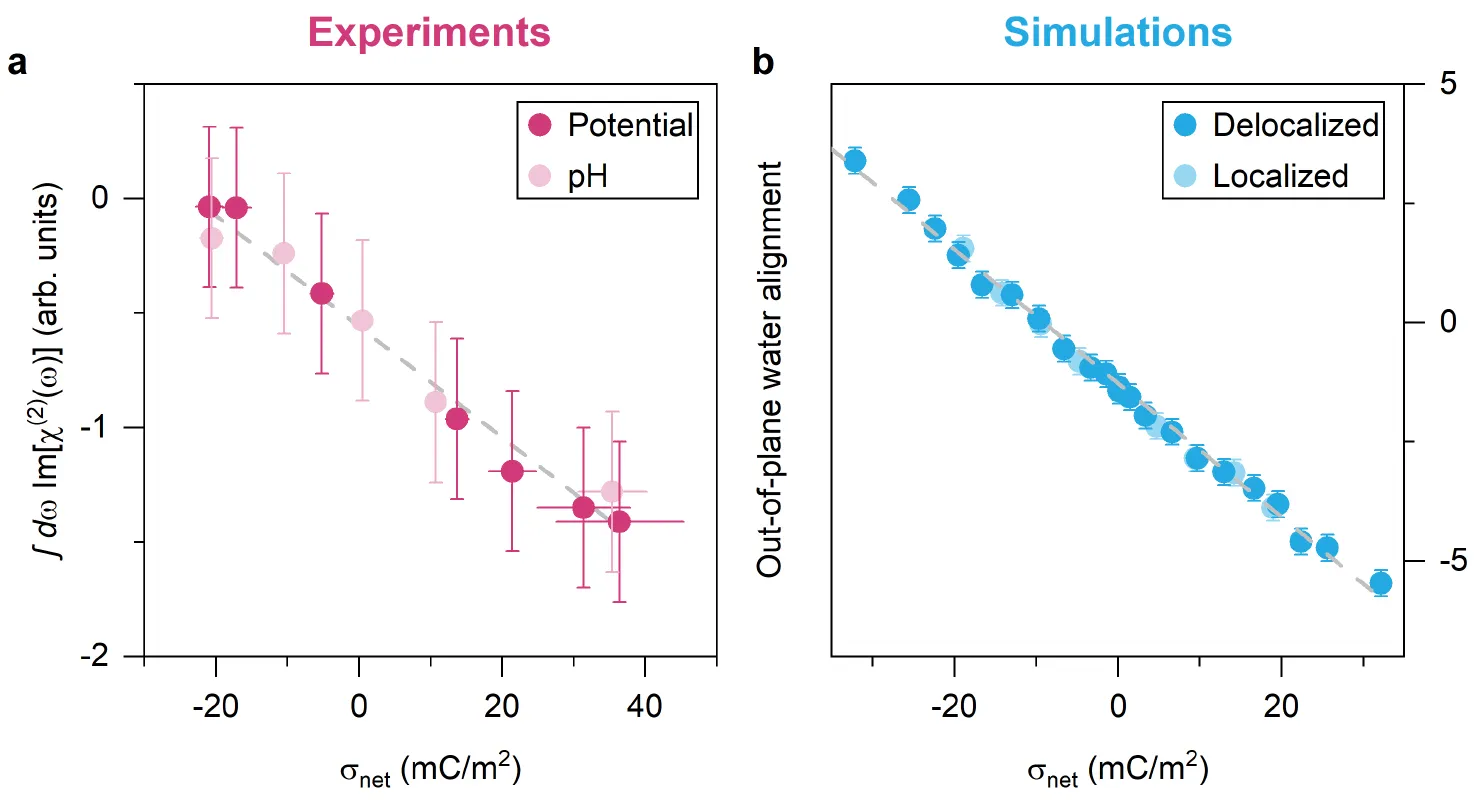
Left, experiments: the water signal follows a straight line with net surface charge, whether charge is set by voltage or by pH. Right, simulations give the same straight line, wherever the charge sits. — Figure 2, Litman, Wang, Cox & Bonn (2026), arXiv:2610.09705.
Because of the offset, the water only becomes unoriented at a negative charge of about −23 ± 14 millicoulombs per square metre, which corresponds to a shift of more than 0.4 volts. At +23, its alignment is roughly twice that at zero charge. Charging one way reinforces the existing tilt; charging the other way must first cancel it. The asymmetry, the authors conclude, comes from the starting tilt, not from a non-linear response.
Simulations agree
Computer simulations of salt water against graphene on calcium fluoride reproduce the same straight but offset line, whether the charge sits in the substrate or spreads over the graphene, for different strengths of the water–graphene attraction, and even on gold with two different models of water. They place the point of zero orientation at about −10 millicoulombs per square metre; the authors attribute the difference to the limits of the charge model, water trapped under the graphene and the simulation’s force field. The orientation change is confined to about one nanometre — two layers of water.
The study also corrects an earlier reading: a spectral band at 3,630 cm⁻¹, previously attributed to dangling water bonds, has the wrong sign for that and fits hydroxyl groups on the calcium fluoride instead.
A baseline for messier surfaces
The authors expect linearity to break down at much higher charges, beyond about 60 to 100 millicoulombs per square metre in their simulations, and at surfaces where chemistry dominates, such as oxides, metals or lipid membranes. What their work provides is a reference: any departure from this straight, offset line points to something extra, like ions sticking to the surface. They also note that the “H-down” tilt is exactly what certain models invoke to explain why negatively charged particles in water attract each other.