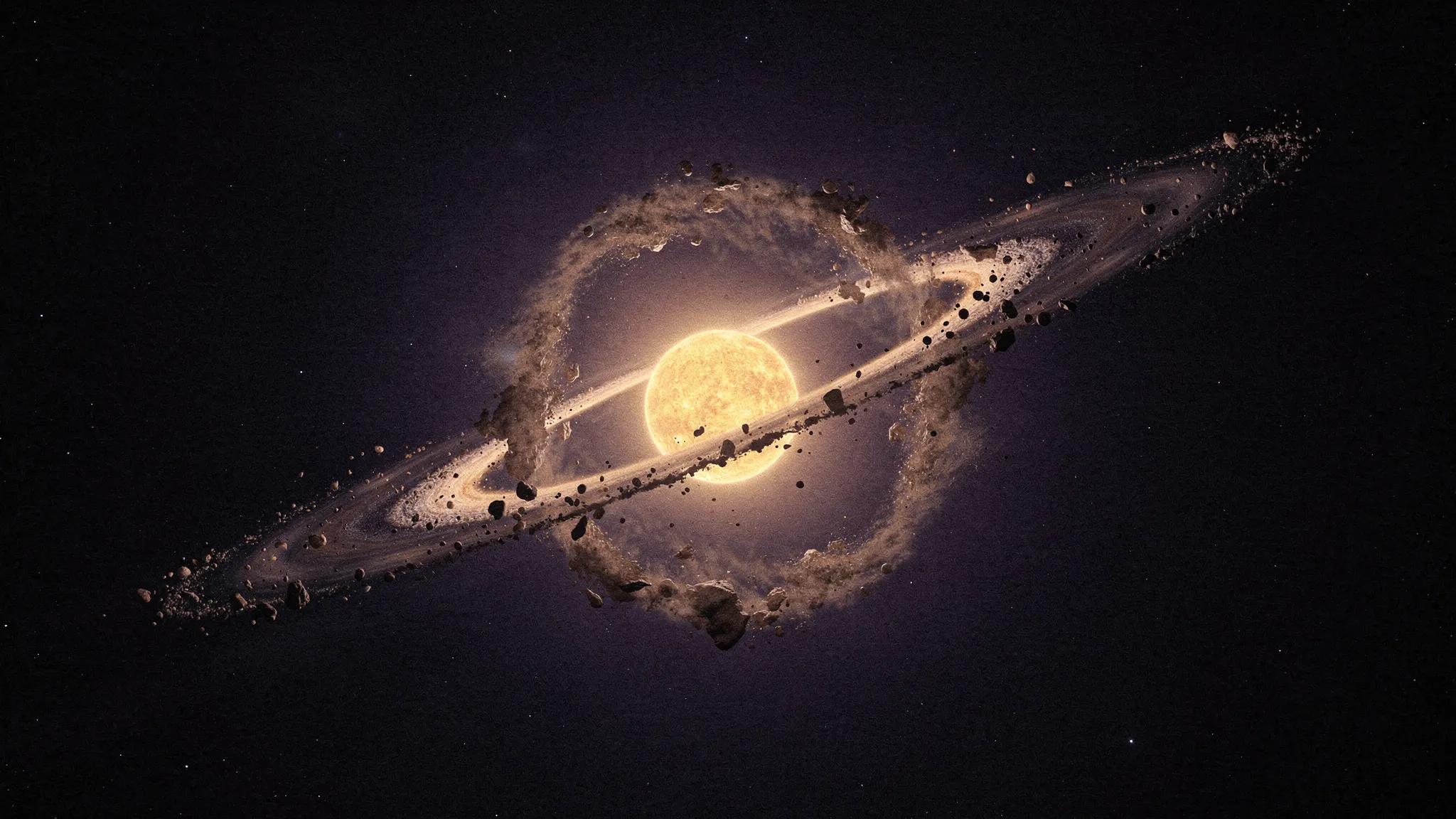
THE DEBRIS OF A GIANT IMPACT COME BACK EVERY 957 DAYS
Rocky planets are expected to finish growing through giant impacts, once the gas around a young star has dispersed and planetary embryos start colliding. The debris can take many forms: clouds of condensed vapour, fine silicate grains, fragments still bound to the star, and streams of material on stretched orbits. Some young stars are surrounded by unusually bright, warm dust — extreme debris disks — that astronomers read as the signposts of such collisions.
A key question remains: when the infrared glow of these disks varies, does it trace short-lived dust clouds, or a longer-lived reservoir left behind by the impact?
A benchmark young sun
NGC 2547 ID8 is a solar analog about 35 million years old, in the star cluster NGC 2547, about 352 parsecs away. Earlier studies had seen its warm dust change over 10 to 35 days, and interpreted events in 2012 and 2014 as two distinct impacts, possibly linked by fragments returning after a first collision.
Xiaodian Chen, Shu Wang and Zhuochao Huang, of the National Astronomical Observatories of the Chinese Academy of Sciences and partner universities in Beijing, assembled a 19-year infrared record:
- four mid-infrared spectra: one from the Spitzer Space Telescope in 2007 and three from JWST in 2022, 2023 and 2024;
- photometry at 3 to 5 micrometres from Spitzer, WISE and NEOWISE, plus three new measurements from the SPHEREx mission in 2025 and 2026 — 509 points in total.
Two layers of dust
They fitted each spectrum with two components: a smooth, hot continuum, and a thin surface of mineral grains.
The mineral surface barely changes. Across 17 years, it stays at a temperature of about 560 kelvin and keeps the same recipe: roughly 88 to 90% olivine grains about 1 micrometre in size, and 10 to 12% much smaller grains of forsterite, about 0.1 micrometre. The hot continuum, by contrast, swings strongly, with colour temperatures between 637 and 972 kelvin.
A beat of 956.8 days
The 4.5-micrometre glow rises and falls with a mean recurrence of 956.8 days, about 2.6 years. Six high states appear in the record, the latest in early 2026, caught by SPHEREx. The rhythm is not perfectly regular: the gaps between successive peaks range from 823 to 1,132 days, and the height of the peaks varies from cycle to cycle.
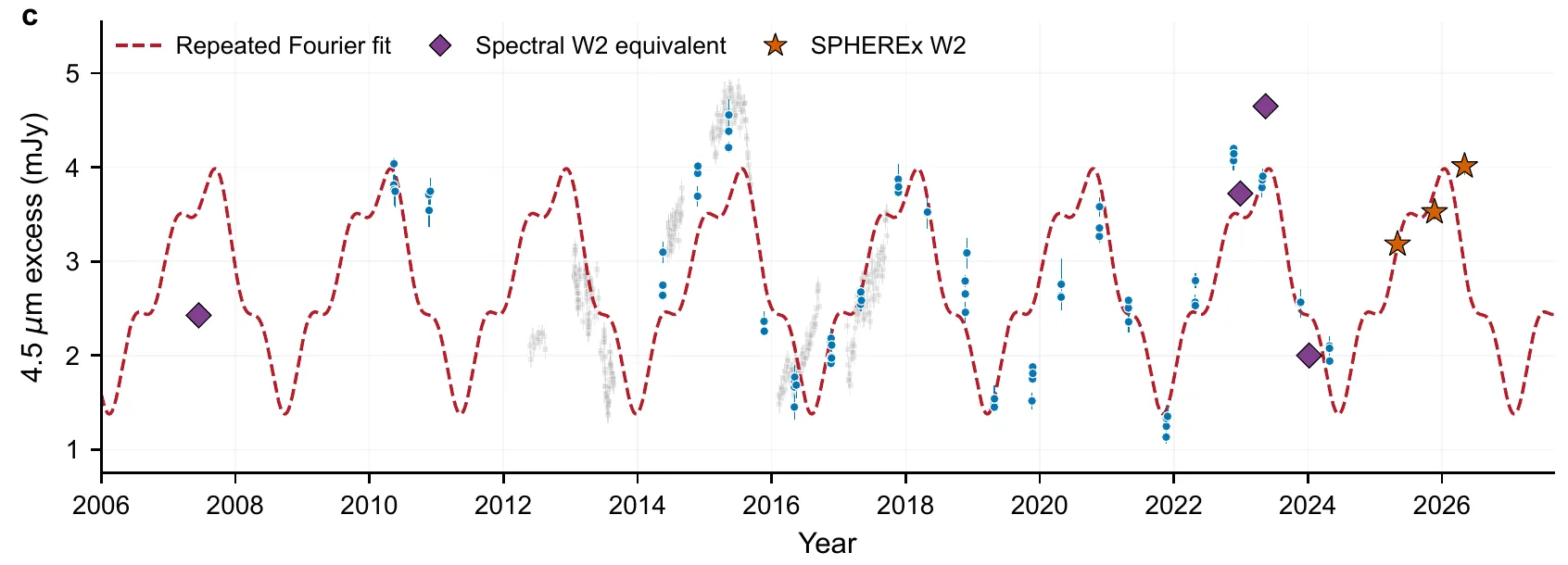
The infrared excess of ID8 from 2006 to 2026, with the 956.8-day pattern repeated as a dashed curve; diamonds are values from the spectra, stars from SPHEREx. — Figure 2c, Chen, Wang & Huang (2026), arXiv:2610.10130.
Why the orbits must be stretched
A simple ring of dust cannot explain both the temperature and the rhythm. Dust at 560 kelvin sits around 0.21 astronomical units from the star, where a circular orbit takes only about 36 days. A ring with a 956.8-day period would be too far out to dominate the 3–5 micrometre glow. The authors therefore favour material on eccentric orbits that repeatedly dives back into the warm region, changing the amount of hot dust at each passage while leaving the mineral surface almost untouched.
The tiny forsterite grains also tell a story. Starlight pushes them away: if they absorb light efficiently, they are blown from 0.21 to 1 astronomical unit in about 21 days. Keeping them in place over 17 years requires grinding down the equivalent of a rocky body 400 to 460 kilometres across. The stable surface is therefore best explained as a collisional cascade fed by a reservoir of larger bodies.
One of a kind, for now
Compared with 12 other warm debris disks observed by JWST, ID8 is the only one that combines a surface dominated by small grains with a significant multi-year rhythm. Two scenarios remain on the table: a stream of debris that keeps coming back, or a larger body that periodically ploughs through the reservoir and triggers fresh collisions. Current data cannot separate them.
If confirmed, the picture moves the aftermath of a giant impact beyond a brief cloud of dust, towards warm reservoirs that can survive for decades or longer — without needing a string of unrelated collisions to keep them shining. Faster and longer infrared monitoring, and more SPHEREx spectra of other disks, should tell whether ID8 is a rare case or simply the clearest one.