A CLOCK TUNED TO AN ATOMIC NUCLEUS RAN FOR 30 HOURS
The most precise clocks in the world count the oscillations of electrons inside atoms, probed by lasers. They serve as frequency references for metrology and for tests of fundamental physics. Thorium-229 offers a different kind of pendulum: its nucleus has an excited state, called an isomer, only about 8.4 electronvolts above its ground state — low enough for a laser to reach. The light needed lies in the vacuum ultraviolet, at 148.4 nanometres.
According to the authors, a clock built on this nuclear transition would be especially sensitive to possible variations of the fundamental interactions, and could help search for dark matter. Embedding thorium in a transparent crystal of calcium fluoride gives an enormous number of absorbing nuclei in a small solid piece: the route to a solid-state nuclear clock.
Not the first, but the longest-running here
The paper is careful about what was already done. Its references list nuclear fluorescence, direct laser excitation, comb spectroscopy, continuous ultraviolet lasers, absorption spectroscopy and even nuclear feedback loops reported by other teams. What this work adds is a clock that runs for a long time on a given crystal, and a careful link between its measured spectrum and the frequency the clock actually delivers.
Absorption is the key. Rather than waiting for excited nuclei to decay — a slow process — the team measures how much light the crystal swallows. That gives a fast signal saying whether the laser sits on the line or beside it.
Three doublings to reach the nucleus
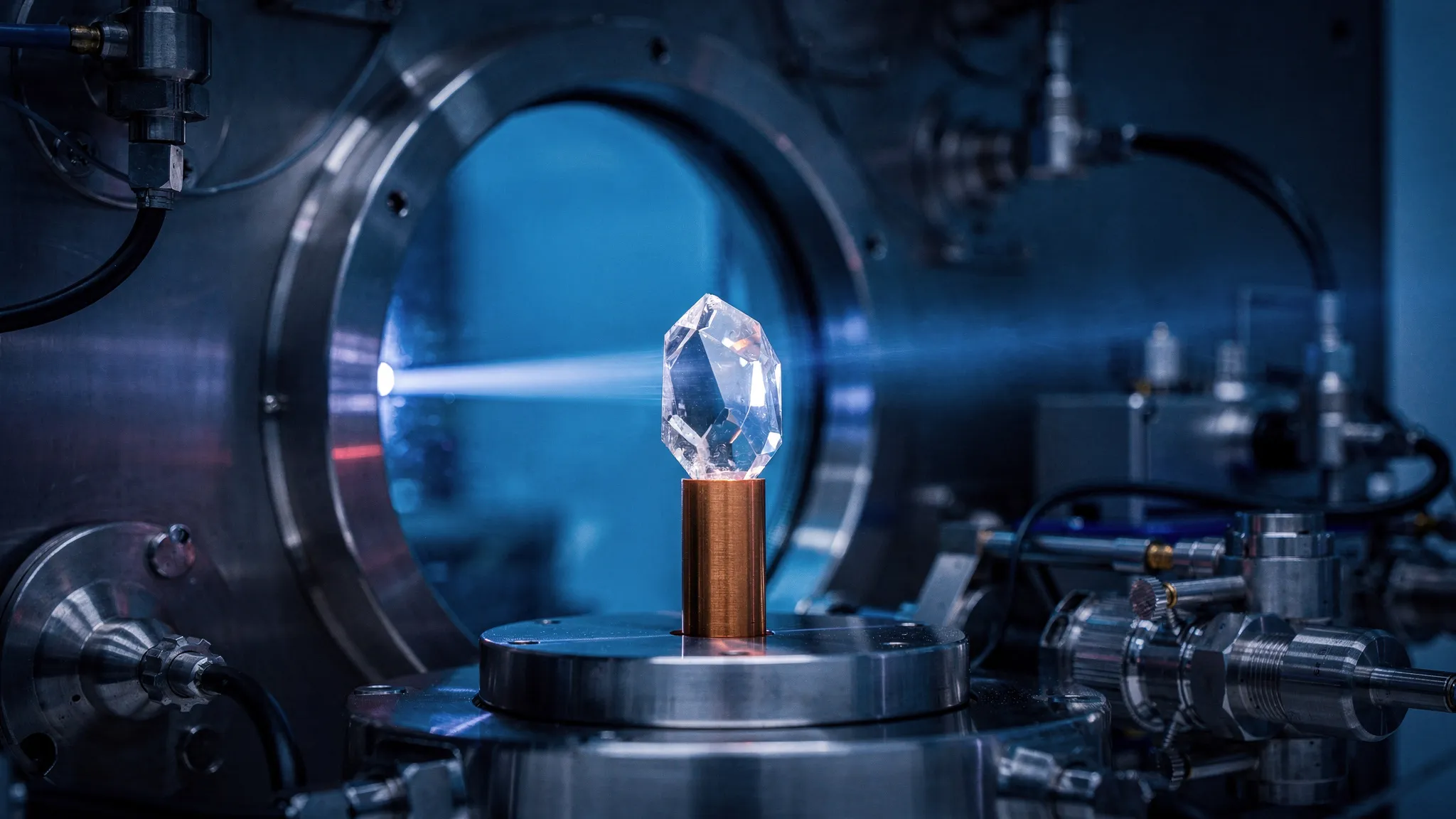
Pengfei Wang, Xu-Fei Yin, Yu-Ao Chen and colleagues at the University of Science and Technology of China, with partners at the Chinese Academy of Sciences and TU Wien in Vienna, start from an infrared laser at 1,187 nanometres, stabilised on an ultrastable optical cavity. Three successive frequency doublings turn it into 594, then 297, then 148.4 nanometres. About 750 picowatts of ultraviolet light then cross a piece of thorium-doped crystal 1.8 millimetres thick, cut from a crystal called X2. Other pieces of X2 have been measured in Vienna and at JILA.
Inside the crystal, the local electric field splits the nuclear line into several components. At one type of thorium site, the team resolves four of them, plus a broader resonance from a second type of site. The strongest and narrowest line, called b, is only 83 kilohertz wide — on a frequency of about two million billion hertz.
Thirty hours on one line
To run the clock, the system probes both flanks of line b and nudges the laser frequency about every 10 seconds. A frequency comb, referenced to a hydrogen maser calibrated against a strontium atomic clock, measures the output.
- The loop held for 30 hours — 1,061,000 measurement cycles, of which only 29 were rejected.
- The team stopped the run while the clock was still locked: the photon rate had fallen from 5.79 to 2.41 million per second, which the authors attribute to outgassing degrading the ultraviolet transmission.
- The measured frequency of line b: 2,020,407,298,796.17 kilohertz, with an uncertainty of 0.13 kilohertz.
- Its stability improves with averaging time and reaches 1.24 × 10⁻¹³ after 10,000 seconds.
- A second run of 6.6 hours on another component, line c, also worked.
The line positions read from the absorption spectra and the frequencies delivered by the clock agree within their uncertainties. When the team restarted the clock three more times, after opening the chamber and realigning the optics, the average frequencies spread over 1.6 kilohertz.
Same crystal, three laboratories
Comparing their piece with pieces of the same crystal measured in Vienna and at JILA, after correcting for temperature, the team recovers the same pattern of lines. Some offsets remain: line b sits 11.6 kilohertz above the Vienna value and 6.6 above JILA’s; line c about 30 kilohertz above both. The authors cannot yet tell whether these come from residual temperature errors, biases in the locking, or real differences between samples.
Far from the finish line
The numbers deserve context, and the paper provides it. The comparison between the hydrogen maser and the strontium clock used as a reference is itself more than ten times more stable than the thorium clock over the same averaging times. The uncertainty budgets are explicitly partial, and temperature was not recorded during the first 14.7 hours of the long run. The value of this work lies in endurance and in cross-checking: a nuclear transition, held for more than a day, compared with pieces of the same crystal in three laboratories.