A JUPITER-STYLE AURORA ON A COLD DWARF NEXT DOOR
Ultracool dwarfs sit at the frontier between stars and planets. The family includes very low-mass stars, brown dwarfs and objects of planetary mass, all colder than about 2,700 kelvin — cold enough for condensates to gather into cloud-like structures in their atmospheres. Since radio emission from such objects was discovered by chance in 2001, it has revealed magnetic fields of a few thousand gauss. About 15 to 20% of them are “radio-loud”.
Their radio signal often has two parts: a steady, “quiescent” glow, and bright, rotating pulses with a strong circular polarisation. The pulses are attributed to a process called the electron cyclotron maser instability — the same one that powers the radio auroras of Jupiter and Saturn.
Two kinds of aurora on Jupiter
On Jupiter, radio auroras come from two main sources. One is the main oval, a ring of aurora around each magnetic pole, fed by currents linked to a disc of plasma turning with the planet. The other comes from the planet’s moons, above all Io: as the moon moves through Jupiter’s magnetised plasma, it drives currents along the magnetic field lines that connect it to the planet. These are called active field lines.
LSPM J0036+1821, an L-type dwarf 8.7 parsecs away (about 28 light-years), has been known to emit radio waves since 2002. A 2008 study already found its pulses repeating roughly every 3.08 hours. Earlier imaging had also suggested a possible companion, never confirmed.
Three years of listening
D. Martín-Carrero, J.C. Guirado and colleagues at the University of Valencia, with partners at the Centre for Astrobiology in Madrid, Trinity College Dublin, Lowell Observatory, the American Museum of Natural History and the University of Colorado, combined observations from 2019 to 2023:
- an 8.7-hour session with the Very Large Array at 8–12 GHz, on 7 December 2021;
- many shorter sessions with two networks of distant radio dishes combined into one, the European VLBI Network and the Very Long Baseline Array;
- visible-light monitoring by the TESS satellite.
At every epoch, the source looks like a single point. The sharpest images limit the emitting region to less than about 0.025 astronomical units.
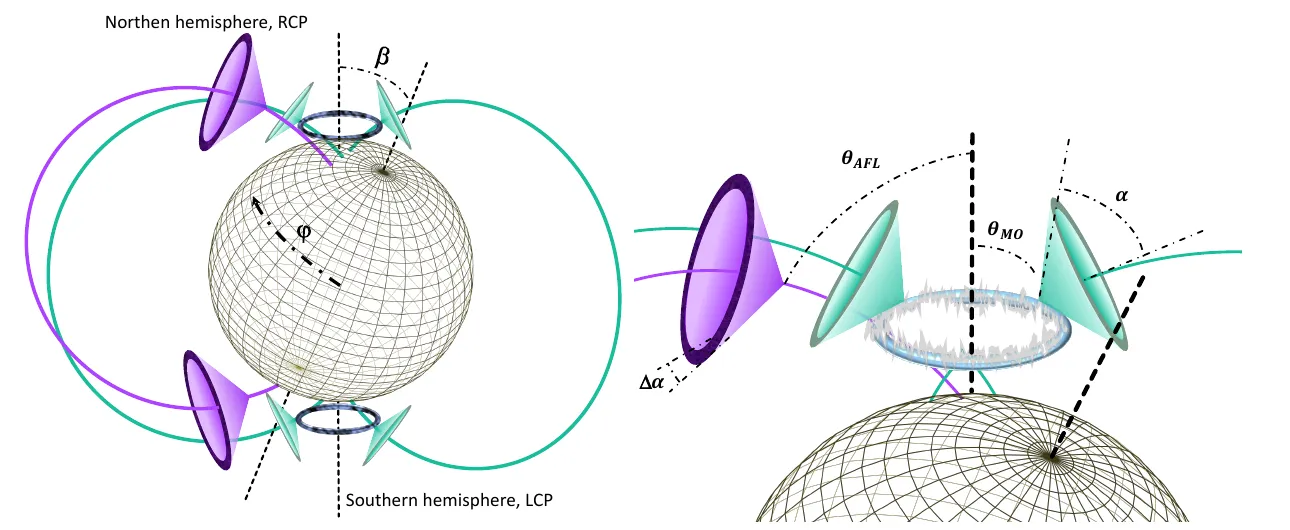
The geometry that best fits the radio pulses: a main auroral oval around each magnetic pole (cyan) and one active field line (purple), each beaming radio waves in hollow cones. Not to scale. — Figure 7, Martín-Carrero et al. (2026), arXiv:2610.09854.
A clock measured to the second
The radio pulses give a rotation period of 3.07941 ± 0.00020 hours; the visible light from TESS gives 3.07908 ± 0.00038 hours. The two agree, with a precision of about one second. According to the authors, few ultracool dwarfs have had their rotation measured this precisely in both radio and visible light.
The pulses keep the same shape across years and instruments. In one circular polarisation, there are two peaks per rotation, one stronger than the other; in the opposite polarisation, a single peak in between. The emission shows no cut-off up to 12 GHz, which implies a magnetic field of more than 4.3 kilogauss.
One ring, one active line
Neither a main oval alone nor an active field line alone reproduces the pulses: each gives symmetric light curves. The team therefore fitted a hybrid model, inspired by Jupiter:
- the main oval provides a stable contribution, including most of the weaker peak;
- a single active field line produces the stronger, variable peak and the opposite-polarisation pulse.
The fit favours a magnetic axis tilted only about 3.6 degrees from the rotation axis, seen almost from the equator.
During the 8.7-hour session, one peak faded from about 600 to 300 microjanskys while the other grew from about 150 to 350. Tiny changes explain this see-saw: either the opening angle of the emission cone shifts by a fraction of a degree, or the active line moves by about 7 to 8 degrees in longitude from one rotation to the next. The same see-saw appears in the 2008 data, about 15 years earlier.
A hidden companion?
On Jupiter, a moving active line is the signature of Io orbiting the planet. Here, a close companion — within a few radii of the dwarf — could play the same role. But the authors stress that other scenarios work without any companion, such as clumps of gas and dust trapped in a rotating plasma torus, or a more complex magnetic field. The candidate companion reported earlier, at about 0.78 astronomical units, was not detected in radio (below 21 microjanskys) and would in any case be too far away for an Io-like interaction. Longer, broader radio campaigns should tell the scenarios apart.