
THREE NEUTRINO DETECTORS, ONE VERDICT
Neutrinos come in three types, and they change from one type into another as they travel — they oscillate. Atmospheric neutrinos were central to showing this, and to establishing that neutrinos have mass. But one basic question about those masses remains open: their ordering. Is the third mass state the heaviest of the three — the “normal” ordering — or the lightest, the “inverted” one?
The answer matters beyond neutrinos, the authors note: it bears on the possible “Majorana” nature of the neutrino, a deep open question, and it connects to cosmological measurements, which currently favour the normal ordering.
Three detectors, one fit
Miaochen Jin and Carlos Argüelles at Harvard University, with Pablo Fernández-Menéndez (Santiago de Compostela) and Iván Martínez-Soler (Madrid and Durham), combined the public data of three detectors that watch the same neutrinos:
- Super-Kamiokande, 50,000 tonnes of water in a Japanese mine, with all its pure-water data: 6,511 days of observation.
- IceCube-DeepCore, the dense core of a detector buried between 1,450 and 2,450 metres deep in the ice at the South Pole: 8 years of data.
- KM3NeT/ORCA, still under construction in the Mediterranean Sea, with its first six detection lines: 510 days and 5,828 events.
Earlier combinations simply added up the published results. Here, all the event samples are fitted at once. Since the three detectors see the same flux of neutrinos interacting with the same water, the uncertainties on that flux and those interactions are shared between them. One experiment’s large statistics then help pin down errors that would otherwise blur another’s.
Along the way, the team found a bug in Super-Kamiokande’s public data release. The collaboration confirmed it and provided a corrected version, used here ahead of its public release.
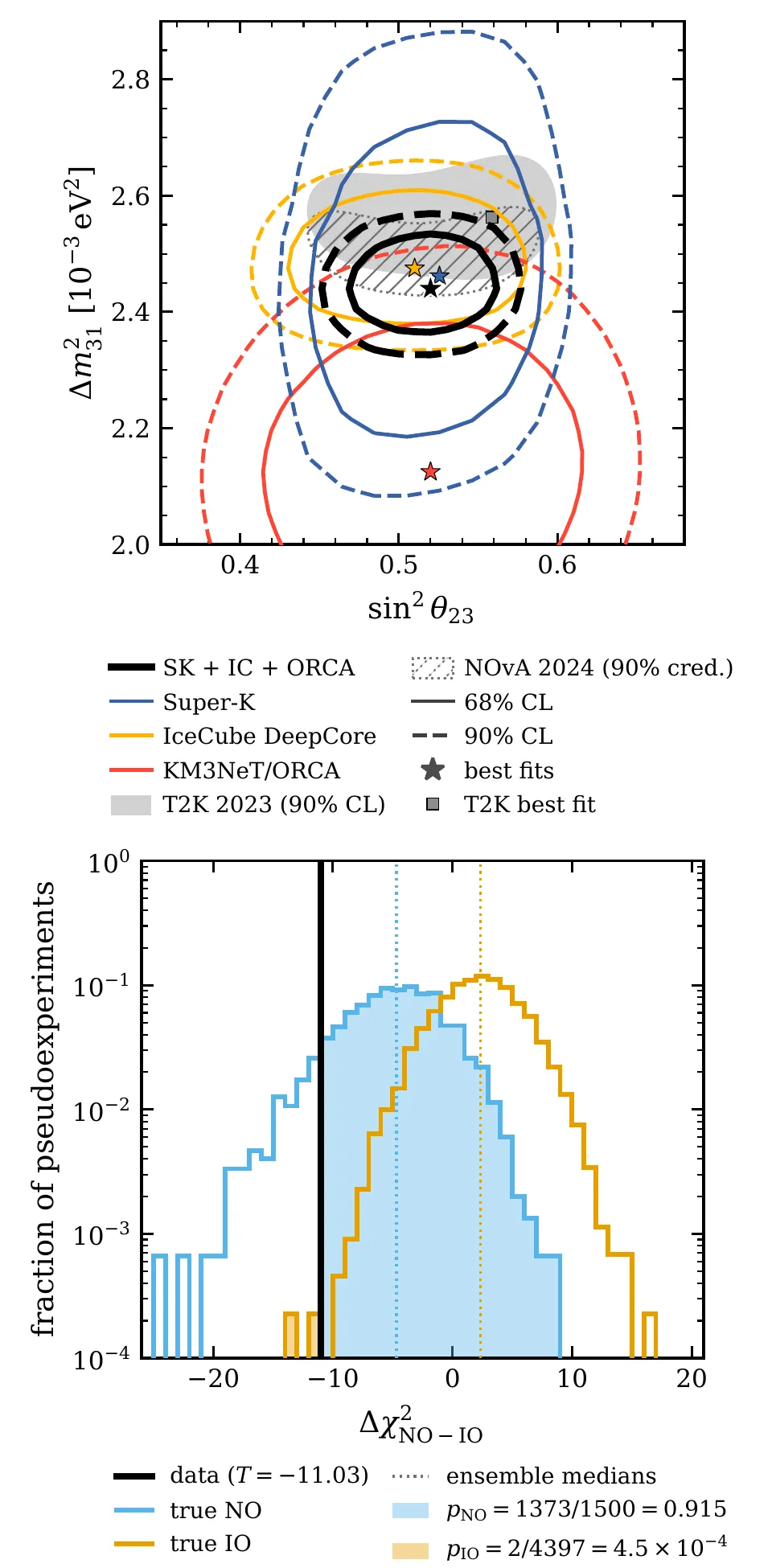
Top: allowed regions for two oscillation parameters from each detector and from the combination (black). Bottom: the observed result (black line) compared with thousands of simulated experiments assuming the normal (blue) or inverted (orange) ordering. — Figure 1, Jin, Argüelles, Fernández-Menéndez & Martínez-Soler (2026), arXiv:2610.12208, CC BY 4.0.
Each hint adds up
On its own, each detector leans only slightly toward the normal ordering. Combined, the preference becomes clear: the fit is worse by 11.0 units of the test statistic under the inverted ordering. To turn that into a probability, the team simulated 4,397 pseudo-experiments in a universe with the inverted ordering. Only 2 gave a result as extreme as the real data. The inverted ordering is excluded at 99.95% confidence, or 3.3 sigma.
Where does the signal come from? Neutrinos between 2 and 10 billion electronvolts that cross Earth’s mantle and core transform differently depending on the ordering. In the normal ordering, the matter they traverse boosts the conversion of neutrinos rather than antineutrinos, and all three detectors respond to this boost together.
Precision for free
The same fit measures other neutrino properties without any particle accelerator:
- the mass splitting that drives these oscillations to 2.2%, and one mixing angle to 6.1%, which the authors call competitive with accelerator experiments;
- a mixing angle compatible with the maximum possible value;
- a constraint on the CP-violating phase — a quantity linked to the imbalance between matter and antimatter — that relies on no beam experiment at all.
Not yet a discovery
Several cautions come with the result. It is an independent reanalysis of public data, not an official result of the three collaborations. A more conservative statistical criterion lowers the significance to 2.55 sigma. The overall fit quality is mediocre (a probability of 0.011), driven by the ORCA data, and the three data sets show a mild 2.2-sigma tension with each other. The authors declare that AI tools, which they do not name, helped prepare the manuscript, the plots and the code.
Their outlook: adding the reactor experiment JUNO to this atmospheric data could, by their rough estimate, bring the answer close to 4 sigma — a figure they say still needs a full joint simulation. “The normal ordering is looming,” they write.