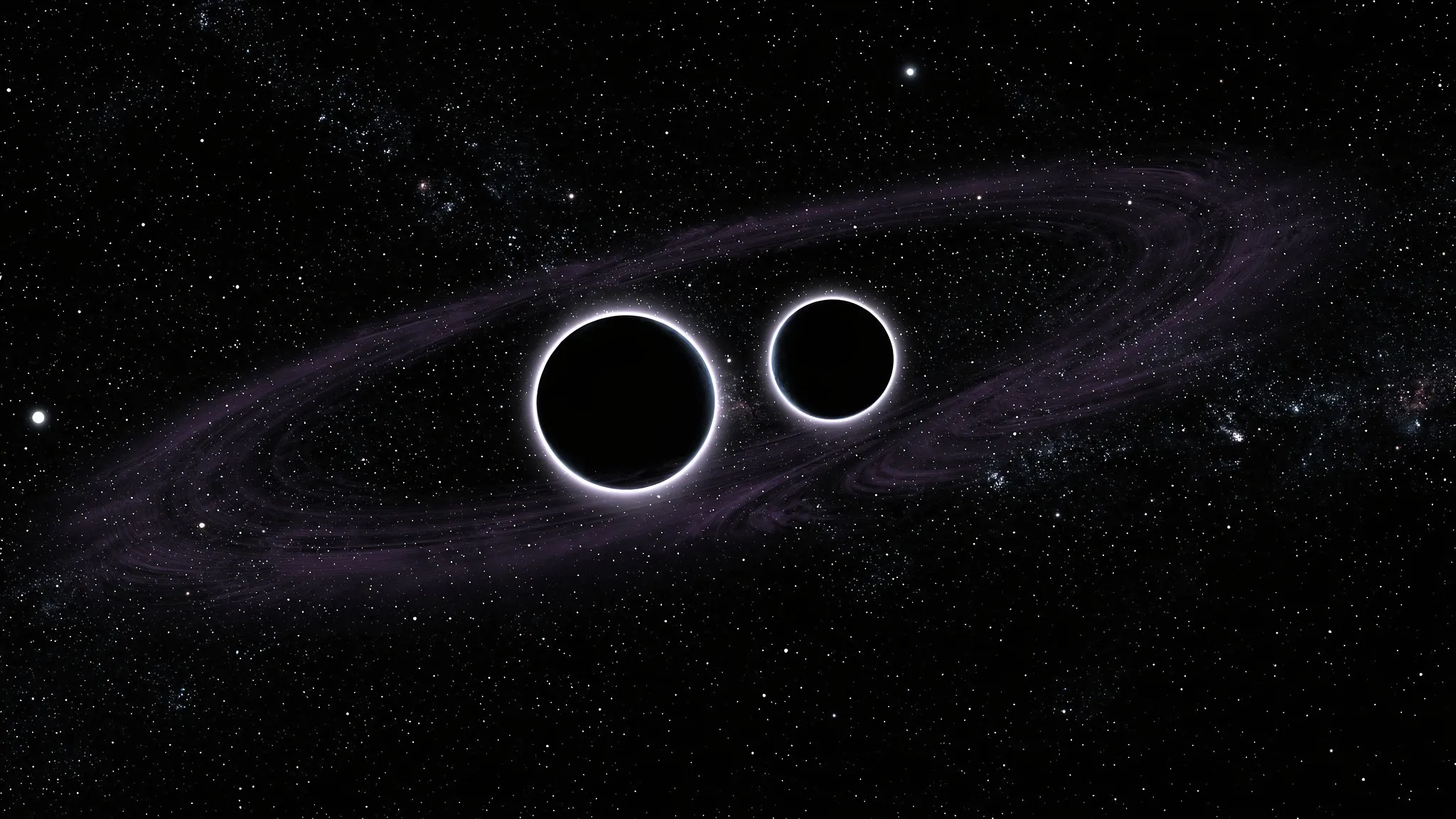
THE HEAVIEST BLACK HOLE COLLISION WAS NOT ON A CIRCLE
On 23 November 2023, the LIGO observatories at Hanford and Livingston recorded GW231123, the most massive merger of two black holes reported so far. Assuming a circular orbit, the standard analysis gave masses of about 137 and 101 times the mass of the Sun, both spinning extremely fast.
Those numbers are awkward. The smaller black hole falls in the so-called pair-instability mass gap, a range of masses that the ordinary collapse of a star struggles to produce. One way around it is a hierarchical merger: in a crowded environment such as a dense star cluster, the remnant of one merger stays around and later merges again. The paper also notes a useful clue: when two black holes of similar mass and little spin merge, the remnant typically spins at a value of about 0.7, on the dimensionless scale physicists use, where values close to 1 mean a near-extremal spin.
Only a few cycles
GW231123 was short: only a few measurable wave cycles before the final plunge. That makes its interpretation very sensitive to the model of the waveform. One property is especially hard to pin down: eccentricity, how oval the orbit is. Radiating gravitational waves tends to round off the orbits of old, isolated pairs, but close encounters in dense environments can leave some eccentricity. Over just a few cycles, an oval orbit can mimic the wobble of spinning black holes. If a model leaves eccentricity out, the spins may absorb its signature.
Starting lower, seeing more
Baoxiang Wang and Tao Yang at Wuhan University, with colleagues from Beijing Normal University, the Max Planck Institute for Gravitational Physics in Potsdam and Ningbo University, reanalysed the public data with a waveform model that allows both eccentricity and precessing spins. The key difference: for the Hanford detector, whose public data had been cleaned of a glitch, they started at 11 hertz instead of 20. Eccentricity is larger at lower frequencies, so this early part of the signal matters most.
- The orbit’s eccentricity comes out at 0.34, defined at a frequency of 5.5 hertz.
- The eccentric model is favoured by a Bayes factor of 10.2: the data are about ten times better explained by an oval orbit than by a circular one.
- Starting at 20 hertz, as earlier studies did, they find little eccentricity — in agreement with those studies.
To check this, they built a fake GW231123 with an oval orbit and analysed it the same way. It behaved exactly like the real event: clearly eccentric from 11 hertz, much less so from 20. Starting too high can hide an oval orbit.
The spin puzzle loosens
Allowing for eccentricity changes the smaller black hole most. Its spin drops from 0.90 in the circular analysis to about 0.74, close to the 0.7 expected for the remnant of an earlier merger. The fake signal shows the same effect: analysed as circular, its smaller black hole looks faster-spinning than it really is.
The larger black hole stays fast-spinning either way, and its mass hardly fits a simple second-generation origin. The two black holes may therefore have different histories: the smaller one possibly the child of two earlier black holes, the larger one formed some other way. Adding the possibility of a gravitational lens along the line of sight does not change the eccentric result.
What it changes
Earlier studies used GW231123’s smaller black hole to locate the upper edge of the pair-instability mass gap. If that black hole is itself the product of a merger, the authors argue, its mass cannot set that edge on its own. A Bayes factor of 10 is a hint rather than a proof — the authors themselves note that truly eccentric signals do not always give strong preferences when the signal is short. When a population boundary rests on a few unusual events, they conclude, the waveform assumptions behind those events matter directly.