SOUND CAUGHT JUMPING, ONE QUANTUM AT A TIME
Pluck a guitar string and the sound dies away smoothly. Quantum mechanics, however, predicts that the energy of any vibrating object comes in discrete packets — phonons, the quanta of sound. The catch is that you cannot see them by watching the object move. A measurement of position only ever shows a smooth exponential decay, exactly like a classical oscillator.
To reveal the packets, you have to measure the energy itself, and do it without disturbing it: a so-called quantum non-demolition measurement. Such jumps between energy levels were first seen in single trapped ions, then for particles of light trapped in cavities. A team at Stanford University and SLAC, led by Amir Safavi-Naeini, has now done it for a vibrating object.
A crystal floating above a qubit
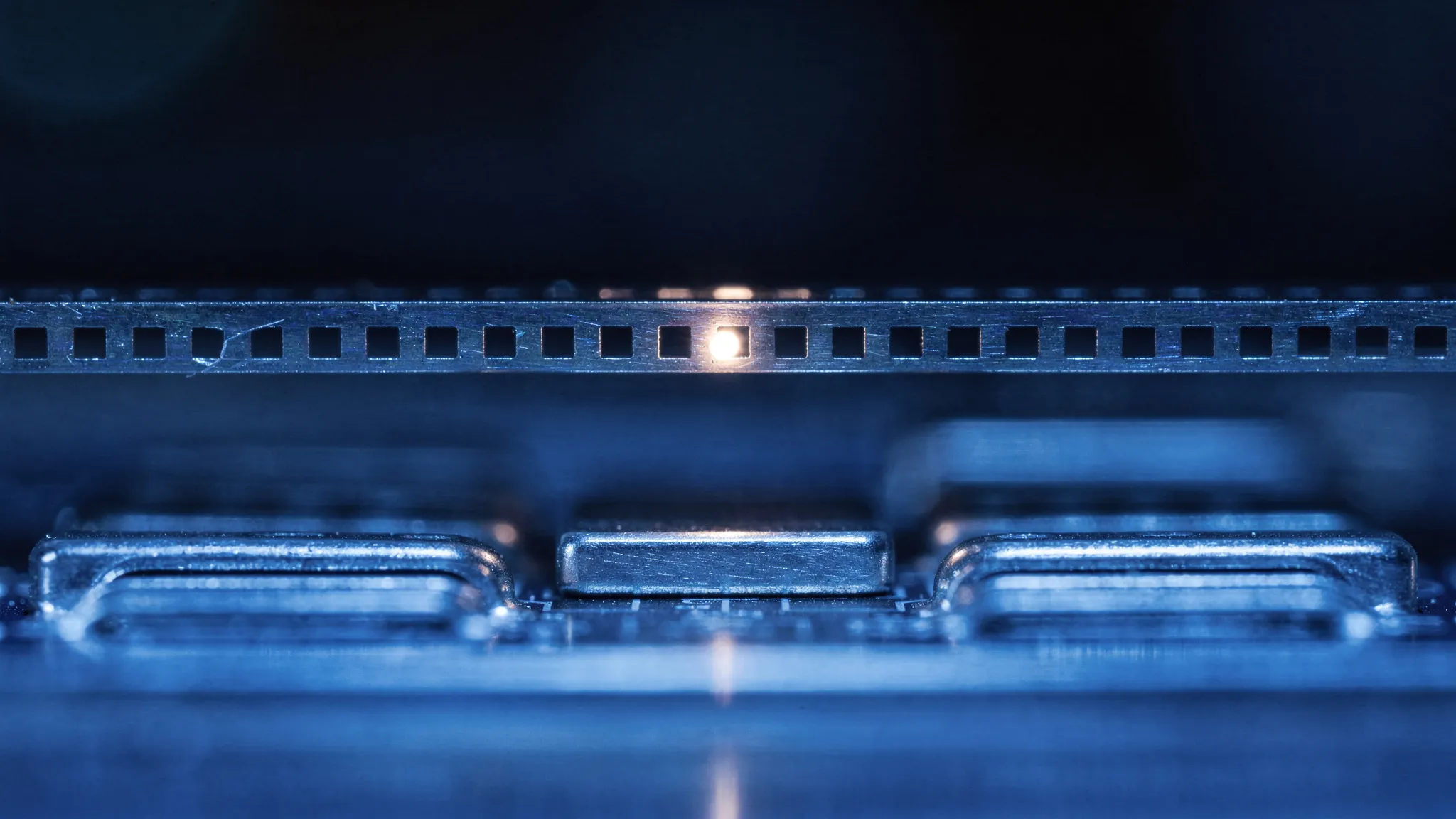
The vibrating object is a tiny block of lithium niobate, a crystal that turns vibration into voltage. It sits at the centre of a patterned beam whose periodic holes act as acoustic mirrors, trapping the vibration inside. Its effective mass is about 0.2 picograms — a fifth of a trillionth of a gram.
The detector is a superconducting qubit, the same kind of circuit used in quantum computers. The two parts are made separately, then a precision bonding machine stamps the crystal onto the qubit, so that the block floats just 75 nanometres above it.
The coupling works like this: each phonon in the block shifts the qubit’s frequency by 328 kilohertz. By timing a short pulse sequence, the qubit ends up in one state if the number of phonons is even and in the other if it is odd. Since the block holds at most one phonon in practice, this boils down to a simple question: zero or one? Each check takes about 12 microseconds.
The jumps
First, the team learned to recognise a single phonon. A single check is right only about 68% of the time, so they repeat it: after six “one phonon” answers in a row, the block holds exactly one phonon with 85% probability.
Then they kept asking — 294 times in a row. The raw answers already show it by eye: a long stretch of mostly “one”, then an abrupt switch to mostly “zero”. The block did not leak its energy away gradually; it lost its single phonon in one jump, at a random moment that differed from one run to the next. The times of these jumps follow an exponential law, the signature of a spontaneous, memoryless process.
Numbers that make it possible
- A phonon survives 2.1 milliseconds in this block, which the authors call exceptionally long for this kind of resonator at gigahertz frequencies. They credit two choices: no metal touches the resonator, and its top surface is never hit by the ion beam used to etch it.
- That leaves room for about 170 checks within one phonon lifetime.
- Each check leaves the phonon intact about 99% of the time. The small disturbance shortens the phonon’s life to about 0.65 milliseconds while it is being watched.
- The combined figure of merit, called cooperativity, exceeds 3 million, which the authors describe as ten times better than other quantum acoustic platforms.
Toward quantum bits made of sound
The authors’ next step is a “dual-rail” quantum bit made of two mechanical resonators sharing one qubit, where the loss of a phonon becomes a detectable error. Their stamping technique allows several resonators on the same chip. They also point to sensors: an object this light, vibrating this long, is what weighing a single molecule requires.
For now, the measurement still has limits: a single check is far from perfect, and it cannot tell zero phonons from two. Two of the authors are Amazon Scholars, and Amazon Web Services helped fund the work.
Quantum jumps have now been seen in atoms, in light and, with this experiment, in sound.