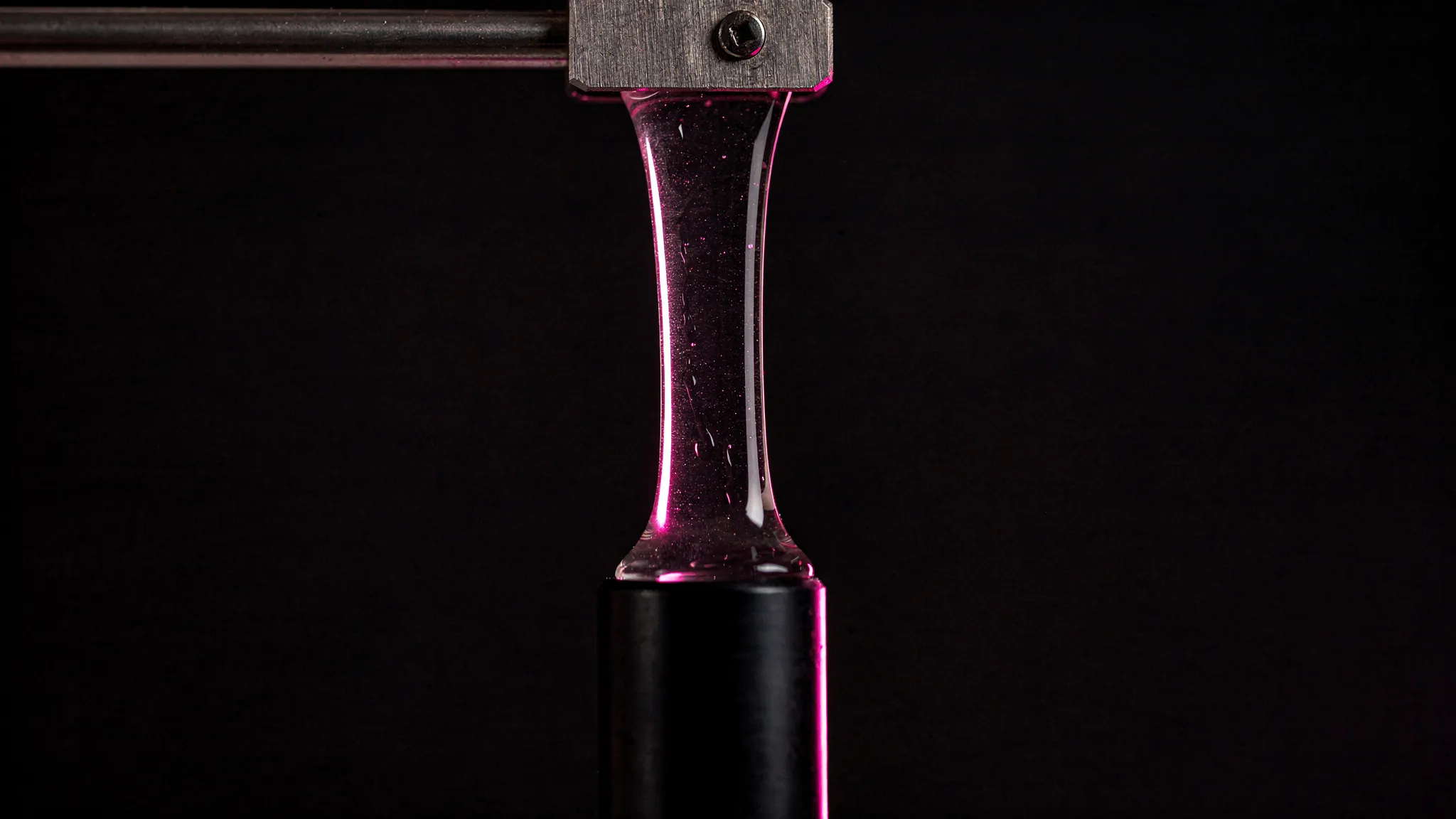
A GEL THAT HOLDS A KILO
A single polymer chain, pulled from both ends, first uncoils, then stiffens sharply as it straightens, and finally breaks a strong covalent bond. Yet a network made of such chains — a gel or a rubber — is orders of magnitude weaker than one chain. Recent computer simulations, cited by the paper, show why: when a network is stretched, tension is shared very unevenly. A few high-tension paths form and break one after another, while most strands stay coiled and barely loaded.
Yu Zhou, Chenghai Li, Zheqi Chen, Xianyang Bao and Zhigang Suo at Harvard University put the blame on the cross-links, the junctions that tie strands together. Each cross-link joins four strands, but only two of them carry the high tension. Cross-links concentrate the load.
Fewer knots, more tangles
Their remedy is to deconcentrate tension. With far fewer cross-links, strands become long and entangled. The authors picture the load being carried by “high-tension cylinders” — whole bundles of tangled strands. Because the forces between strands are weak, entanglements slip like pulleys: when a tangle engages four segments, all four bear the load. Longer strands recruit more of the network.
They tested this on polyacrylamide hydrogels, soft solids made mostly of water, swollen to equilibrium before every test, as they would be in use. Two knobs set the network: the amount of cross-linker and the amount of water during synthesis.
- Strength measured per unit of polymer — the authors’ “effective strength” — rose as cross-links became sparser, following a simple law: it grows as the inverse of the cross-linker amount, reaching about 100 megapascals.
- Changing the amount of water, and therefore of tangles, changed it by less than a factor of two. Cross-links concentrate tension; entanglements do not.
Swell, squeeze, repeat
To turn this into a strong material, the team built prestretched interlocking networks. A sparsely cross-linked gel is soaked in the same starting mixture, squeezed flat so that it stretches sideways, then exposed to ultraviolet light: a second network forms inside the first and locks it in its stretched state. Doing it once more gives a triple network.
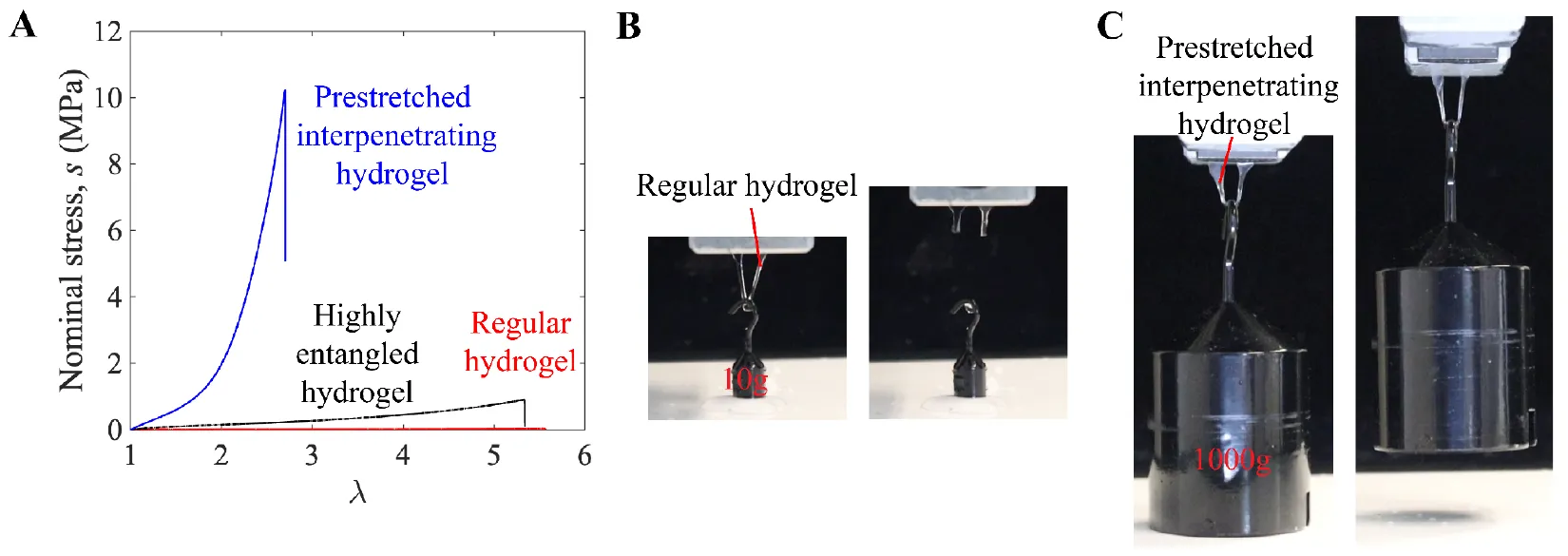
Three polyacrylamide hydrogels: regular, highly entangled and prestretched interpenetrating. The regular one holds about 10 g; the prestretched one holds 1,000 g. — Figure 3, Zhou, Li, Chen, Bao & Suo (2026), arXiv:2610.11837, CC BY 4.0.
- Strength climbs from about 0.05 megapascals for a regular hydrogel to about 1 for a highly entangled one and about 10 for the triple network.
- The triple-network gel holds a weight about a hundred times heavier than a regular gel.
- It stays elastic: only 8.4% of the energy is lost in a stretch-and-release cycle.
- To the authors’ knowledge, it is the strongest polyacrylamide hydrogel reported.
The recipe also works without water. In a rubber-like material without water, an elastomer called poly(ethyl acrylate), strength rose from about 1 to 4 megapascals with fewer cross-links, and to about 25 megapascals after prestretching, with energy losses of only a few per cent.
Still only 1% of the strands
Even 100 megapascals is far below the roughly 10 gigapascals that covalent bonds can withstand. By the authors’ estimate, only about 1% of strands reach that limit; the rest still carry much less. How to recruit the other 99% is, they write, an open question that may need entirely new network designs.