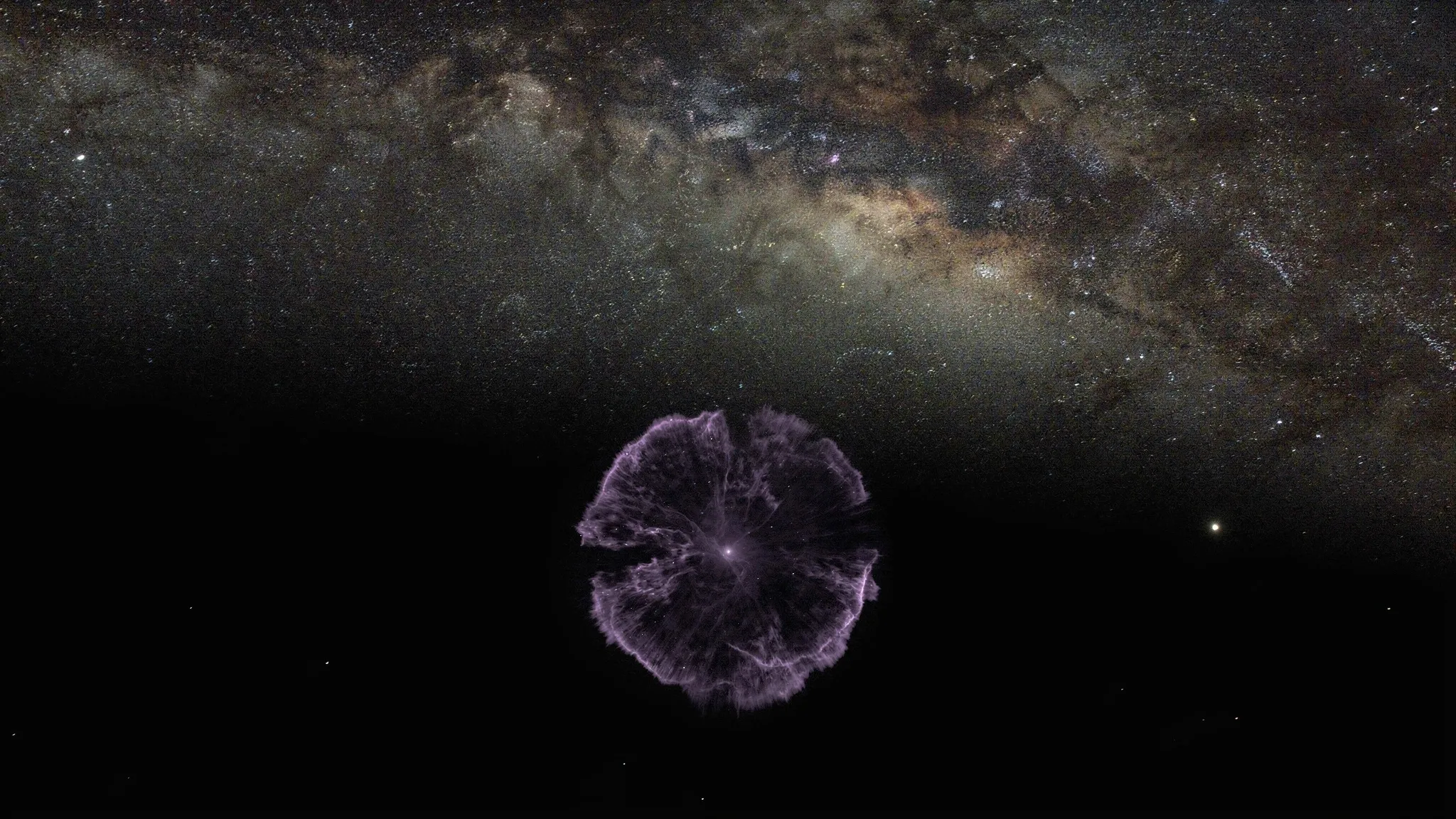
Ba a fassara ba tukuna: ainihin rubutun Turanci.
A NEUTRON-STAR CRASH IN OUR OWN GALAXY?
When two neutron stars merge, the collision throws out neutron-rich matter that builds elements heavier than iron through rapid neutron capture, the r-process. The flash that follows is called a kilonova. In our Galaxy, such mergers are rare: the authors quote a rate of 10⁻⁵ to 10⁻⁴ per year, so only a handful of kilonova remnants should exist, against hundreds of supernova remnants. None has been identified so far.
An orphan in the gamma-ray sky
The H.E.S.S. telescopes in Namibia found 78 sources of very-high-energy gamma rays in their 2004–2013 survey of the Galactic plane; 30 are still unexplained. One of them, HESS J1507−622, stands out. It sits about 3.5 degrees below the Galactic plane, much farther than most of these sources. It is compact (about 0.3 degrees across), steady, and bright from the GeV range seen by the Fermi satellite up to the TeV range seen by H.E.S.S.
Yet at lower energies there is almost nothing: no matching X-ray glow, no radio shell, no pulsar. The two usual suspects both struggle. A pulsar wind nebula needs a pulsar that nobody has found, and its energy budget becomes impossible beyond about 10 kiloparsecs. A supernova remnant should show a shell and usually stays near the plane where its star was born.
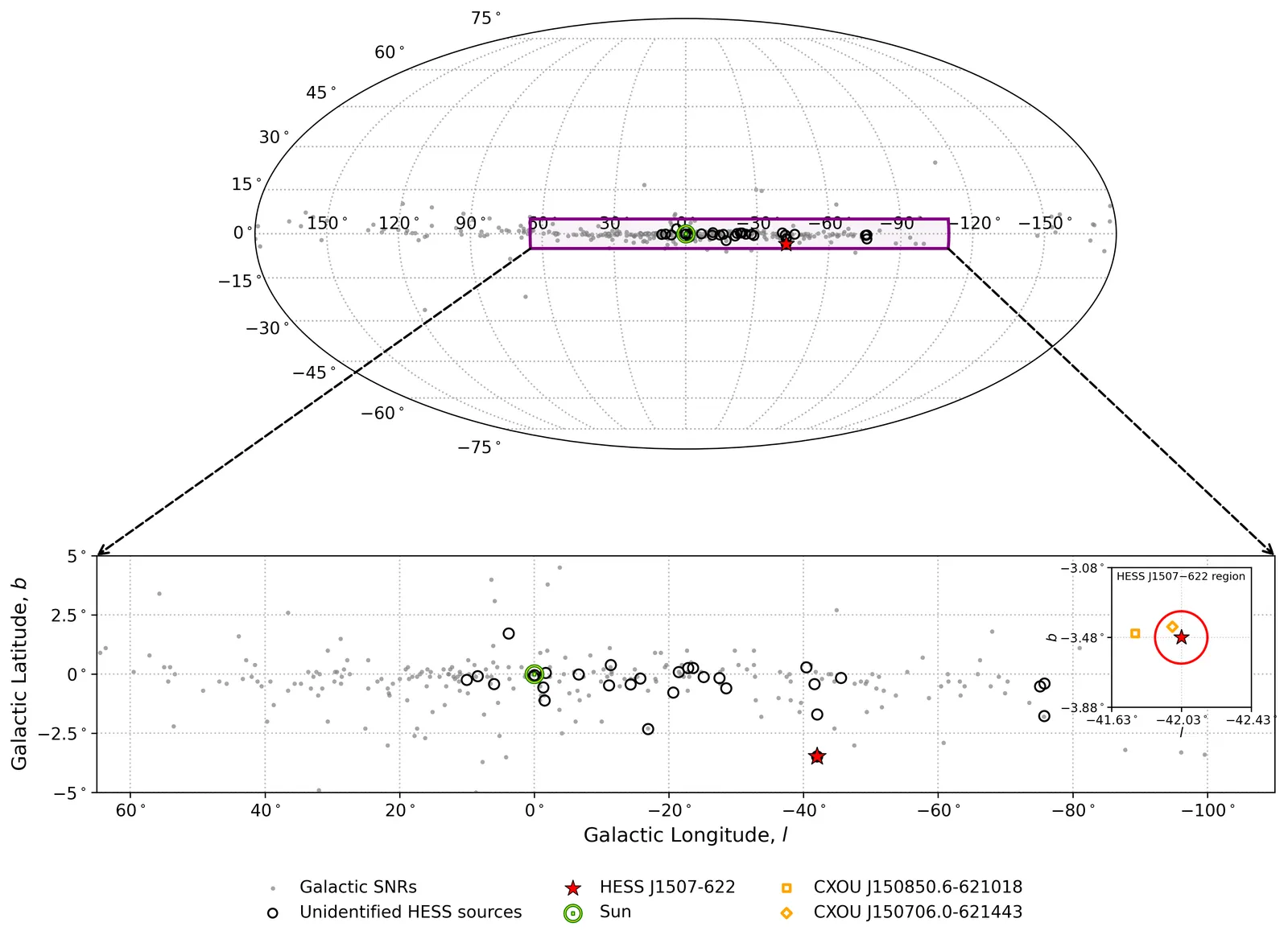
The 30 unidentified H.E.S.S. sources (black circles) and 310 known supernova remnants (grey dots); HESS J1507−622 is the red star, well below the plane. — Figure 1, Sarmah et al. (2026), arXiv:2609.38341.
Electrons, not protons
Prantik Sarmah, Xilu Wang and colleagues at the Institute of High Energy Physics in Beijing, with Rebecca Surman’s group at the University of Notre Dame, revisit an idea that the H.E.S.S. team had floated in 2011 and dropped. The objection then was energy: making the gamma rays with protons would demand an absurdly powerful explosion.
The new model uses electrons instead. Accelerated by the shock of the expanding debris, they kick photons of the cosmic microwave background up to gamma-ray energies. Protons are useless here anyway: the gas around the source is so thin, about one particle per thousand cubic centimetres, that a proton would travel roughly 11 gigaparsecs before hitting anything.
The off-plane position also fits. A pair of neutron stars receives a kick at birth; leaving the Galactic bulge at 10–100 km/s, it would take 0.1 to 1 billion years to reach this spot, in line with typical delays before such pairs merge.
Young, and close enough to have been seen
Matching the source’s size and brightness, the model places it at 3.8 to 14.3 kiloparsecs and gives it an age of 200 to 3,000 years, with a preference for less than 1,000 years. Its predicted radio and X-ray glow stays below every current upper limit.
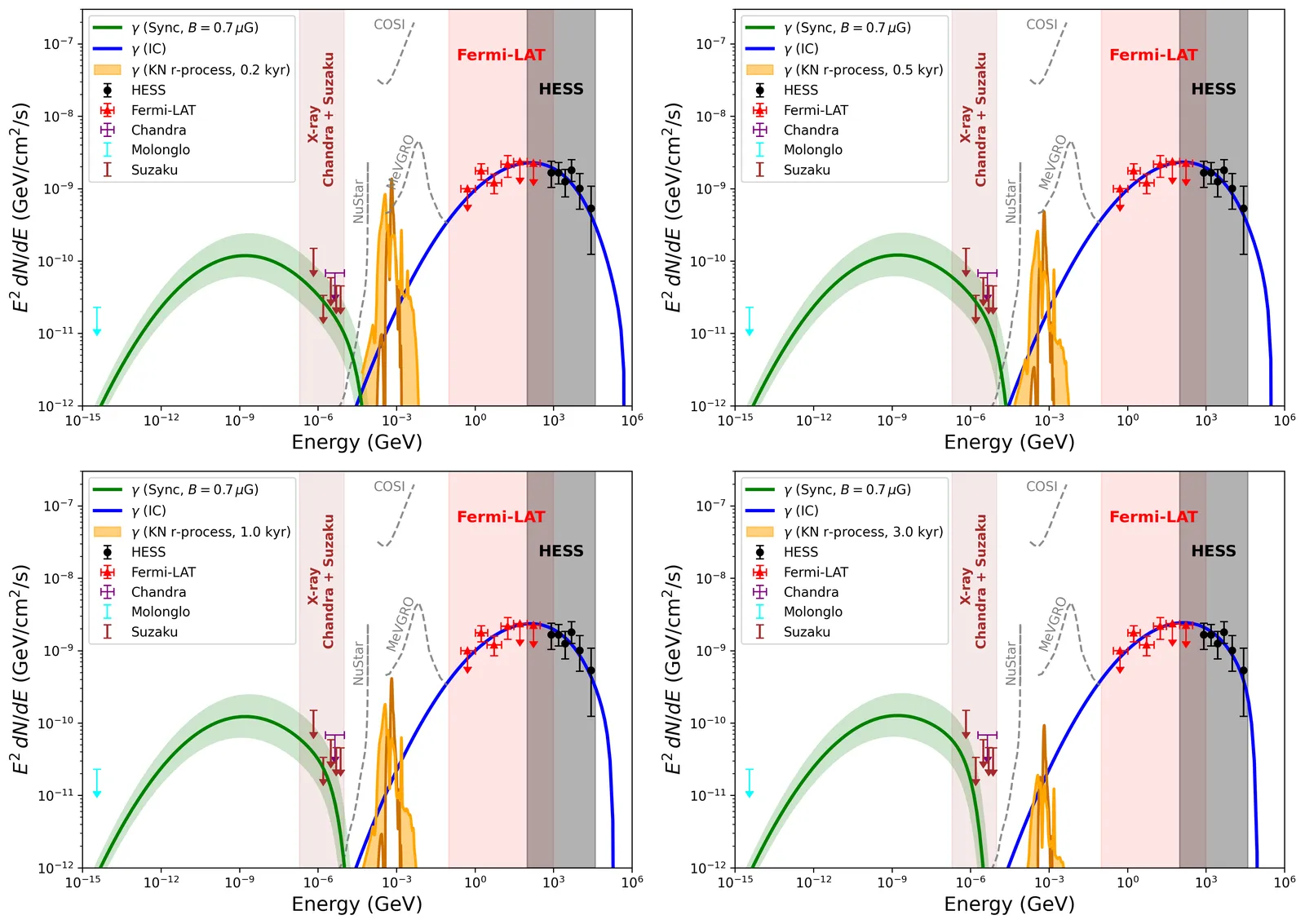
Modelled emission for ages of 0.2, 0.5, 1 and 3 thousand years: electrons scattering microwave photons (blue) fit the Fermi and H.E.S.S. data; the orange bump is the MeV signal of decaying r-process nuclei. — Figure 3, Sarmah et al. (2026), arXiv:2609.38341.
Scaled from the merger GW170817, such a kilonova would have peaked at an apparent magnitude between −0.8 and −3.2, comparable to the brightest planets. Why is there no historical record? The authors give three reasons: kilonovae fade by about 1.1 magnitudes per day, so the show lasted under nine days; the source lies at a declination of −62°, out of reach for the well-documented sky-watchers of China, Japan, Egypt and Europe; and dust may have dimmed it.
Three ways to catch it
- MeV gamma rays from the radioactive decay of freshly made heavy nuclei: too faint for NuSTAR or the upcoming COSI, but within reach of a next-generation instrument such as MeVGRO if the remnant is under about 1,000 years old.
- A light echo: the original flash reflected by interstellar dust, at 27–33 magnitudes per square arcsecond, within reach of large telescopes and the Rubin Observatory. It could even reveal the spectrum of the explosion itself.
- Mid-infrared glow from warm dust, and possibly neutrinos if a dense cloud lies along the line of sight.
The paper remains a hypothesis built on existing data, and the authors stress that gamma-ray spectra alone cannot tell a kilonova remnant from its rivals. If one of these signatures turns up, the Galaxy would offer a kilonova remnant to study on its own doorstep, a chance the authors call unprecedented.