Ba a fassara ba tukuna: ainihin rubutun Turanci.
A SUPERSOLID AT ROOM TEMPERATURE
In 1956, according to the paper, Penrose and Onsager asked a strange question: could a single state of matter be at once a crystal, its particles arranged in a regular lattice, and a condensate, its particles sharing one quantum wave and flowing without friction? Such a state is called a supersolid.
The first clear experimental signatures came in 2017, in clouds of ultracold atoms, followed by dipolar quantum gases that break into regular arrays of droplets. Researchers have since seen their vibrations, two-dimensional arrays and even quantised vortices. But all these supersolids exist at a few nanokelvins, billionths of a degree above absolute zero, and need heavy cooling and vacuum equipment.
Half light, half matter
A way around the cold is the exciton–polariton, a hybrid quasiparticle, part light and part matter. Because polaritons are constantly pumped and constantly leak away, they can keep a collective quantum coherence at much higher temperatures. Condensates and superfluids of polaritons already work at room temperature in organic materials and perovskites. A polariton supersolid had recently been made in photonic crystals — but with conventional semiconductors, at cryogenic temperatures.
Yuanhao Gong, Jingwen Ma and colleagues, led by Xiaobo Yin and Xiang Zhang at the University of Hong Kong, combined the two ingredients. They grew thin single crystals of a lead-bromide perovskite, MAPbBr₃, selected a film 70 nanometres thick, and placed it on a photonic crystal: a silicon nitride layer etched with a pattern repeating every 290 nanometres. The pattern shapes how light can travel, creating one high-quality mode at rest and a pair of modes travelling in opposite directions.
Two thresholds
The researchers pumped the device with femtosecond laser pulses and watched the light it emitted.
- At 13.14 µJ/cm², a condensate formed in the resting mode.
- At 15.89 µJ/cm², light suddenly appeared in the two counter-propagating modes. The condensate was feeding them through a nonlinear “parametric” process — the authors show the growth curves change exactly as such a process predicts. Filling a pair of opposite waves breaks the smooth, uniform symmetry of the fluid: this is the onset of the supersolid.
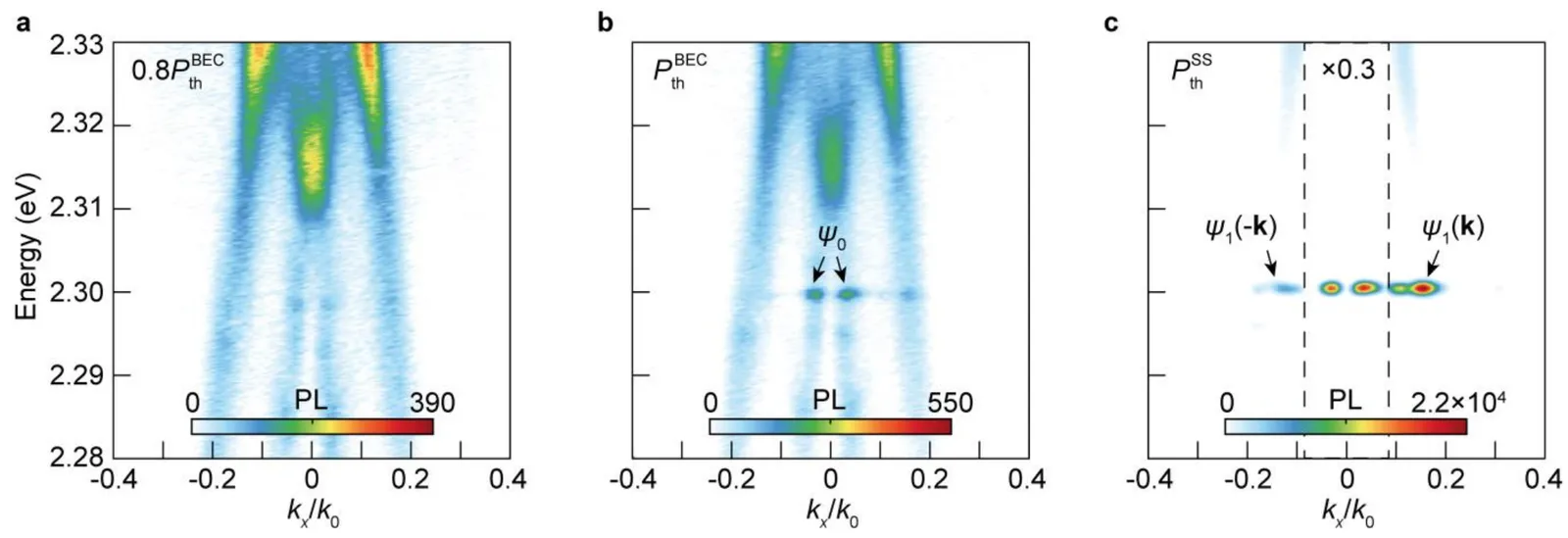
Emission below threshold (a), at the condensation threshold (b) and at the supersolid threshold (c), where bright spots appear at two opposite momenta ψ₁(±k) at the condensate’s energy. — Figure 2, Gong et al. (2026), arXiv:2609.40009.
A crystal that is not printed in the chip
Imaged directly, the glowing fluid shows regular stripes spaced by 3.33 micrometres, close to the predicted 3.46. That period has nothing to do with the 290-nanometre pattern of the chip: the order is not an imprint of the etched structure but arises from the interactions themselves. And it is soft: as the density rises, the spacing shifts continuously.
To check the quantum side, the team measured how light from the two opposite modes is correlated, using two single-photon detectors. At zero delay the correlation was 1.0121, very close to 1, the signature of coherence between the two modes. Crystalline order and global coherence together: for the authors, definitive proof of a supersolid at room temperature.
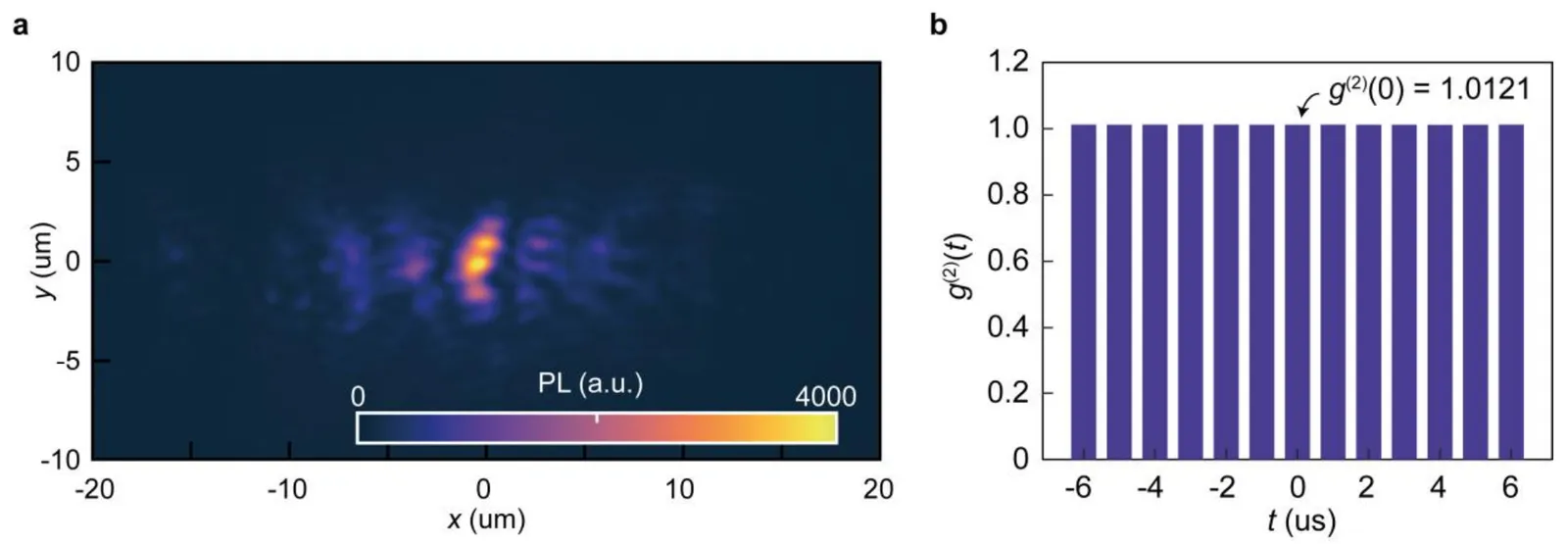
Left: the supersolid in real space, a stripe pattern spreading across the condensate. Right: the correlation between the two opposite modes, 1.0121 at zero delay. — Figure 4, Gong et al. (2026), arXiv:2609.40009.
From hydrodynamics to quantum light
The device is driven by pulses and constantly losing light, so this supersolid lives out of equilibrium, unlike its atomic cousins. Earlier preprints cited by the authors had already aimed at room-temperature supersolidity; this one claims a direct view of both orders. Next on their list: two-dimensional patterns, supersolid vortices, the vibrations that reveal its stiffness — and, since the scattering that builds the supersolid is itself a source of non-classical light, a compact on-chip source of squeezed and entangled light.