Ainda não traduzido: versão original em inglês.
40 MILLION BLACK HOLES WANDER OUR GALAXY
When a massive star dies, it can collapse into a black hole. Gravitational-wave detectors have caught hundreds of them merging far away. Yet in our own Milky Way, only about two dozen stellar black holes are known — almost all of them in pairs, where a companion star gives them away.
Theory says there should be around a hundred million. The vast majority would be isolated: alone, dark, with nothing to reveal them. Only one has been confirmed so far, OGLE-2011-BLG-0462, about 7 times the mass of the Sun, spotted because it briefly magnified the light of a star behind it — an effect called gravitational microlensing.
Simulating a galaxy’s worth of stars
Jian-Guo He, Yong Shao and colleagues at Nanjing University built POPKIN, a new Python code. It follows single stars and pairs of stars from birth to death — mass transfers, mergers, supernova explosions — within a model of the Milky Way’s star formation and chemical history over 12 billion years. Then it tracks every resulting black hole along its orbit through the Galaxy up to today.
They ran ten versions of the model, changing the most uncertain physics: how stars explode, and how pairs of stars exchange mass.
The census
In their reference model:
- The Milky Way holds about 40 million isolated black holes (other supernova recipes give 100 to 200 million).
- About 80,000 lie within 1 kiloparsec of the Sun — roughly 3,300 light-years.
- Their average mass is about 11 times the Sun’s. Their masses cluster around 9 and 20 solar masses, with a striking gap between 13 and 17.
- Most are close to the plane of the Galaxy. Nearly half come from the old, thick disk of the Milky Way.
- The most common origin: a pair of stars torn apart by a supernova (about 48%).
- More than two thirds were born without a kick. They follow calm, nearly circular orbits. Those that received a kick at birth travel much faster, often 100 to 200 km/s.
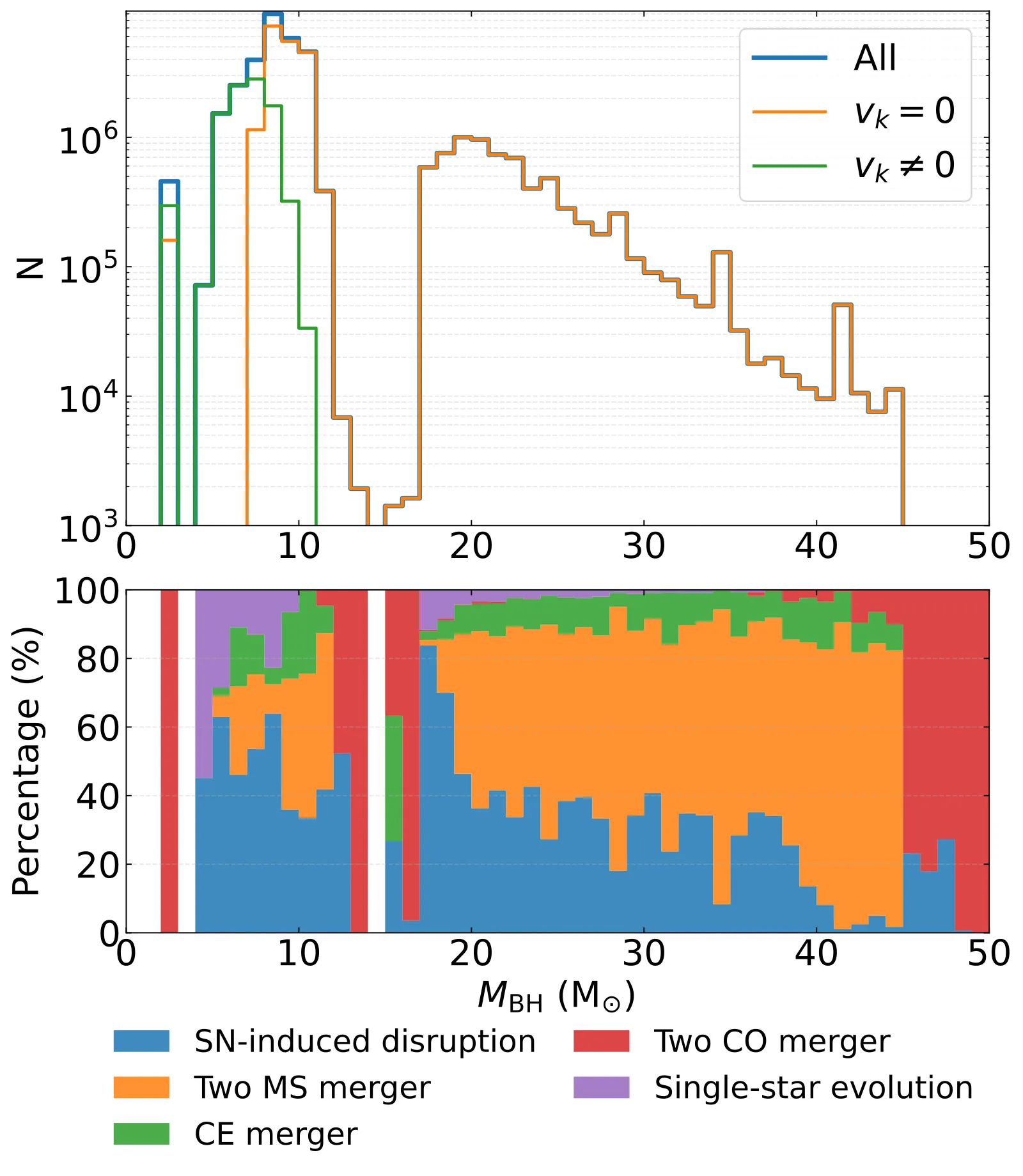
Predicted masses of isolated black holes: two peaks near 9 and 20 solar masses, and a gap between 13 and 17. — Figure 13, He et al. (2026), arXiv:2609.29211.
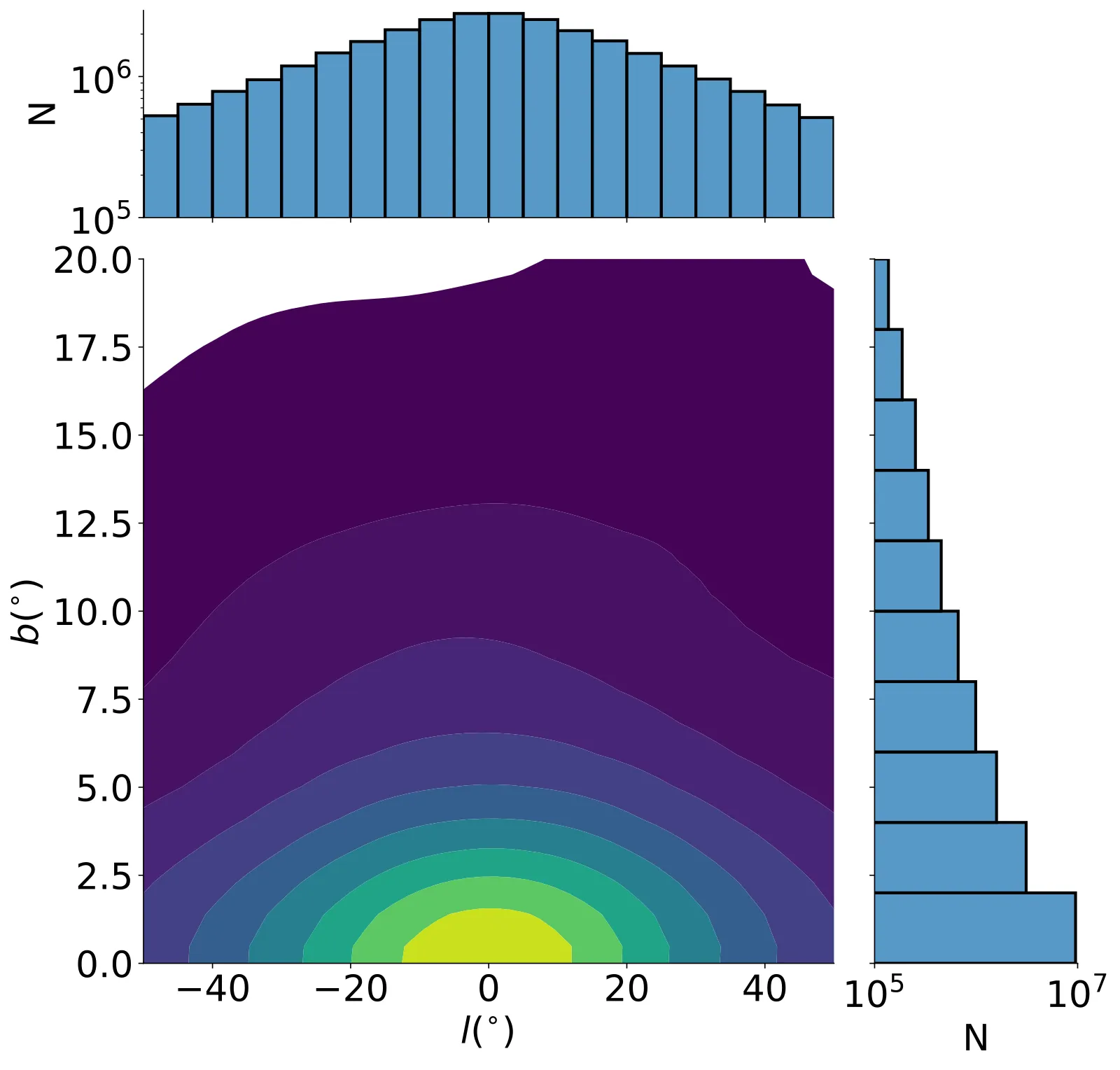
Where they would appear on the sky: concentrated toward the plane and the centre of the Milky Way. — Figure 15, He et al. (2026), arXiv:2609.29211.
How to find them
- X-rays. A black hole moving slowly through interstellar gas swallows some of it and glows. The model predicts about 5,000 such sources above a given brightness threshold across the Galaxy, about 100 within 1 kiloparsec — optimistic numbers, very sensitive to how efficiently the swallowed gas radiates.
- Microlensing. Long-lasting magnification events are the best clue. For the future Roman space telescope’s survey of the Galaxy’s centre, the model predicts about 360 events over five years — an upper limit, before real-world selection effects.
The model also offers a guess about the one known lonely black hole: its motion fits best a black hole born in the thin disk that received a kick at birth, although another origin is not ruled out.
Why the numbers differ
The total count depends mostly on how stars explode, which remains uncertain. That is the point: long microlensing events keep the fingerprints of this physics, such as the gap in masses. Counting lonely black holes could reveal how massive stars die.