Bado haijatafsiriwa: toleo asili la Kiingereza.
A 1,800 KM CLOUD ON MARS MAY BE BORN WITHOUT DUST
Clouds need seeds. On Earth as on Mars, water vapour normally turns into droplets or ice crystals by condensing onto tiny particles already floating in the air. This is heterogeneous nucleation. In theory, crystals can also form directly from the vapour, with no seed at all: homogeneous nucleation. But it requires a gigantic excess of humidity. On Earth it is considered impossible in real atmospheric conditions; on Mars, it would take a saturation ratio of about 100,000, deemed out of reach because the abundant dust would soak up the vapour first.
A team from the Laboratoire de Météorologie Dynamique and LATMOS, in Paris, argues that a strange Martian cloud shows the opposite.
The cloud that grows from a volcano
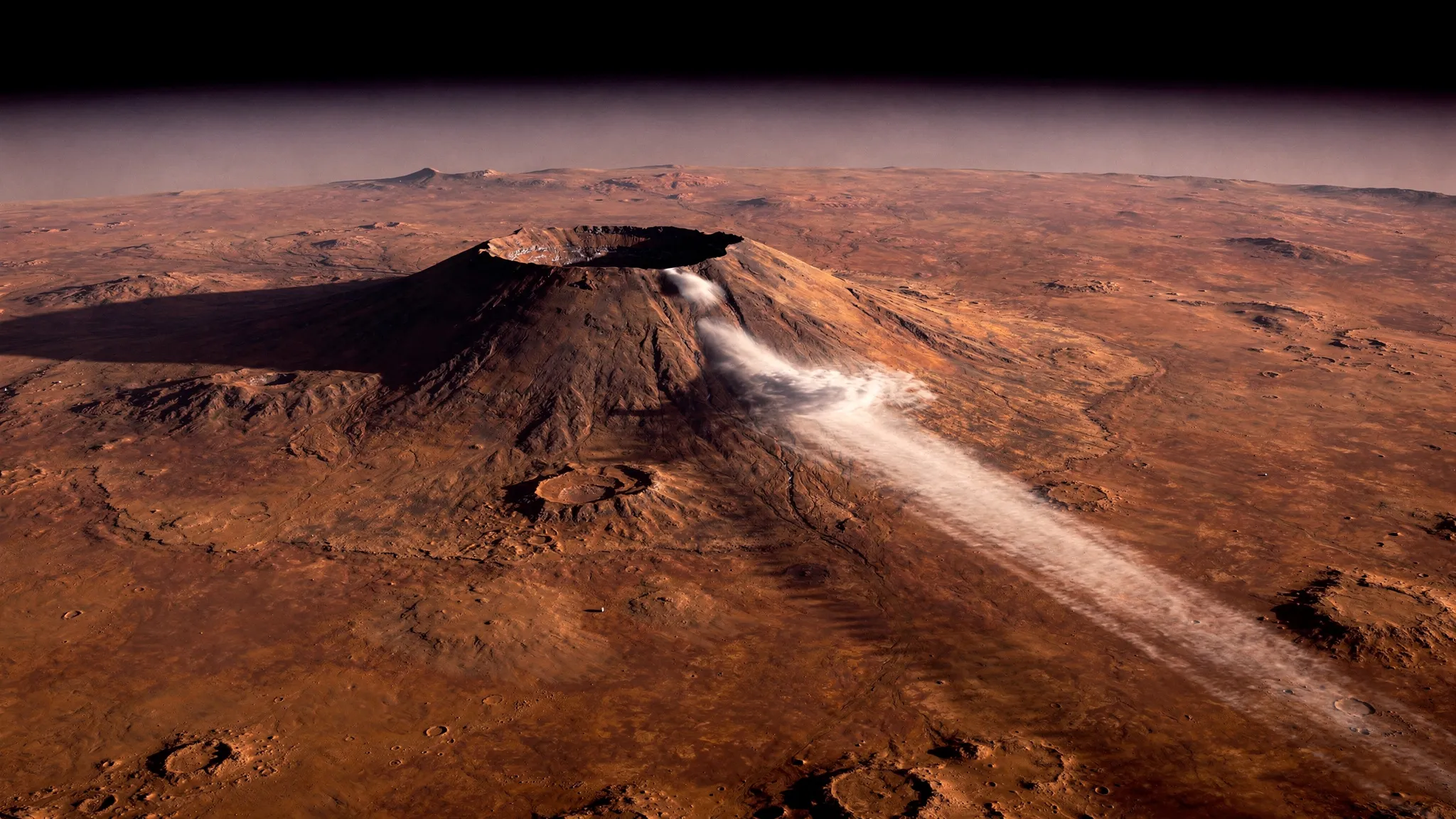
The Arsia Mons Elongated Cloud forms every morning, during part of the Martian dusty season, on the western flank of the volcano Arsia Mons, at about 45 kilometres altitude. It appears at sunrise, stretches rapidly for three hours, then detaches from the volcano. At its peak it can reach 1,800 kilometres in length, pulled by the wind.
Several explanations had been proposed — water carried up by slope winds, cold pockets created by atmospheric waves — but none reproduced its long, thin tail.
A cold pocket over the mountain
J. Hernández-Bernal, A. Määttänen, A. Spiga and F. Forget simulated the region with a Martian weather model at 10-kilometre resolution. With standard cloud physics, the model fails: no tail. It does produce, however, waves raised by the volcano, which cool a wide area to its west.
In a small “core cold pocket” on the western slope — exactly where the real cloud is born — air is lifted by several kilometres, cooling by 0.05 degrees per second for 800 seconds, down to below 130 kelvin. Humidity there reaches about 100,000 times saturation. Under these conditions, a separate microphysics model shows hundreds of ice crystals per cubic centimetre forming directly from the vapour.
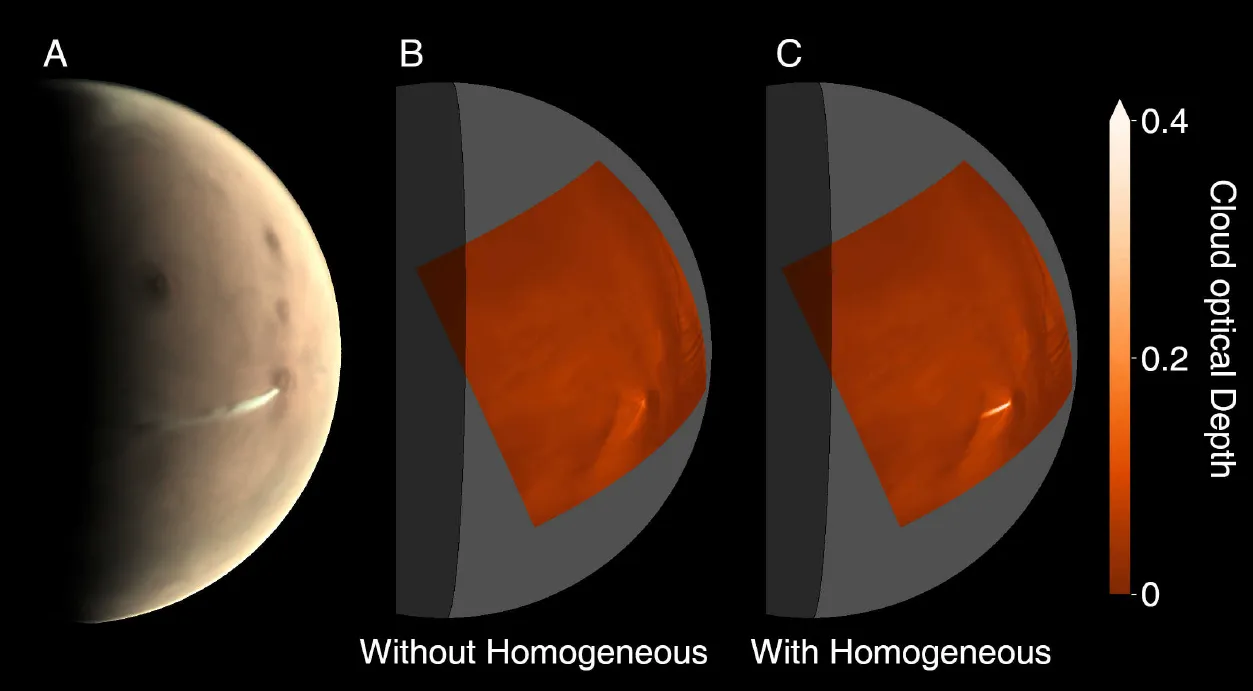
A: the cloud seen by Mars Express. B: simulation with ordinary, dust-based ice formation — no tail. C: with ice forming directly from vapour added — the tail appears. — Figure 1, Hernández-Bernal et al. (2026), arXiv:2609.37259.
Why the tail is so long
Once added to the model, the dust-free ice reproduces the cloud: its birth, its tail, the shrinking of its head and its detachment later in the morning when the cold pocket fades. The explanation for the length is elegant. The new crystals grow until they are in balance with the surrounding air. Around them, the air remains supersaturated, because there is too little dust to form a cloud. The tail, already in equilibrium, simply stays stable while the wind carries it away.
The simulated cloud’s thickness and particle size (about 0.25 micrometres) match observations. Other numbers do not yet: the simulated cloud is 30 to 50% narrower, starts about 1.5 hours late, and its maximum length before detachment is about a quarter of the real one. The team also tested an alternative — ice forming on very fine dust particles — and only got widespread hazes, never the sharp tail.
A draft with a warning
The version posted on arXiv is unusual: the authors themselves state at the top that it is the text before peer review, which “contains known errors and inaccuracies that were corrected during the review process”. The reviewed version, accepted in Nature Geoscience, carries a more cautious title — the clouds “suggest”, rather than “evidence”, homogeneous nucleation. The improved text cannot be freely shared for six months.
If the conclusion stands, a process taught but considered purely theoretical would have been caught at work for the first time in a planetary atmosphere. The authors now want to know whether it happens elsewhere on Mars, and whether Earth’s own high atmosphere might hide it too.