ابھی ترجمہ نہیں ہوا: اصل انگریزی متن۔
THE MOST POWERFUL RADIO GALAXY EVER FOUND
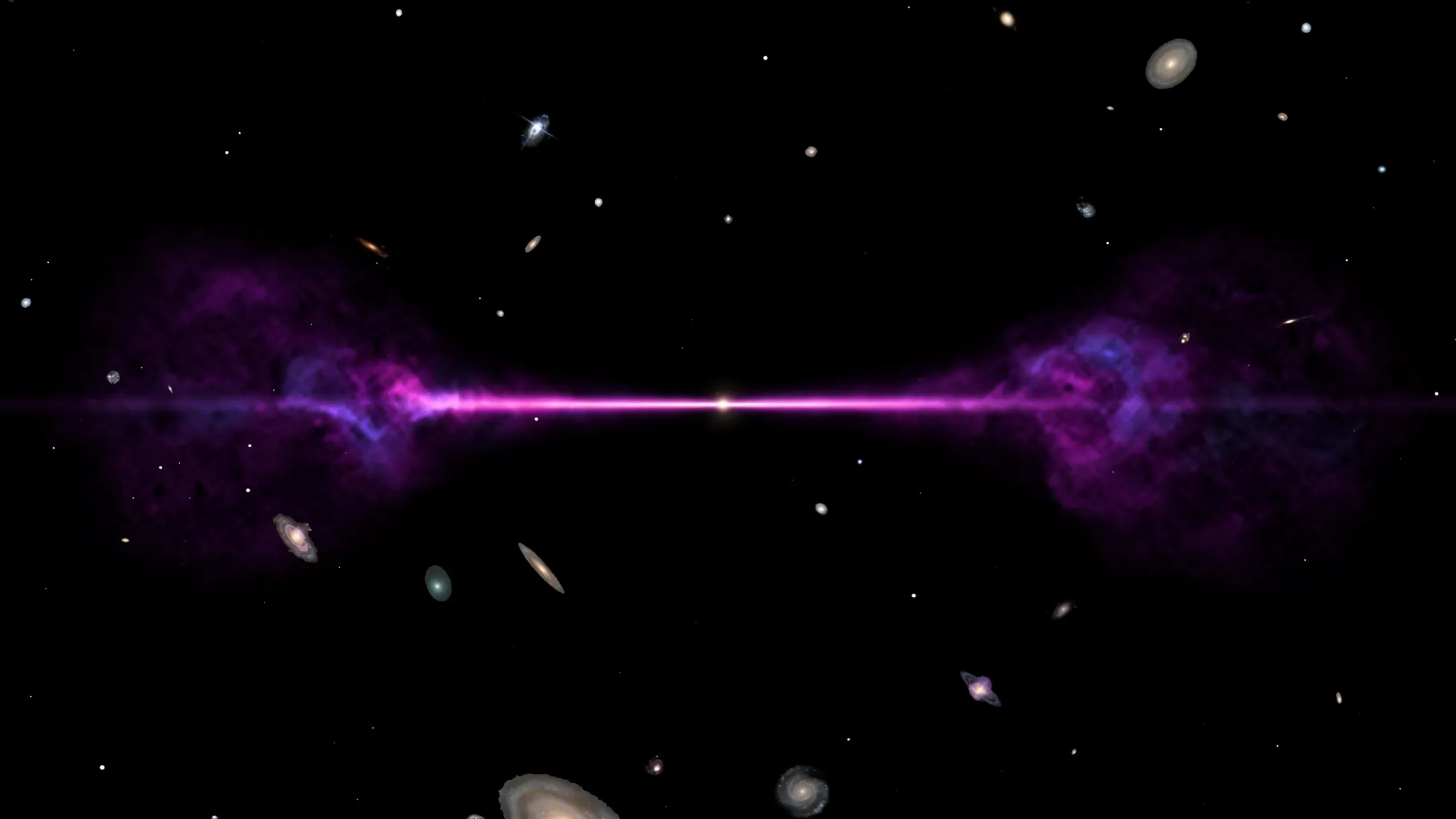
Some galaxies harbour a hyperactive heart: matter falling onto a supermassive black hole powers relativistic jets that shine brightly in radio waves. These radio galaxies are the most extreme form of this activity. Their jets can shape how their host galaxy forms stars, and in the distant universe they act as beacons pointing to massive galaxies and young clusters.
Rare and hidden
More and more evidence suggests that most of these active nuclei in the early universe are hidden behind dusty gas. Only the radio jet pierces through. They then look like radio galaxies rather than bright quasars. A 2024 study estimated that as many as 90% of them could be obscured beyond redshift 3.5.
Yet very few are known. A 2008 review listed 37 radio galaxies beyond redshift 3, and only two beyond 4.5; four more were confirmed since. Most were found with one radio criterion — an “ultra-steep” spectrum — that may miss many of them.
The hunting method
Barbara Balmaverde and colleagues, at the Italian National Institute for Astrophysics in Turin, used another approach: the Lyman break. A galaxy at redshift about 5 vanishes in some optical colours because hydrogen along the way absorbs its light. They cross-matched radio sources from the TGSS survey (Giant Metrewave Radio Telescope, 150 MHz) with the deep optical images of the Subaru telescope, then with precise positions from the VLA.
On 18 September 2025, they pointed ESO’s Very Large Telescope in Chile at one candidate, the radio source TXS 2354+015.

The source in five colours from the Subaru telescope: it vanishes in the two bluest bands, the signature of a galaxy near redshift 5. — Figure 1, Balmaverde et al. (2026), arXiv:2609.28632.
What they found
The spectrum shows a bright, very asymmetric line: hydrogen’s Lyman-alpha emission. A second, fainter line from nitrogen confirms it. The redshift is z = 4.946 ± 0.001. That makes TXS 2354+015 the second most distant radio galaxy known, after TN J0924-2201 at z = 5.19.
Its radio spectrum, measured from 74 MHz to 4.8 GHz, follows a single power law with no break. At a rest-frame frequency of 500 MHz, its power reaches 6.2 × 10²⁹ watts per hertz. The previous record holder, TN J0924-2201, reached 3.2 × 10²⁹. TXS 2354+015 is therefore, according to the authors, the most powerful radio galaxy currently known — about twice the former champion.
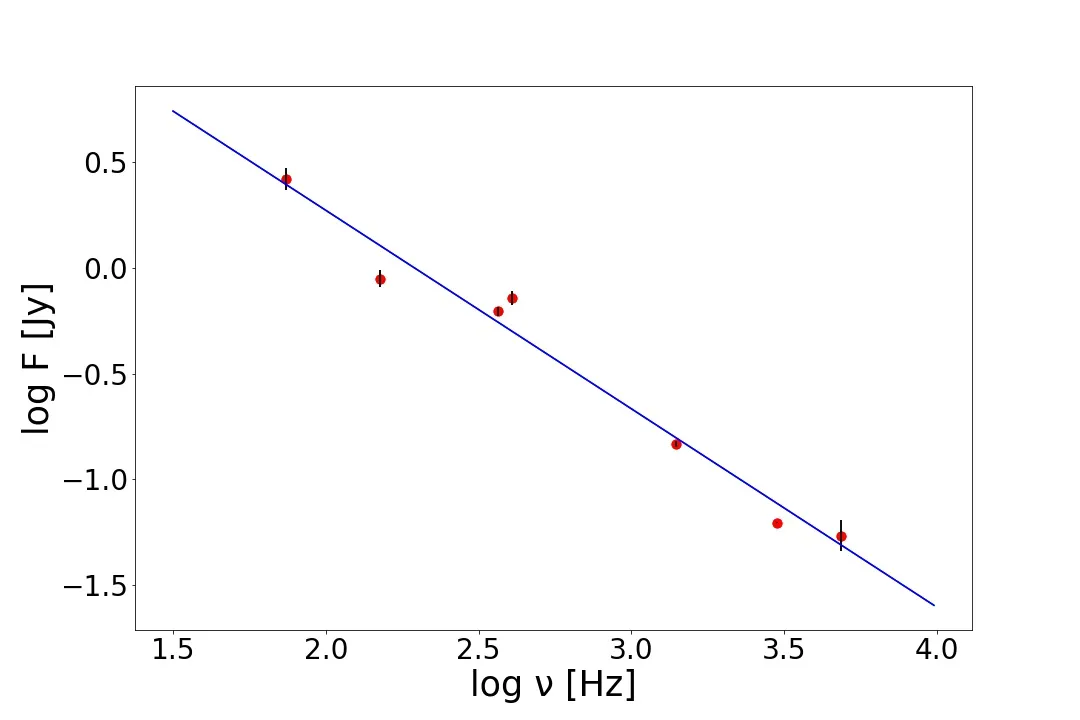
Radio spectrum of TXS 2354+015 from 74 MHz to 4.8 GHz: a single straight power law. — Figure 4, Balmaverde et al. (2026), arXiv:2609.28632.
The glowing hydrogen around it stretches over about 6 kiloparsecs, probably more, since the telescope slit was nearly perpendicular to the radio jets.
A lesson for the hunt
Its radio spectrum is not ultra-steep. Together with earlier finds, this shows that the classic radio criterion only reveals part of these galaxies. The Lyman-break method uncovers others.
Still uncertain
The mass of the host galaxy is only a rough estimate — around 2 × 10¹² solar masses, possibly ten times less — and the authors stress that better data are needed. And this is one object: building a proper sample of radio galaxies around redshift 5 is the next step.