Chưa có bản dịch: bản gốc tiếng Anh.
A CAPSULE THAT BURSTS LIKE A SEED POD
Tiny magnetic microrobots could one day navigate the digestive tract to deliver drugs, treat a lesion or take images. But they first have to get there in one piece — protected from acid, mucus and the churning of the stomach — and then be released quickly at the right spot. Today’s capsules either pack motors, springs and electronics, leaving little room for the cargo, or rely on “smart” materials that take minutes to hours to open.
Mengfan Zhang, Zike Chen, Rui Xiao, Guoyong Mao and colleagues at Zhejiang University, in Hangzhou, found their solution in a flowering plant.
The trick of a bursting pod
When the seed pod of Impatiens balsamina is ripe, a slight touch makes it burst: its valves curl inward in a flash and fling the seeds. In related species, seeds leave at about 1 to 4 metres per second. The principle is a latched spring: the curved valves store elastic energy, and the surrounding tissue acts as a latch. Release the latch, and the stored energy does all the work.
Three pieces
The capsule copies this design with three parts:
- a soft silicone dome, turned inside out during assembly — that is the spring;
- a 3D-printed plastic base, a cylinder 8 millimetres across and 5 millimetres high, with a small chamber for the robots;
- a ring of gel made of gelatin, carrageenan and iron oxide nanoparticles — that is the latch.
Under an alternating magnetic field, the nanoparticles heat the gel. It softens and tears from within, the dome snaps back into shape, and the capsule bursts open. Pure gelatin would melt between 30 and 36 °C, too close to body temperature; adding carrageenan keeps the gel firm at 37 °C, with a transition to liquid at 51.6 °C.
Getting the spring right
The hard part was mechanical. An inverted dome can be bistable — staying flipped once pushed — and then it would never reopen. It must be monostable, always springing back. But too stiff a dome would tear the gel before the trigger. Using computer simulations, the team mapped which shapes are bistable or monostable and found that the collar used to glue the dome pushes it toward bistability, so the dome has to be thicker than a textbook shell. Their final dome: 2.6 millimetres high and 1.5 millimetres thick over a 5-millimetre half-span. Released by tweezers, such a dome flies off at 1.21 metres per second and fully detaches within 100 milliseconds.
From a printed track to a pig’s stomach
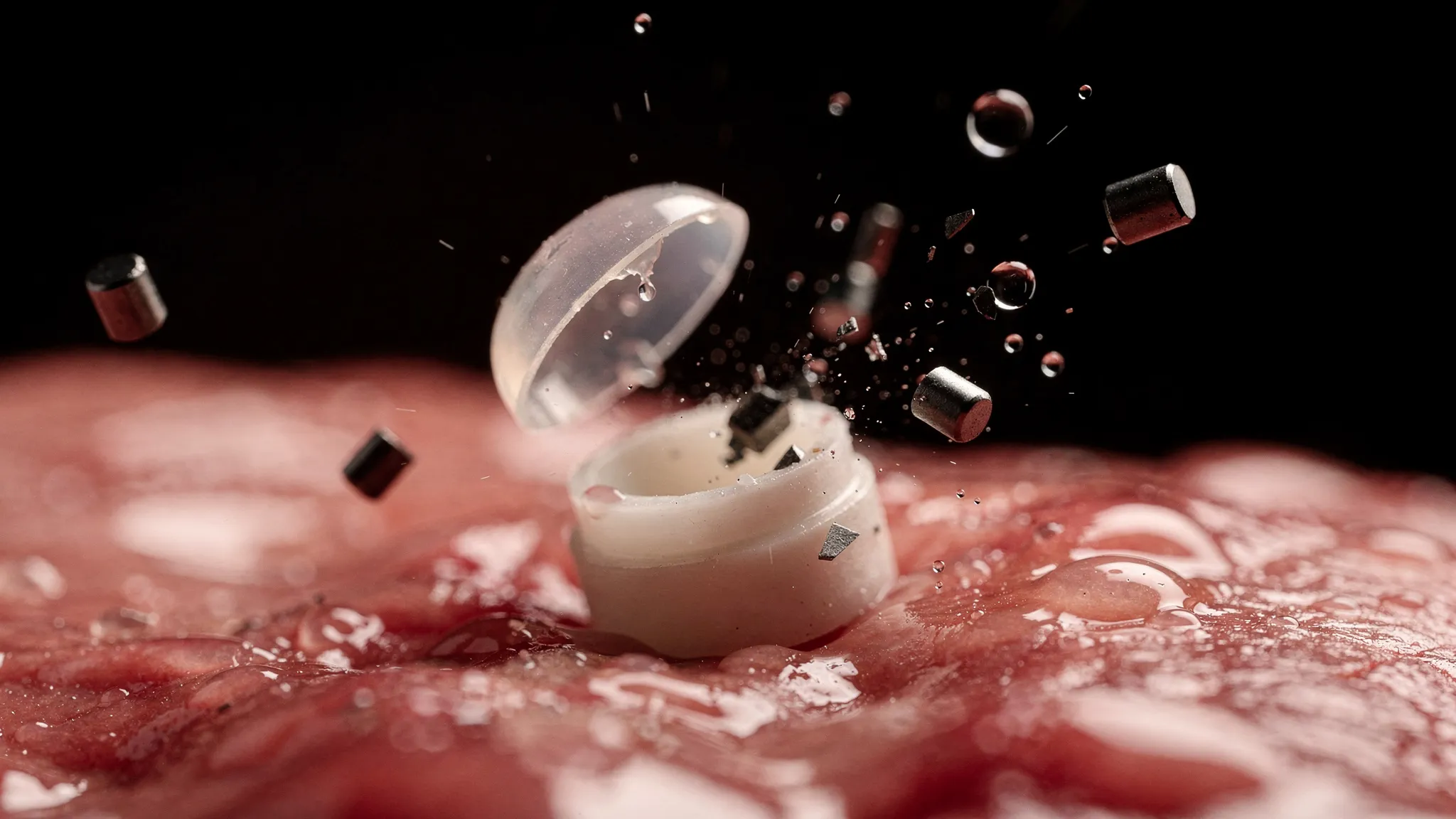
In the full test, a magnet slides the closed capsule along a 3D-printed track to its target in about 70 seconds. The alternating field then heats the gel from about 20 to 41 °C. The capsule opens less than 50 milliseconds after the gel softens, and the robots are thrown out at about 1.0 metre per second — the low end of the seeds’ range. A magnet then gathers them toward chosen spots. The “robots” here are small pieces of magnetic elastomer.
On a pig stomach outside the body, the capsule stayed shut while being steered over the tissue and opened on command. The soft, sticky tissue absorbed part of the energy: ejection speed fell to about 0.5 metre per second at first. The released robots could still be steered across the surface. Placed the other way up, the capsule opens gently without throwing anything, and the magnet pulls the robots out — a milder mode.
The authors list what remains: no test in a living animal, unknown behaviour of the gel in stomach acid and digestive fluids, and a stronger gel that would also melt at a higher temperature. Four of them — Mao, Zhang, Chen and Xiao — have filed a patent application on the capsule.