尚未翻译:以下为英文原文。
ONE SUPERNOVA, SEEN SEVERAL TIMES
A massive galaxy cluster bends the light of objects far behind it. This gravitational lens can show the same distant object several times — and since each image follows a path of different length, the images do not arrive together. If the background object is an exploding star, the delay between its images can be measured. Combined with a model of the cluster’s mass, that delay gives the Hubble constant, the expansion rate of the universe, independently of the usual ladder of distances.
Only a handful of such repeating supernovae are known, the farthest awaiting a predicted future image at redshift 1.95. A new one, reported by Seiji Fujimoto of the University of Toronto and 66 colleagues, nearly doubles that redshift.
A dot that was not there
The VENUS survey uses the James Webb Space Telescope to image lensing clusters repeatedly. On 3 July 2026, it observed the cluster RXC J0018.5+1626 in ten filters. A small, very red point source appeared that was absent from Webb images taken on 15 December 2024, and from earlier Hubble images. Something had exploded in between.
The team obtained extra Webb time from the director. On 17 August 2026, a second set of images and a deep spectrum followed.
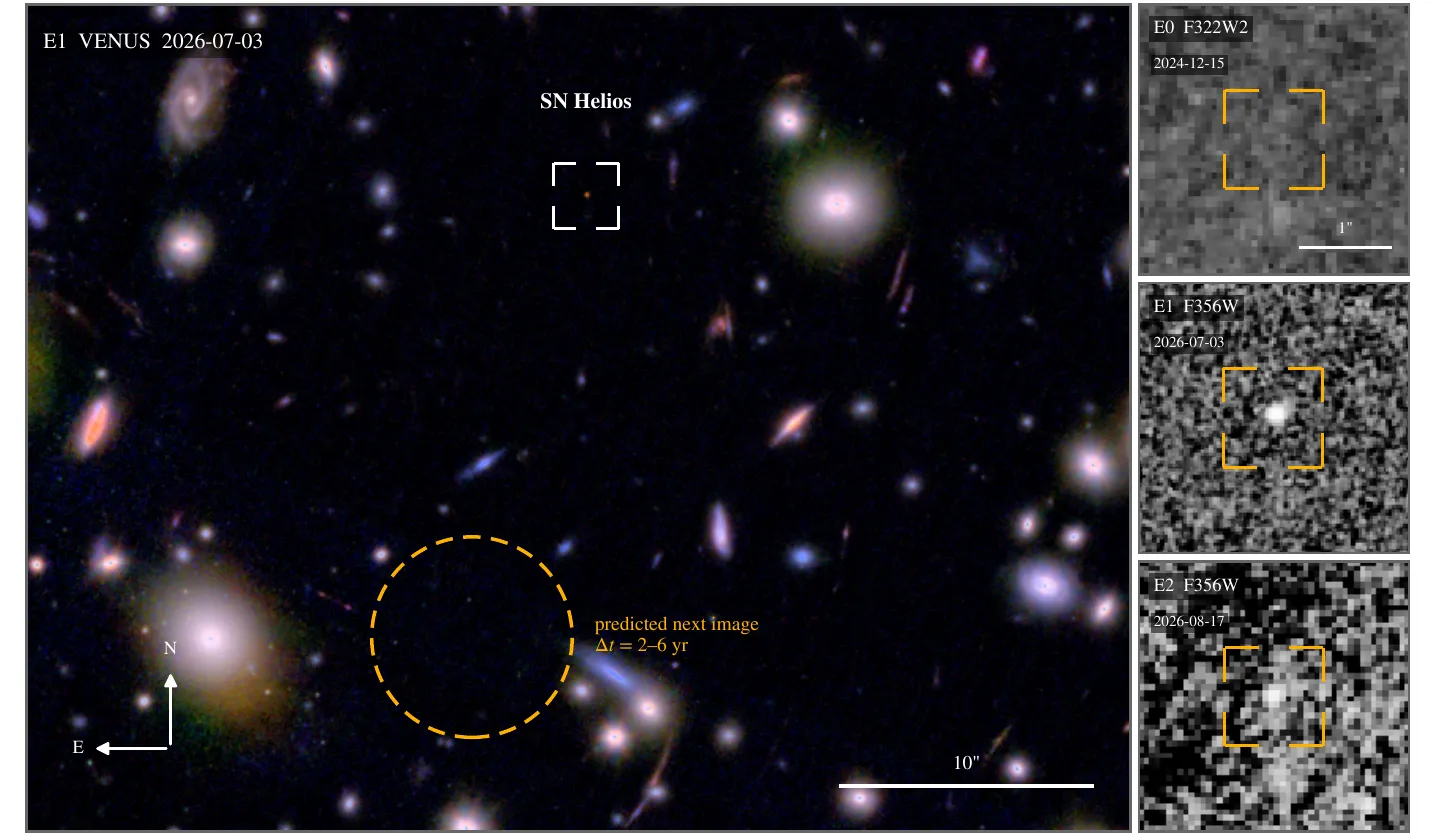
The cluster at discovery. Brackets mark SN Helios; the dashed circle shows where the next image is predicted, 2 to 6 years later. Right: nothing in December 2024, the supernova in July 2026, already fainter in August. — Figure 1, Fujimoto et al. (2026), arXiv:2609.30440.
The fingerprint of hydrogen
The spectrum shows a strong, broad hydrogen-alpha line, about 7,900 km/s wide, with a dip on its blue side — the classic “P-Cygni” profile of an expanding cloud. Hydrogen-beta and helium lines follow the same pattern. The verdict: a Type II supernova, the core collapse of a massive star that kept its hydrogen envelope, at redshift 3.34. Its outer layers are expanding at 7,000 to 9,000 km/s.
Comparisons with nearby supernovae place the spectrum 27.5 ± 2.8 days after peak brightness, in the star’s own time. The closest match is SN 2013ej, a fast-declining event.
A rendezvous in 2028–2032
Five independent models of the cluster’s mass agree that the supernova is multiply imaged. They put the observed image’s magnification between 5.3 and 25.1; the team adopts about 11. The next image should appear 2 to 6 years after discovery — between 2028 and 2032 — at nearly the same spot in all models. Some models even place an earlier image several decades in the past.
SN Helios is the first confirmed multiply imaged supernova beyond redshift 2 with a future image due on a measurable timescale. It exploded 1.4 billion years earlier in cosmic history than the previous record holders of that kind. Once the cluster models are pinned down by planned Keck spectroscopy, the authors hope for a Hubble-constant measurement as precise as the 2–4% reached with earlier lensed supernovae.
A host too faint to see
No galaxy is visible at the explosion site — not in deep infrared images, not in emission lines, not in millimetre light from ALMA. Corrected for magnification, the host must be fainter than an absolute ultraviolet magnitude of about −13, fainter than any known host of such a supernova. This supports the idea that tiny galaxies produce more of these explosions per star formed.
The impostor at redshift 16
The first colours told a very different story. A sharp drop below 2 microns, no host, and detections in all redder bands looked like the signature of a galaxy at redshift about 16 — and the team at first took it as a promising candidate. Three clues dismantled that within a day: a faint signal in the “dropout” band, a flat colour between two neighbouring filters, and above all the fact that the source had not existed in 2024.
To show how convincing the disguise was, the authors divided the fluxes by the magnification and fitted galaxy models: the answer was redshift 15.8, with more than 99.99% probability above redshift 10. The supernova’s real spectrum shows how a step in its light plus the hydrogen line mimic a very distant galaxy.
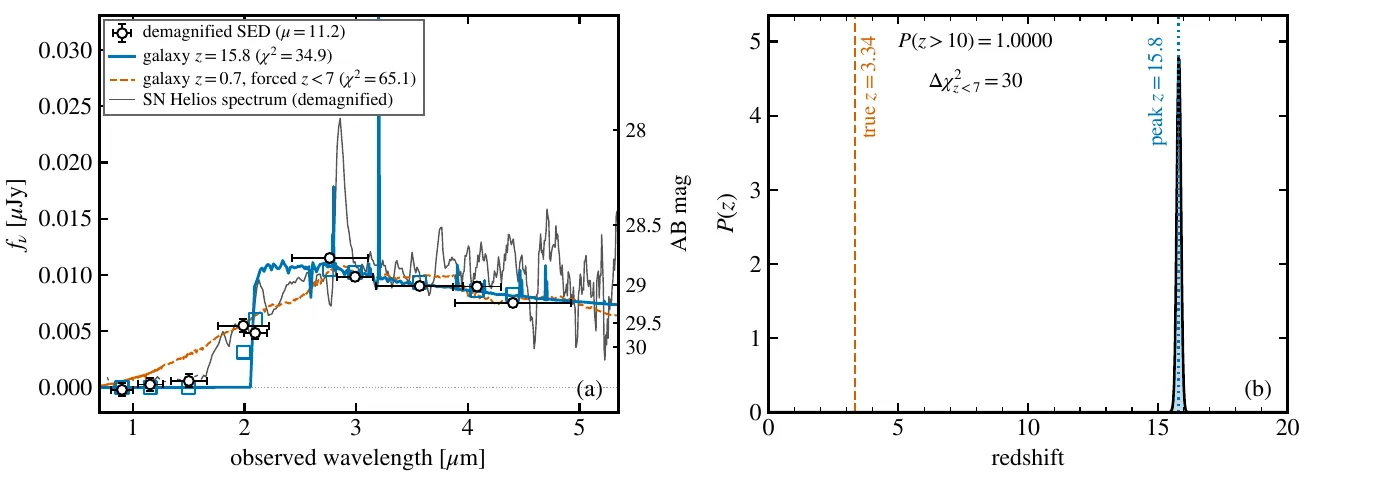
Without the lens and the follow-up, SN Helios would pass for a galaxy at redshift 15.8. — Figure 6, Fujimoto et al. (2026), arXiv:2609.30440.
A template for the hunters
Deep surveys reaching magnitudes 30–31 are exactly where such impostors are bright enough to detect and confidently misclassified. Finding one behind a single cluster suggests that wide unlensed searches face more of them. The team releases the spectrum as a template so that galaxy hunters can screen their candidates. A third Webb visit is scheduled for late 2026 to follow the light curve while the clock runs toward the supernova’s next appearance.