WHEN DOES AN OVERHAND SHUFFLE FORGET THE DECK?
Card shuffling is a concrete version of a basic question in probability: how long does a random process take to forget where it started? A freshly opened deck is in order. Each shuffle scrambles it a little more, until no trace of the original order can be detected.
Mathematicians distinguish two levels of answer. The mixing time gives the order of magnitude. A cutoff says much more: around one precise moment, the deck switches from “clearly not mixed” to “thoroughly mixed” almost at once. Run the shuffle a bit less than that and you can still tell; run it a bit longer and you cannot.
The shuffle, as a mathematician sees it
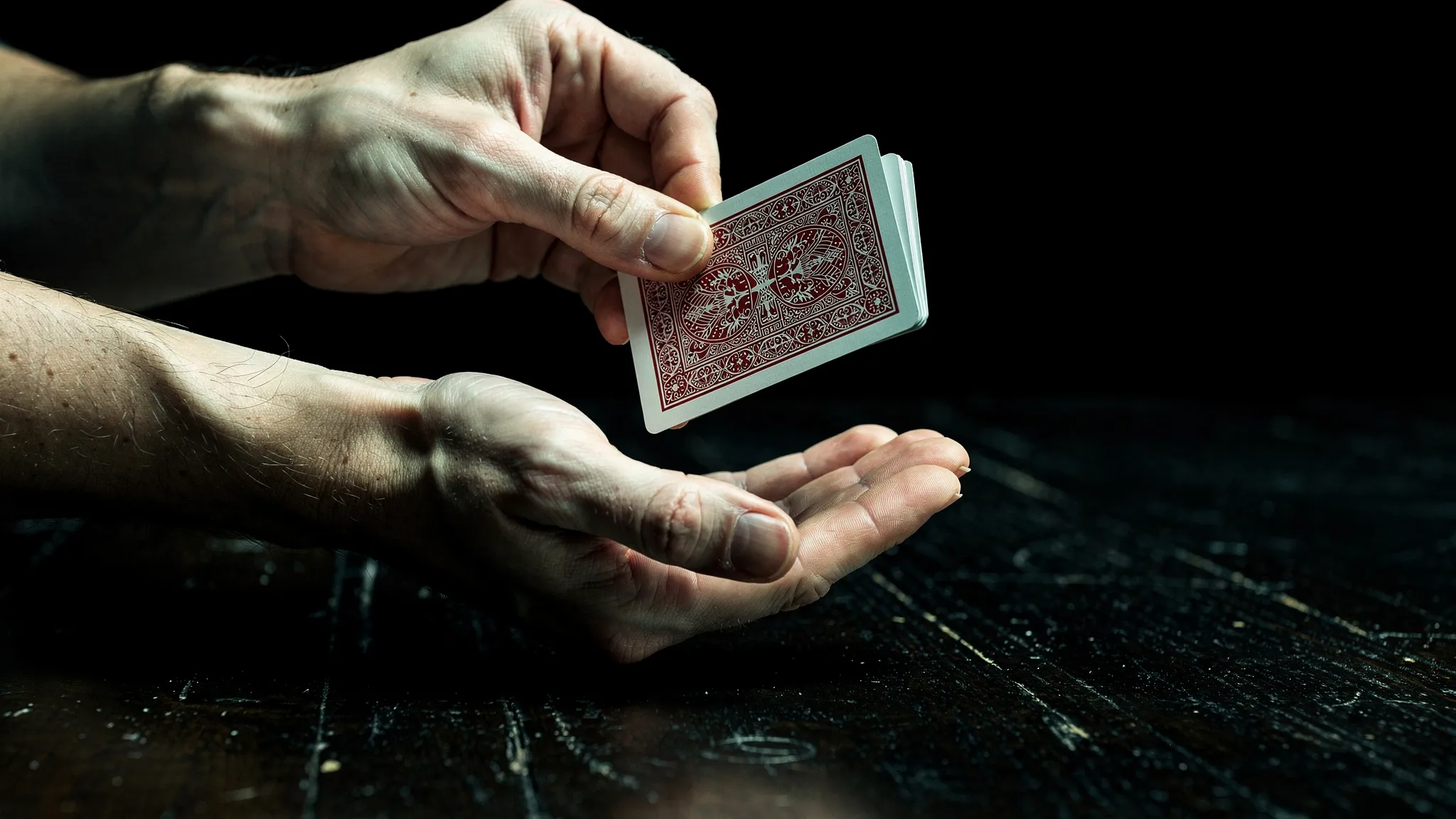
In the overhand shuffle, you hold the deck in one hand and drop small packets of cards into the other. The paper models it this way: every one of the n − 1 gaps between neighbouring cards is cut independently with probability p, and the order of the resulting packets is reversed. One full pass through the deck counts as one shuffle.
According to the paper, earlier work had already pinned down the order of magnitude. Pemantle bracketed the mixing time between n² and n² log n; Jonasson then showed that n² log n is the right order. But the exact constant, and whether a sharp cutoff occurs at all, remained open: Diaconis and Pal listed the overhand cutoff as an open problem in 2022.
The result
Yunjiang Jiang proves that the cutoff exists and locates it.
Theorem. For a fixed cut probability p, the overhand shuffle mixes, to first order, at
p² / (2(1 − p)π²) × n² log n
shuffles. Slightly before, the deck remains far from random; slightly after, it is close to random.
For p = 1/2 — a cut in half of the gaps on average — the formula becomes n² log n / (4π²).
How the proof works
The proof has three independent parts.
- The lower bound follows a single card. Its position evolves in a remarkably clean way: exact cosine-shaped patterns decay at a known rate, even for a finite deck. Summed over the whole deck, they keep a detectable trace of the starting order until the predicted moment.
- The upper bound compares two decks that differ only by the swap of two cards. Run with the same random cuts, the difference behaves like two marked positions wandering through the deck until they become neighbours and can merge. The rate at which that happens matches the lower bound.
- A static inequality about permutations, unrelated to shuffling, turns this comparison into a statement about the whole deck. It is the most technical part of the paper, built by recursion on tables that count how cards are spread across blocks.
The paper also proves a cutoff for another way of measuring disorder, the relative entropy, without pinning down its exact location.
What the formula says about a real deck
Plugging a 52-card deck into the formula with p = 1/2 gives 52² × ln 52 / (4π²), about 270 shuffles. This is our own arithmetic, not a figure from the paper, and it should be read as a rough indication: the theorem describes the behaviour of very large decks, and the correction term is not quantified. For comparison, the paper cites the scale of (3/2) log₂ n established by Bayer and Diaconis for the riffle shuffle — about 8.6 for 52 cards, with the same caveat. The gap between n² log n and log n is what makes the overhand shuffle so slow.
First order, idealised hands
The result is first-order: it does not give the width of the transition window or its exact shape. The cut probability is held fixed, and the cuts are assumed independent, an idealisation of real hands. In a footnote, the author states that the AI system GPT-6 Astra was “used in developing arguments, checking calculations, and preparing the exposition”, and that the author is responsible for the mathematical content. The paper is a preprint.