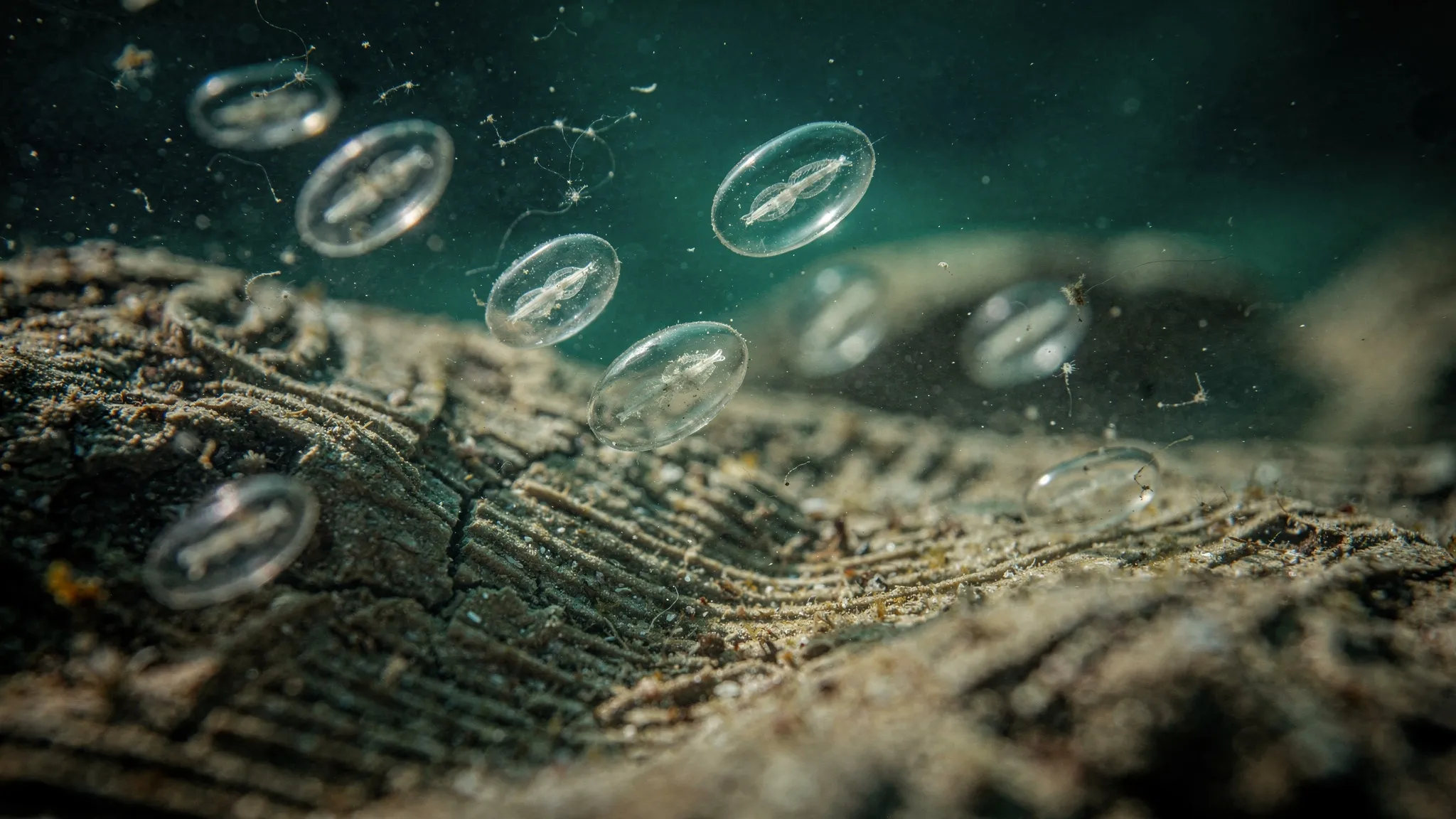
SPEED OR SHAPE: WHAT LANDS A CORAL LARVA
Many sea creatures that spend their adult life fixed to the bottom — corals, barnacles and others — begin as small swimming larvae, from a few hundred microns to a few millimetres long. Currents can carry them over kilometres for up to several weeks. Then comes the critical moment: they must settle on a surface.
Before choosing a good spot, a larva first has to physically reach the seabed. That happens on a scale of millimetres, where its swimming meets the local flow. Coral larvae swim at about 1 to 5 mm per second, barnacle larvae up to 2 cm per second — 10 to 1,000 times slower than typical currents over reefs. So larvae are often treated as passive particles. Close to the bottom, though, eddies slow the water down, and swimming may start to count. Shape may count too: elongated swimmers tend to line up with the flow.
Larvae in a virtual wave tank
Daniel Gysbers and Gabriel Juarez at the University of Illinois Urbana-Champaign, with Mark Levenstein at Université Paris-Saclay (CEA, CNRS), built a two-dimensional model. Water oscillates back and forth over a bottom lined with rectangular ridges 3 mm high, spaced from 0.75 to 90 mm apart, like waves over a reef, with a period of 5.5 seconds and a peak speed of about 60 mm per second.
Thousands of model larvae, each 1 mm long, are released into this flow. They swim straight ahead at 1, 2, 3 or 4 mm per second, in five shapes from round to elongated (length up to 4.4 times the width), and turn as the flow twists them. They have no behaviour of their own: no reaction to chemical cues or currents. A larva settles if it touches a surface while moving slower than 1.33 times its swimming speed.
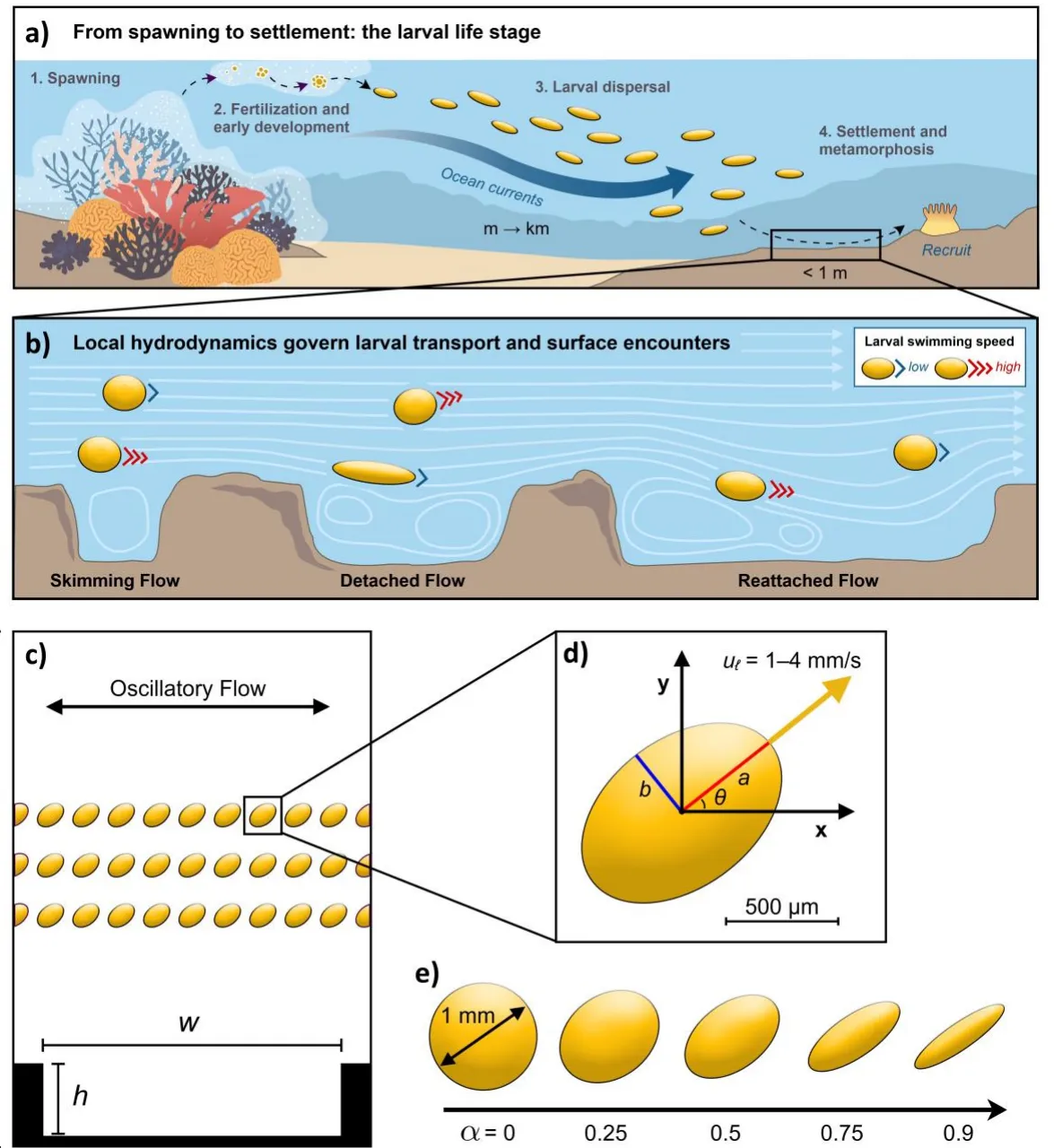
From spawning to settlement (a), the three flow regimes over ridges (b), and the simulation set-up with model larvae of increasing elongation (c–e). — Figure 1, Gysbers, Levenstein & Juarez (2026), arXiv:2610.03596.
Three kinds of flow, three filters
Settlement success ranges from 0.7% to 52.7% — up to tenfold — for the same flow over the same bottom, depending only on the larva. Which trait matters depends on the spacing of the ridges:
- Skimming flow (narrow gaps). A vortex fills each gap; the water above the ridges runs at up to 63 mm/s, while inside the gaps it never exceeds 1.2 mm/s. This fast layer is a barrier. Speed decides: on one such bottom, slow larvae settle at 0.7–1.2%, fast ones at 9.4–12.3%. Shape barely matters.
- Reattached flow (wide gaps). Water enters the gaps but stays fast — up to 27 mm/s, and 11 mm/s just 1 mm from the floor, more than five times the fastest larva. The middle of the gap behaves like an exposed flat floor; larvae land mostly in the sheltered corners. Here success peaks at 52.7%, and speed again dominates, with shape playing a smaller role.
- Detached flow (medium gaps). A vortex fills the gap but is ejected at each reversal of the flow, connecting the gap to the water above. Now shape wins. Elongated larvae align with the flow more often (17.5–23.1% of the time near the bottom, against 10.5–12.5% for round ones), follow the swirling streamlines into the gaps, and reach them more (net transport 27.5–35.7% against 15.5–23.3%).
In this last regime, speed creates a trade-off: slow larvae pile up in the gaps (61 to 81 larvae per millimetre, against 7 to 10), but fast ones settle there more than six times faster. The best compromise for elongated larvae is a medium speed, 2 mm per second. Speeds and shapes near this optimum have been reported for real coral larvae, including the Caribbean reef-building coral Colpophyllia natans.
Designing the seabed
The flow near the bottom acts as a passive filter on larval traits, deciding which ones can cross fast-water barriers, stay near the surface and reach sheltered nooks. The authors conclude that seabed shape, water motion and larval traits cannot be studied separately. One application: shaping restoration substrates to favour target species, such as fast-growing or pioneer corals — or, conversely, shaping surfaces to keep fouling organisms off.
The model is deliberately simple: flat two-dimensional ridges, larvae with no behaviour, a single wave condition, no survival after landing. Three-dimensional seabeds, turbulence and real larvae will be needed to see whether reaching the surface becomes a new coral on the reef.