Edition of October 6, 2026

  1. Physics

    A GIANT TANK OF WATER CATCHES NUCLEAR PLANTS 146 KM AWAY

    Inside a huge cylindrical underground detector filled with water, walls lined with rows of round light sensors, lit in deep blue.

    Every nuclear reactor sheds antineutrinos, near-massless particles that fly through almost anything. Catching one is rare. Catching those from plants about 200 km away is harder still.

    Super-Kamiokande is 50,000 tonnes of water, 1,000 m underground in Japan. Since 2020, 40 tonnes of a gadolinium salt have been dissolved in it. Each catch now gives a double flash, tens of microseconds apart.

    Late 2020, nearby reactors were almost all switched off. That quiet period gave the background noise. Then the signal rose and fell with reactor activity, month after month.

    Result: reactor antineutrinos seen at about 6 sigma, a first for this detector. Their oscillations match solar neutrinos measured in the same tank, within 1.9 sigma.

    Source: First observation of electron antineutrinos from nuclear reactors at Super-Kamiokande, https://arxiv.org/abs/2610.03143

    PreprintObservation3 min read
  2. Space & astronomy

    X-RAY JETS FROM A BLACK HOLE THAT FIRES COSMIC RAYS

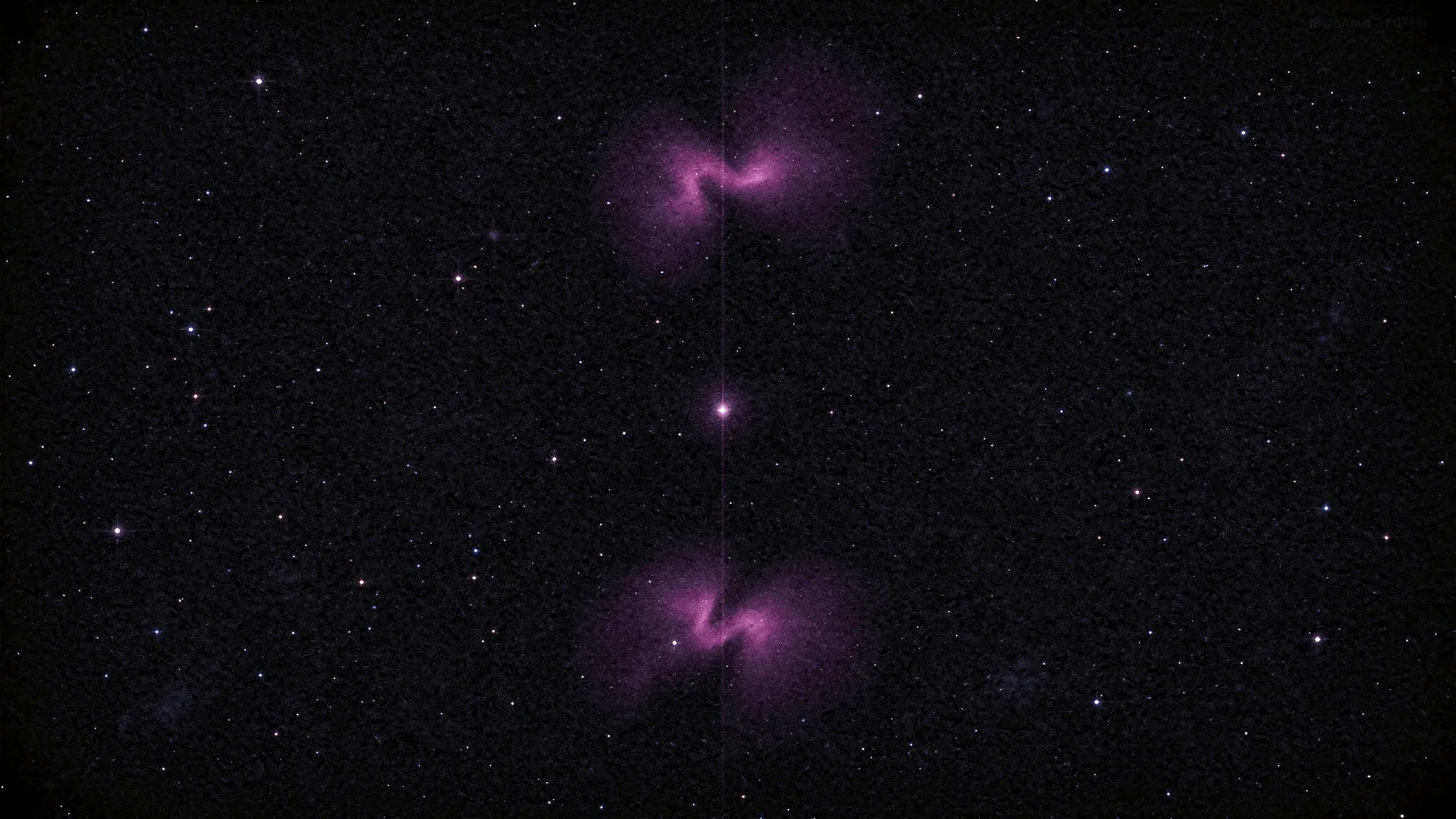
    False-colour X-ray image of a dark star field with two faint diffuse glowing knots placed symmetrically above and below a small bright point, in violet tones.

    In our Galaxy, a black hole of 6.4 suns orbits a companion star. This pair, V4641 Sagittarii, accelerates particles to staggering energies. Gamma rays up to 0.8 PeV come from around it.

    Its X-ray light had mostly been studied during outbursts, when the centre is blinding. In September 2025, the XMM-Newton telescope looked while it was quiet. The black hole was about 1,000 times fainter.

    Two diffuse knots appeared, north and south, about 20 parsecs from the pair. They line up with the radio jets and sit inside the gamma-ray glow.

    Their light comes from fast electrons spiralling in a weak magnetic field, 3 to 5 microgauss. The authors suspect many similar knots have simply been overlooked.

    Source: XMM-Newton Resolves Parsec-scale X-ray Jets in the PeVatron Microquasar V4641 Sgr, https://arxiv.org/abs/2610.02966

    PreprintObservation3 min read
  3. Space & astronomy

    TITAN'S WINDS SPEED UP A THIRD IN 27 DAYS

    An orange globe with broad swirling cloud bands and large oval storms, seen against black space and ringed by a violet glow.

    Titan, Saturn's largest moon, spins slowly: one turn every 15.9 days. Yet winds race around it far faster than the ground turns.

    Using the ALMA radio telescopes in Chile, a NASA-led team tracked a gas in Titan's sky at seven dates between 2016 and 2023. Its Doppler shift reveals how fast the air moves, 200 to 490 km up.

    Near the equator, winds reached 240 m/s. Between April and May 2023, they jumped from 120 to 159 m/s in only 27 days. Further south, they barely changed.

    Two leading computer models of Titan follow the slow seasonal trend. But they put the fastest winds at high latitudes, and equatorial winds up to twice too slow. Something is missing from the simulations.

    Source: Temporal Variability of Titan's Middle-Atmospheric Zonal Winds from Southern Fall to Late Winter (2016–2023), https://arxiv.org/abs/2610.03635

    PreprintObservation3 min read
  4. Space & astronomy

    THE MILKY WAY FLATTENED ITSELF IN TWO STAGES

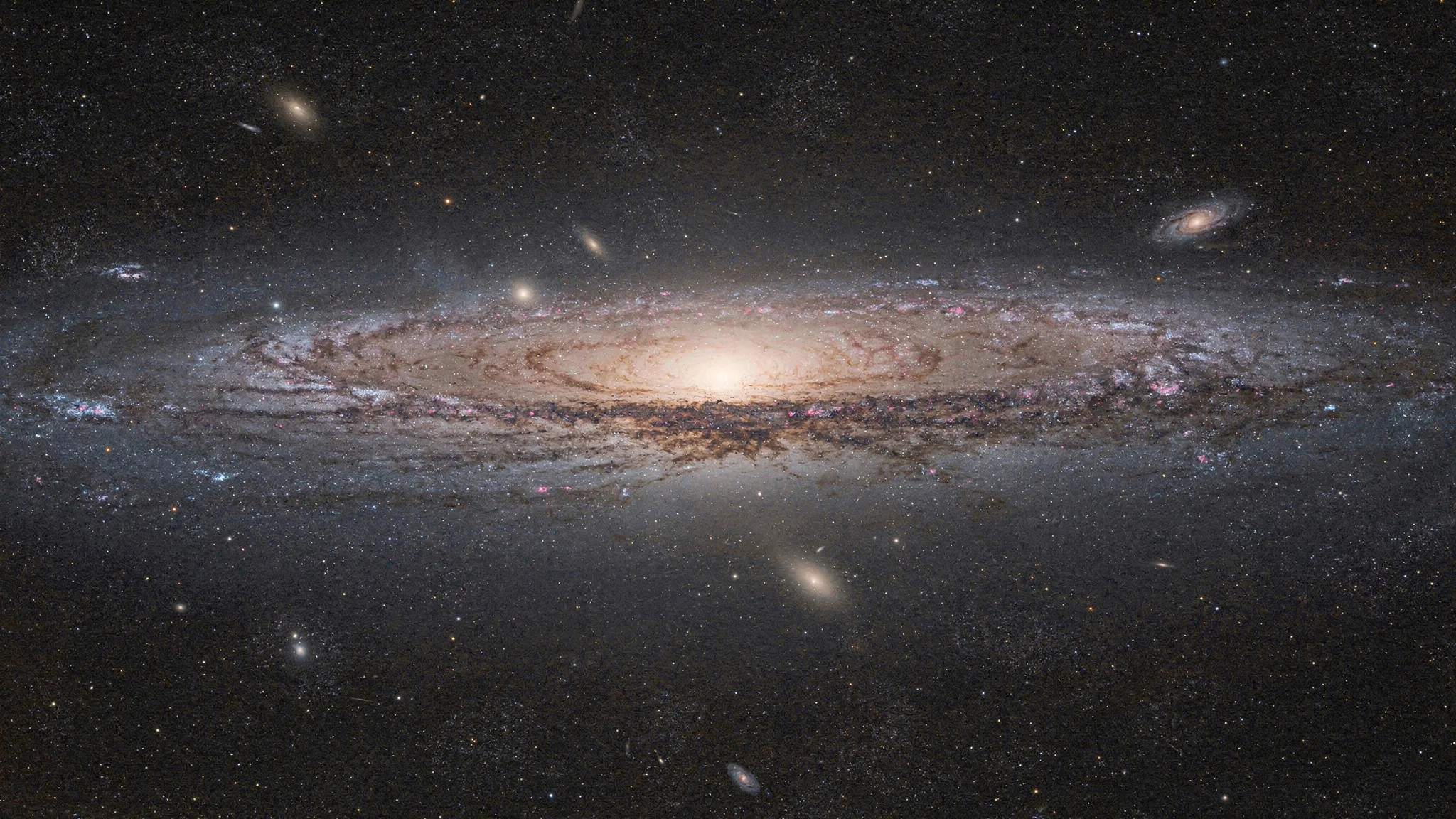
    A large spiral galaxy seen at a steep angle, its bright disk of stars crossed by dark dust lanes and wrapped in a fainter haze, small galaxies scattered around it.

    Seen edge-on, the Milky Way is a disk: a thin one of young stars inside a thicker one of old stars. Why the difference has long been debated.

    A Spanish-led team dated stars near the Sun with Gaia data. Their ages are precise to better than 5%. Stars of the same age and composition were grouped, and the thickness of each group measured.

    The oldest groups rise over 1.26 kiloparsecs above the plane. In just 2 billion years, that dropped to about 0.5. Then, 10.85 billion years ago, the thinning slowed sharply.

    The authors' reading: the young Galaxy was turbulent, and its stars were born already thick. After that wild phase, a calm era built the thin disk slowly.

    Source: A two-stage settling of the Milky Way disk revealed by precise ChronoGal ages, https://arxiv.org/abs/2610.03164

    PreprintData analysis3 min read
  5. Mathematics

    THE TRAVELLING SALESMAN'S HIDDEN NUMBER, CORNERED

    Hundreds of small pins standing in rows on a dark square board, one thin glowing cyan thread forming a single closed loop among them.

    A salesman must visit many towns and come home by the shortest route. Scatter the towns at random in a square. The best tour then grows like β times the square root of their number.

    Since 1959, mathematicians have known β exists. Its exact value is still unknown. Computer runs suggest about 0.7124, but that is no proof.

    Two researchers at the University of Texas at Austin now prove β lies between 0.6421 and 0.8810. The previous proven range was 0.6277 to 0.90367.

    Both bounds rest on huge computer-checked calculations, one an eleven-dimensional integral. The authors declare they used the AI tool GPT-5.6 Sol Pro to prepare the paper. They say they checked every result themselves.

    Source: New Bounds for the Euclidean TSP Constant, https://arxiv.org/abs/2610.02809

    PreprintTheory3 min read
  6. Earth & climate

    WHY TIBET'S THAWING SLOPES COLLAPSE IN CLUSTERS

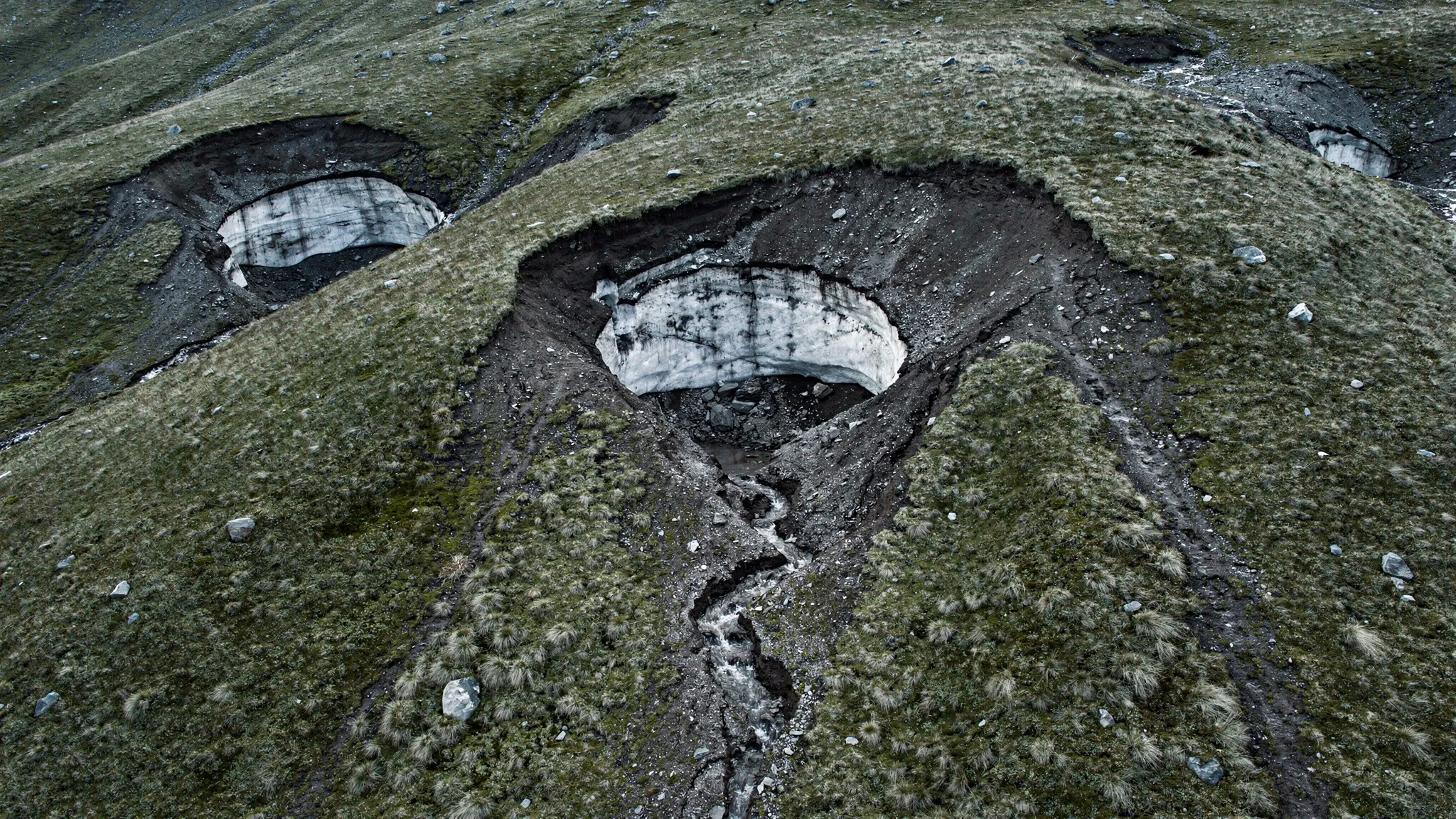
    Aerial view of a high grassy mountain slope with a fresh horseshoe-shaped scar of bare mud and exposed ice flowing downhill, under olive-green light.

    On the Tibetan Plateau, the frozen ground is warming everywhere. Where ice-rich soil thaws, whole slopes slump and flow downhill. These scars are called retrogressive thaw slumps.

    Yet they are oddly picky about where they form. Across the plateau, 90% of known slumps sit on just 1.2% of the land. Many slopes stay intact right beside collapsing ones.

    A team in Beijing mapped how weakened each hillslope is, combining 50 environmental variables. In five of seven regions, the weakest 10% of slopes held 3.35 to 5.09 times more slumps than average.

    Weak slopes also join into connected zones several kilometres wide, and the slumps gather there. Such maps could tell engineers where to watch roads and other infrastructure first.

    Source: Spatially Organized Hillslope Weakening Localizes Retrogressive Thaw Slumps across the Tibetan Plateau, https://arxiv.org/abs/2610.03046

    PreprintData analysis3 min read
  7. Life sciences

    SPEED OR SHAPE: WHAT LANDS A CORAL LARVA

    Close-up underwater view of tiny oval translucent larvae drifting above a rocky reef surface with small ridges and grooves, lit in jade green.

    Corals start life as tiny swimming larvae, a fraction of a millimetre to a few millimetres long. After drifting for days or weeks, they must land on the seabed. Near the bottom, it is a fight with the water.

    A team from Illinois and Paris-Saclay simulated larvae in wave-driven flow over ridged seabeds. They varied two traits: swimming speed, 1 to 4 mm per second, and shape, from round to elongated.

    Landing success ranged from 0.7% to 52.7%, up to tenfold apart. Over narrow ridges or wide gaps, fast swimmers won. Over medium gaps, elongated larvae did better, riding the vortices into shelter.

    So the seabed's shape filters which larvae can settle. That could help design reef restoration surfaces, or surfaces that keep fouling organisms away.

    Source: Flow regime determines whether larval settlement hydrodynamics are governed by swimming speed or shape, https://arxiv.org/abs/2610.03596

    PreprintSimulation3 min read
  8. Medicine & health

    EXERCISE AND DEMENTIA: PART OF THE PATH RUNS THROUGH DEPRESSION

    An older person walking briskly along a path in a park, a small activity tracker on the wrist, warm dark brick-red evening light.

    In the UK Biobank, 42,293 people aged 60 or more wore a wrist activity tracker for a week. They were then followed for dementia. On average they did 40 minutes a day of moderate-to-vigorous activity.

    A Florida team looked for the paths between activity and dementia. AI language models helped sort the variables, then an algorithm drew a map of likely causes.

    The clearest path: more activity, less depression, less dementia. Depression carried about 15% of the link, 19% in men and 12% in women. Paths through smoking, heart and kidney disease were less stable.

    This is observational data, so cause and effect are not proven. Depression might also make people move less. Still, the authors suggest pairing exercise with depression screening.

    Source: Causal discovery identifies pathways linking physical activity to dementia risk in the UK BioBank, https://arxiv.org/abs/2610.02221

    PreprintData analysis3 min read
  9. Computing & AI

    STILL FUNDED, NO LONGER COUNTED

    A printed grant summary page on a dark desk, several lines of text blacked out with thick marker strokes, under a deep amber desk lamp.

    The US National Institutes of Health count their spending with software that reads grant summaries. Each year, the totals by topic go to Congress.

    In March 2025, NIH guidance asked for "DEI language" to be removed from grants not supporting DEI activities. Among 5,461 flagged grants, 39.7% lost every screened word in a year, against 0.08% the year before.

    Projects whose summaries stopped naming a racial or ethnic group mostly lost the "minority health" label: only 15.7% kept it, against 99.4% of unchanged ones. Yet the funding continued.

    Awards naming sexual and gender minorities were recorded as terminated 37.8 points more often, after adjustment. The authors' term for what remains: "uncounted science", research still paid for but no longer recorded.

    Source: Still funded, no longer counted: how NIH's 2025 award reviews changed what the government counts as minority health research, https://arxiv.org/abs/2610.03443

    PreprintData analysis4 min read
  10. Physics

    THE LIGHT MILL'S PUSH, COMPUTED TO THE EDGE

    A thin polished metal disk suspended edge-on inside a glass vacuum chamber, a faint shimmer of warm gas along its sharp rim, cobalt blue light.

    The Crookes radiometer is a classic of physics: thin vanes in a rarefied gas. Heat one face of a vane and it moves, hot side trailing. Gas molecules bounce off the hot face faster.

    At Kyoto University, a team computed this push for the simplest vane: an infinitely thin disk, one side warmer. They solved the equation for the gas molecules themselves, across all levels of rarefaction.

    In very thin gas, the push spreads over the whole face. In denser gas, it shrinks and gathers at the rim. That rim strip is as wide as the distance a molecule travels between collisions.

    This matches an assumption Einstein made in 1924. In dense gas, a free disk at top speed is pushed only by its rim, while the rest of its face brakes it.

    Source: Radiometer effect on an infinitely thin circular disk, https://arxiv.org/abs/2610.02896

    PreprintSimulation4 min read
Legal notice