X-RAY JETS FROM A BLACK HOLE THAT FIRES COSMIC RAYS
Some of the most energetic particles in our Galaxy may come from microquasars: a black hole or neutron star feeding on a companion star and launching relativistic jets. Ground arrays such as Tibet ASγ, HAWC and LHAASO have detected gamma rays from several of them above 100 TeV. That makes microquasars a new class of PeVatrons — accelerators able to push particles to a peta-electronvolt, a million billion electronvolts.
The first one identified was SS 433 with its nebula W50. The second was V4641 Sagittarii.
A champion of gamma rays
V4641 Sgr is the most luminous microquasar in TeV gamma rays. Its gamma-ray glow, detected up to 0.8 PeV, spreads over about one degree of sky, with one of the “hardest” spectra among the Galaxy’s TeV sources. At its heart: a black hole of 6.4 solar masses and a companion star of 2.9 solar masses, about 6.2 kiloparsecs away. The system erupted strongly in 1999 and has flared roughly every two years since; radio jets were seen during the 1999 outburst.
Yet X-ray telescopes had mostly watched it during outbursts, when the central source outshines everything. The XRISM satellite had seen a hint of extended X-rays in 2024, but just after an outburst and over only part of the region.
Waiting for silence
Naomi Tsuji (University of Tokyo and RIKEN), Caterina Tresoldi (INAF–Brera Observatory) and about forty colleagues across Japan, Italy, the United States, China, Canada, France and elsewhere chose the opposite strategy. After checking with other instruments that the black hole was quiet, they pointed the XMM-Newton telescope at the whole gamma-ray region in September 2025: four pointings of 30 to 40 kiloseconds each. The central source was then about three orders of magnitude fainter than during the XRISM observation.
The field turned out to be crowded with point sources — active stars, white dwarfs, distant galaxies — which the team masked to look for diffuse light.
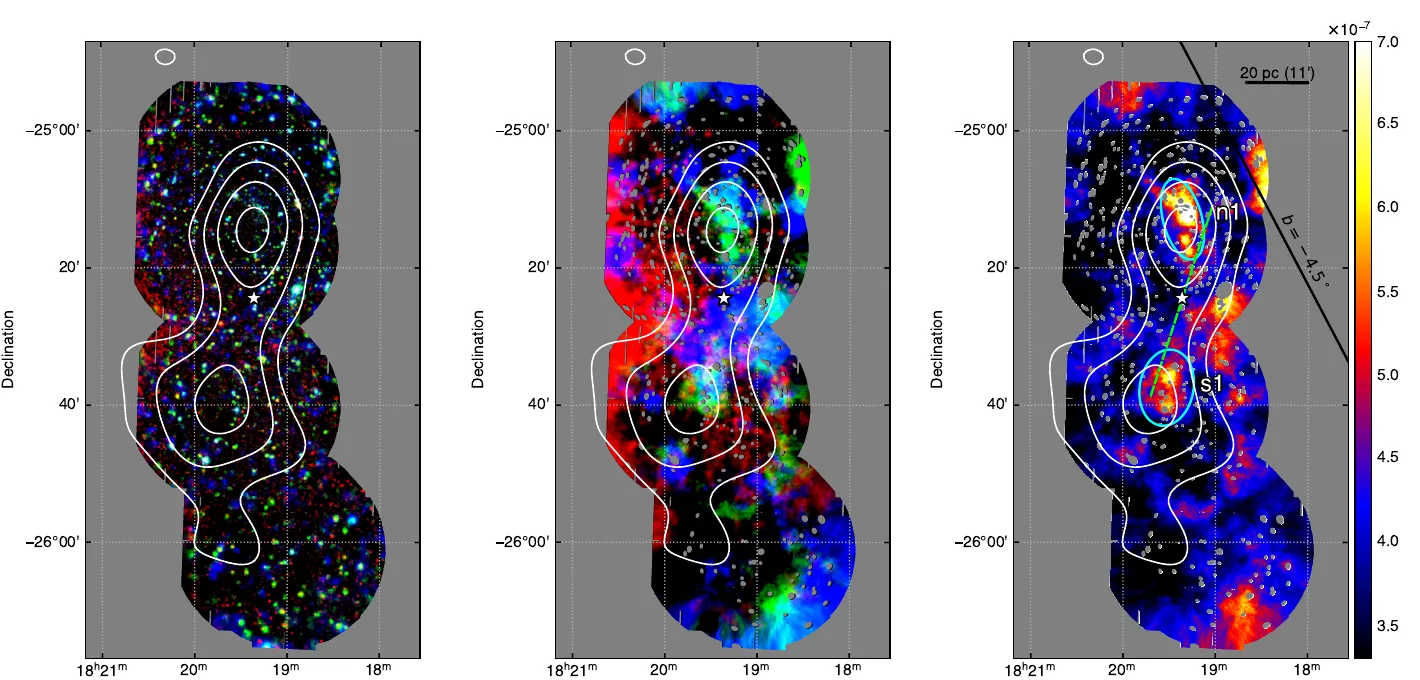
XMM-Newton maps of the V4641 Sgr region (star) with gamma-ray contours from H.E.S.S. in white; right, the two new extended X-ray sources n1 and s1. — Figure 1, Tsuji, Tresoldi et al. (2026), arXiv:2610.02966.
Two knots on the jet axis
In the 2–5 keV band, two extended patches stand out, named n1 (north) and s1 (south) after the known knots of SS 433. They lie about 23 and 25 parsecs from the binary, roughly aligned with the radio jet axis (within 16° and 10°), and inside the gamma-ray emission. Detection significance: 20 sigma for n1, 7 sigma for s1; n1 shows up in two separate observations.
It is the first detection of X-ray jet structures tens of parsecs long in this system. Such structures are known in only a handful of X-ray binaries.
Their spectrum is a smooth power law, without the emission lines of a hot gas; a thermal model fits much worse. The authors read it as synchrotron radiation: electrons with energies of several TeV spiralling in a magnetic field.
A weak field, locally boosted
Modelling X-rays and gamma rays together — the same electrons making both — gives a magnetic field of only 3 to 5 microgauss in the knots, and 1 to 2 microgauss or less elsewhere in the gamma-ray lobes. The field is weak, but locally amplified.
This is the key difference with SS 433, whose knots sit at similar distances: SS 433 shines about ten times more in X-rays than in gamma rays, V4641 Sgr about ten times less, because its field is weaker. The authors suggest a less powerful jet on average, or a thinner environment, since V4641 Sgr lies about 5 degrees below the Galactic plane.
Two readings remain open: the knots may be the acceleration sites themselves, where the jet is shocked, or downstream structures. To reach PeV energies in such a field over about 5 parsecs, the jet would need to move at at least a tenth of the speed of light. Particles produced by protons rather than electrons cannot be ruled out either.
Looking off-centre
The authors caution that unresolved point sources could still contribute, and that the diffuse look may partly come from limited resolution. Chandra and NuSTAR observations are scheduled. A companion paper with the Einstein Probe satellite reports consistent X-ray structures. Their advice to other astronomers is simple: point away from the bright centre, during quiet phases, and look for the knots.