A GIANT TANK OF WATER CATCHES NUCLEAR PLANTS 146 KM AWAY
Nuclear reactors are factories of electron antineutrinos. Inside the fuel, fission fragments undergo beta decay: a neutron in a nucleus turns into a proton, an electron and an antineutrino. Reactors were in fact the first source of neutrinos ever detected, in the 1956 Cowan–Reines experiment. Since then, they have helped measure how neutrinos oscillate — change type as they travel.
The Super-Kamiokande collaboration, some 250 physicists from Japan, the United States, Europe, Korea, China, Canada and elsewhere, now reports that its detector sees them too.
A tank built for bigger game
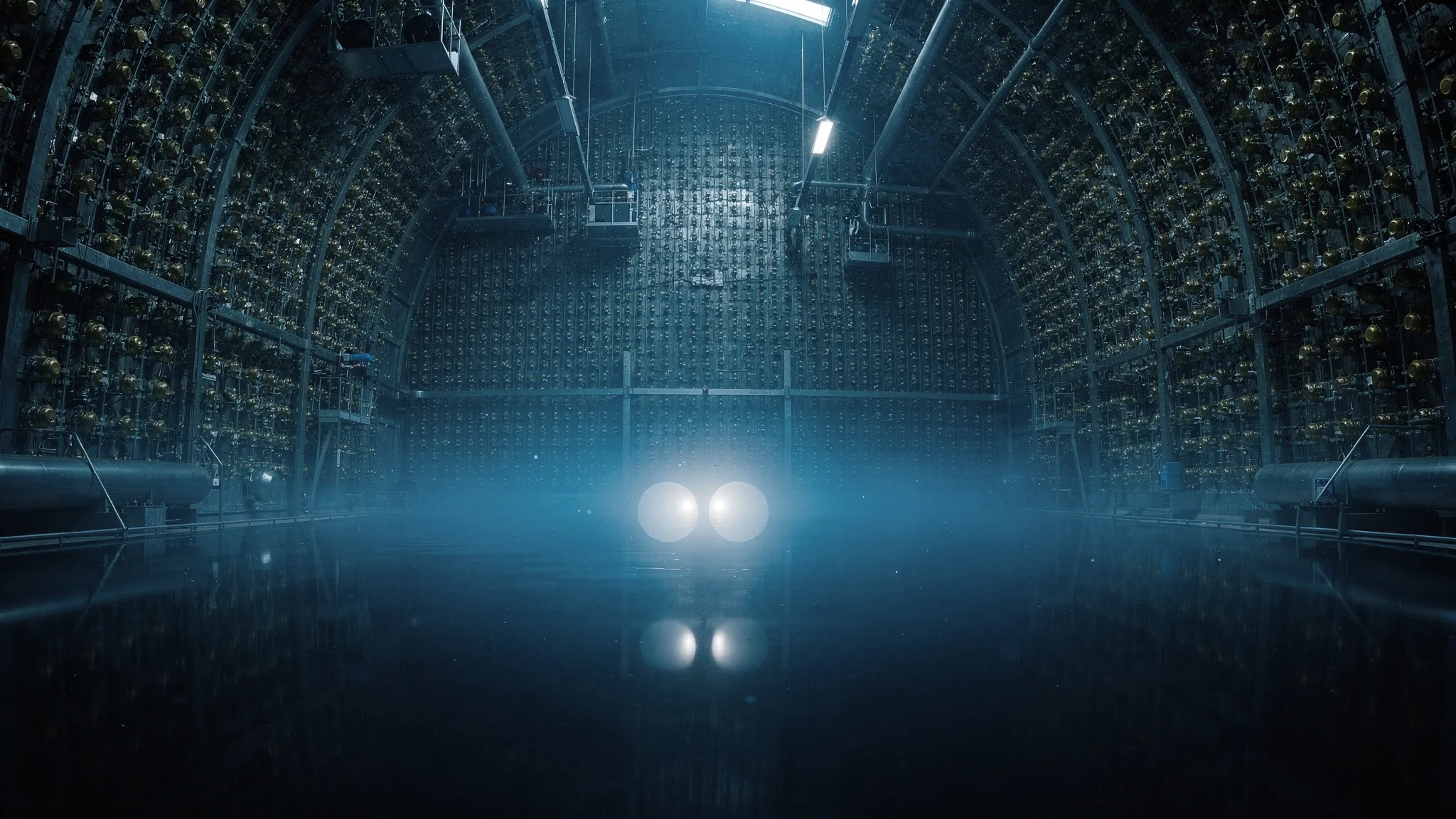
Super-Kamiokande is a 50-kilotonne water detector, 1,000 metres underground in the Kamioka mine in Japan. Its inner volume holds 32,000 tonnes of water watched by 11,129 light sensors, each 20 inches wide. A fast charged particle crossing the water emits a faint cone of light, the Cherenkov light, from which its position, direction and energy can be reconstructed.
Reactor antineutrinos, though, carry only a few million electronvolts. In this low-energy range, a lone flash is easily lost among natural radioactivity and debris from cosmic rays.
A pinch of gadolinium
The trick is a signature in two beats. When an antineutrino hits a proton in the water, it produces a positron, which flashes at once, and a neutron, which wanders, slows down and is finally captured by a nucleus. Captured by hydrogen, the neutron releases a single 2.2 MeV gamma ray, hard to see. Captured by gadolinium, it releases a cascade of gamma rays totalling about 8 MeV, easy to see.
So in July 2020, 13 tonnes of gadolinium sulfate were dissolved in the water (0.011% by mass); in June 2022, 27 tonnes more were added (0.033%). About half the neutrons, then about three quarters, are now captured by gadolinium, within roughly 120 then 60 microseconds. A fast software trigger catches electrons down to about 2.5 MeV with near-100% efficiency.
Listening to Wakasa Bay
Several power plants lie about 200 km from the detector, mostly in Japan, with a small contribution from Korea. The closest active ones are at Wakasa Bay: Mihama 3 (146 km), Ohi 3 and 4 (179 km) and Takahama 1 to 4 (191 km). Between 2020 and 2023, many of them were running or restarting. The expected flux was computed month by month from each reactor’s reported load, using the International Atomic Energy Agency’s reactor database.
Background comes from geoneutrinos — antineutrinos from the Earth’s own radioactivity — from chance coincidences, and from radioactive debris left by cosmic muons. To measure it, the team used a lucky window: in November and December 2020, the main Wakasa Bay reactors were off or shutting down. Data from those two months are almost pure background.
The analysis covers 411.52 days of live time, from February 2021 to September 2023. A machine-learning classifier and cuts on timing (under 80 microseconds) and distance (under 2 metres) between the two flashes pick out the candidate pairs.
A signal that follows the reactors
The monthly event rate tracks the reactors’ activity and matches the prediction that includes oscillations. A world without reactor antineutrinos is rejected with a significance of about 6 sigma: the first observation of reactor antineutrinos in Super-Kamiokande. The paper does not give the total number of events selected.
From the energy spectrum, the team extracts two oscillation parameters: sin²θ₁₂ = 0.500 ± 0.155 and Δm²₂₁ = (9.08 +0.55/−0.54) × 10⁻⁵ eV².
Neutrinos and antineutrinos, side by side
Super-Kamiokande also measures neutrinos from the Sun, which are matter, not antimatter. Comparing the two is a test of a basic symmetry of physics, called CPT. The values differ by about 1.1 sigma for the angle and 2.2 sigma for the mass difference; overall, the two data sets are compatible at the 1.9 sigma level — no statistically significant sign of a difference. Combined, they give sin²θ₁₂ = 0.332 (+0.028/−0.026) and Δm²₂₁ = (8.94 +0.46/−0.47) × 10⁻⁵ eV².
The preprint, submitted to Physical Review Letters, contains one inconsistency: the compatibility test is given as Δχ² = 7.25 in the main text and 7.64 in the appendix, both quoted as 1.9 sigma. The authors conclude that water loaded with gadolinium turns a giant Cherenkov tank into a working detector for antineutrinos of a few million electronvolts, with potential for future measurements in that energy range.