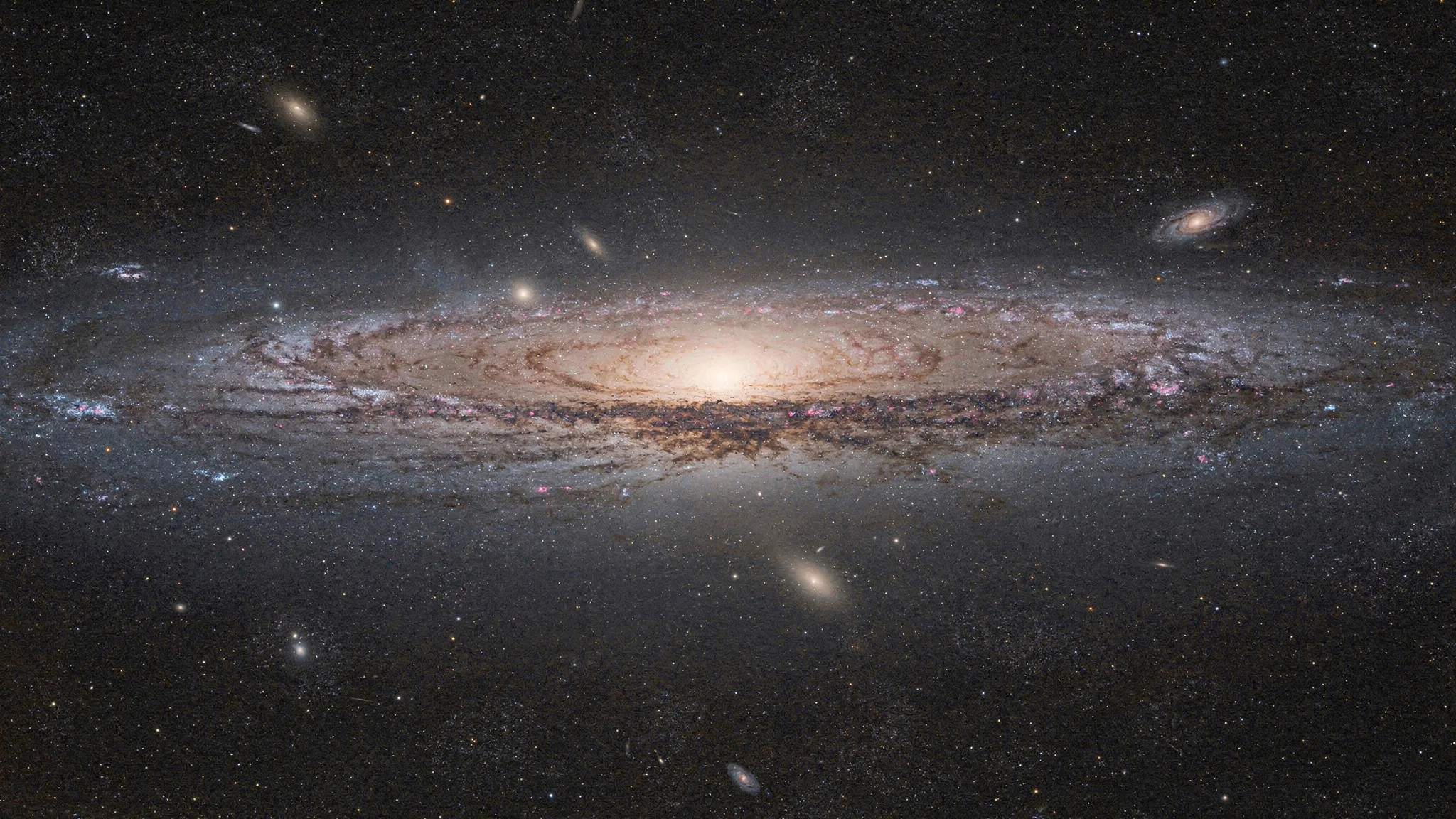
THE MILKY WAY FLATTENED ITSELF IN TWO STAGES
Our Galaxy’s disk is usually described as two disks in one: a thin disk, dynamically “cold” and younger, and a thick disk, “hotter” and older. Stars keep a memory of where and how they formed, which makes them fossils of the Galaxy’s assembly — the subject of Galactic archaeology.
Older stars are known to spread higher above the plane. But why? Two explanations compete:
- Slow heating: stars are born in a thin, cold layer of gas, and over billions of years giant molecular clouds, spiral arms and the central bar kick their orbits, making them wander higher.
- Upside-down formation: the young Galaxy’s gas disk was itself thick and turbulent, stirred by heavy accretion, mergers and intense feedback; old stars were simply born thick, and the gas then cooled and settled.
Telling them apart needs precise ages for complete samples of stars — especially for the earliest times, when things happened fast.
Dating stars by the crowd
David Mirabal, Carme Gallart and colleagues at the Instituto de Astrofísica de Canarias, with partners in Granada, Teramo and Victoria (Canada), work on the ChronoGal project. Rather than dating stars one by one, they fit the whole colour–magnitude diagram of stars near the Sun, measured by the European Gaia satellite (data release 3), with combinations of synthetic stellar populations. The result is a map of how many stars formed at each age and metallicity, with ages precise to better than 5% — about half a billion years for the oldest stars.
They studied stars within 1 kiloparsec of the Galactic plane, split into a kinematically “cold” sample and a “hot” one, sliced into eight layers in height, and corrected for stars missed by the selection. A clustering algorithm then grouped stars into populations of nearly a single age and metallicity. For each, the team measured the scale height — how far above the plane the population typically extends.
A sharp change of pace
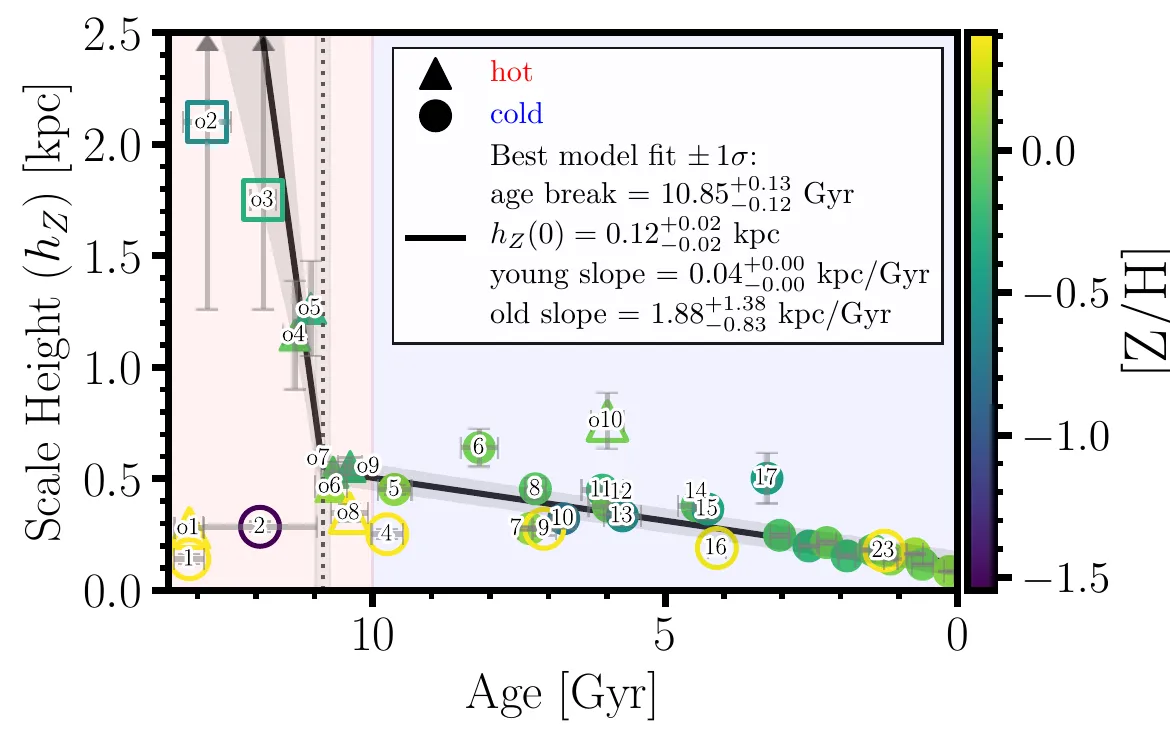
Thickness of stellar populations against their age: a steep drop for the oldest, a slow decline after the break at 10.85 billion years. Colours show metallicity. — Figure 2, Mirabal et al. (2026), arXiv:2610.03164.
The younger a population, the closer it hugs the plane. But the relation is not a single line. A fit with two straight segments finds a break 10.85 billion years ago (give or take about 0.13 billion years):
- Before: thickness dropped by about 1.88 kiloparsecs per billion years. The oldest populations extend over 1.26 kiloparsecs — the two very oldest even more, roughly 1.75 and 2.10 — and within only about 2 billion years the thickness fell to about 0.5 kiloparsec.
- After: the thinning slowed to just 0.038 kiloparsec per billion years. The youngest populations sit at about 0.1 kiloparsec, and stars born today would extend to about 0.12.
The uncertainty on the early rate is large, but the two regimes are clearly distinct. Even populations just slightly older than the break, about 11 billion years old, are thicker than the thick disk as a whole (about 0.9 kiloparsec). The break survives a test with a simple uniform grid of ages and metallicities instead of the automatically defined groups.
Born thick
For the authors, slow heating alone cannot explain such a rapid early settling: frequent mergers would have kept the young disk hot until the last major merger, which the authors call GSE, about 10 billion years ago. Instead, the data support upside-down formation in the early phase. The turbulent gas cooled and sank towards the midplane over a few billion years, forming the thick disk; the chemically defined thick disk was in place by about 11 billion years ago.
Then, roughly after that merger, the Galaxy entered a quieter era, in which the gas settled gradually and built the thin disk we see today. For this later period, the data alone cannot tell slow heating from slow settling. The picture matches cosmological simulations of Milky Way–like galaxies, and a recent dating of the Galaxy’s “spin-up” into a rotating disk.
In the authors’ words, the great height of the oldest stars is “not merely the result of prolonged secular dynamical heating, but a structural fossil of the early Galaxy’s assembly phase.”