
EXERCISE AND DEMENTIA: PART OF THE PATH RUNS THROUGH DEPRESSION
Dementia affects more than 57 million people worldwide, with nearly 10 million new cases each year, according to figures cited in the paper. With no treatment that changes the course of the disease, prevention through modifiable risk factors is a priority — and physical activity is one of the most consistent protective factors found so far. In one analysis of activity-tracker data cited by the authors, even low levels of moderate-to-vigorous activity were associated with nearly half the risk of dementia compared with complete inactivity.
But how does moving protect the brain? Directly, through blood flow, inflammation or brain plasticity? Or indirectly, through mood, mobility, sleep, social life or the heart? Classic statistics test pathways chosen in advance. Wasif Khan, Panayiotis Benos, Joshua Wong and Ruogu Fang at the University of Florida tried to let the data draw the map.
A week on the wrist
The study uses the UK Biobank, a large British cohort. Between 2013 and 2015, more than 100,000 participants wore a wrist accelerometer for seven days. The team kept 42,293 adults aged 60 or older, with an average age of 67; 53.3% were women. They did on average 40.2 minutes a day of moderate-to-vigorous activity — 48.0 for men, 33.3 for women. People diagnosed with dementia within a year of wearing the device were excluded, to limit “reverse causation”, where early dementia itself reduces activity. Afterwards, 647 developed dementia (1.5%).
Language models as sorters
The UK Biobank data dictionary is vast. To choose which ones to study, the team built a pipeline of large language models: a first model screened all variables by their descriptions; four GPT models (gpt-4o-mini, gpt-4.1, gpt-oss-120b and gpt-5) scored their relevance; “reviewer agents” with expert roles — epidemiology, causal inference, neuroscience, physical activity — rescored them; and the researchers then checked the top 100 by hand. Known dementia risk factors such as hearing loss and head injury were added, giving 39 variables.
An algorithm called PC then estimated a causal graph — a network of likely cause-and-effect arrows — with constraints such as “age causes, but is not caused” and “dementia is the end point”, and resampling to test how stable each arrow was. Finally, chain mediation analysis measured how much of the activity–dementia link flowed through each path.
The depression route
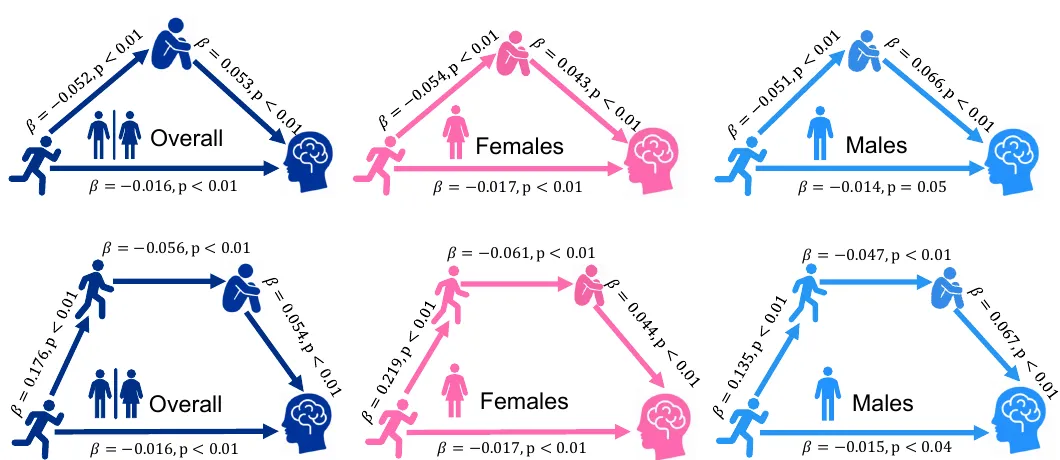
Chain mediation: activity → depression → dementia (top) and activity → walking pace → depression → dementia (bottom), for everyone, women and men. — Figure 2, Khan et al. (2026), arXiv:2610.02221.
The most stable route was more activity → less depression → less dementia. Depression accounted for 15.06% of the total association — 19.31% in men and 12.27% in women. Adding walking pace in the chain (activity → faster walking → less depression → less dementia) explained only about 3%.
When the team excluded dementia cases appearing within 2, 4 or 5 years instead of one, the share carried by depression rose to 23.8%, and in men up to 60.8%, while the direct link weakened. The authors warn that this share is a relative measure, which grows mechanically when the direct link shrinks, and should be read with caution. Longer windows also revealed routes through high blood pressure, heart disease, head injury and kidney disease, but these were not stable when the data were resampled.
The networks differed by sex: in women, activity connected mostly to metabolic and functional factors — blood fats, waist size, walking pace; in men, to behavioural and cardiovascular cascades involving smoking, fine-particle pollution, heart and kidney disease, arthritis and hearing loss.
What can and cannot be concluded
The authors list the limits themselves. The data are observational: a “causal graph” does not prove causation, hidden factors may remain, and depression and inactivity may feed each other in both directions. A week of tracking may not reflect lifelong habits. The language-model step and the manual curation may affect reproducibility, and the UK Biobank is not representative of every population. The authors declare no competing interests; the models were used as tools in the method.
Within those limits, they argue for prevention that combines encouraging activity with screening and treating depression in mid to late life, alongside managing heart and metabolic risk.