THE LIGHT MILL'S PUSH, COMPUTED TO THE EDGE
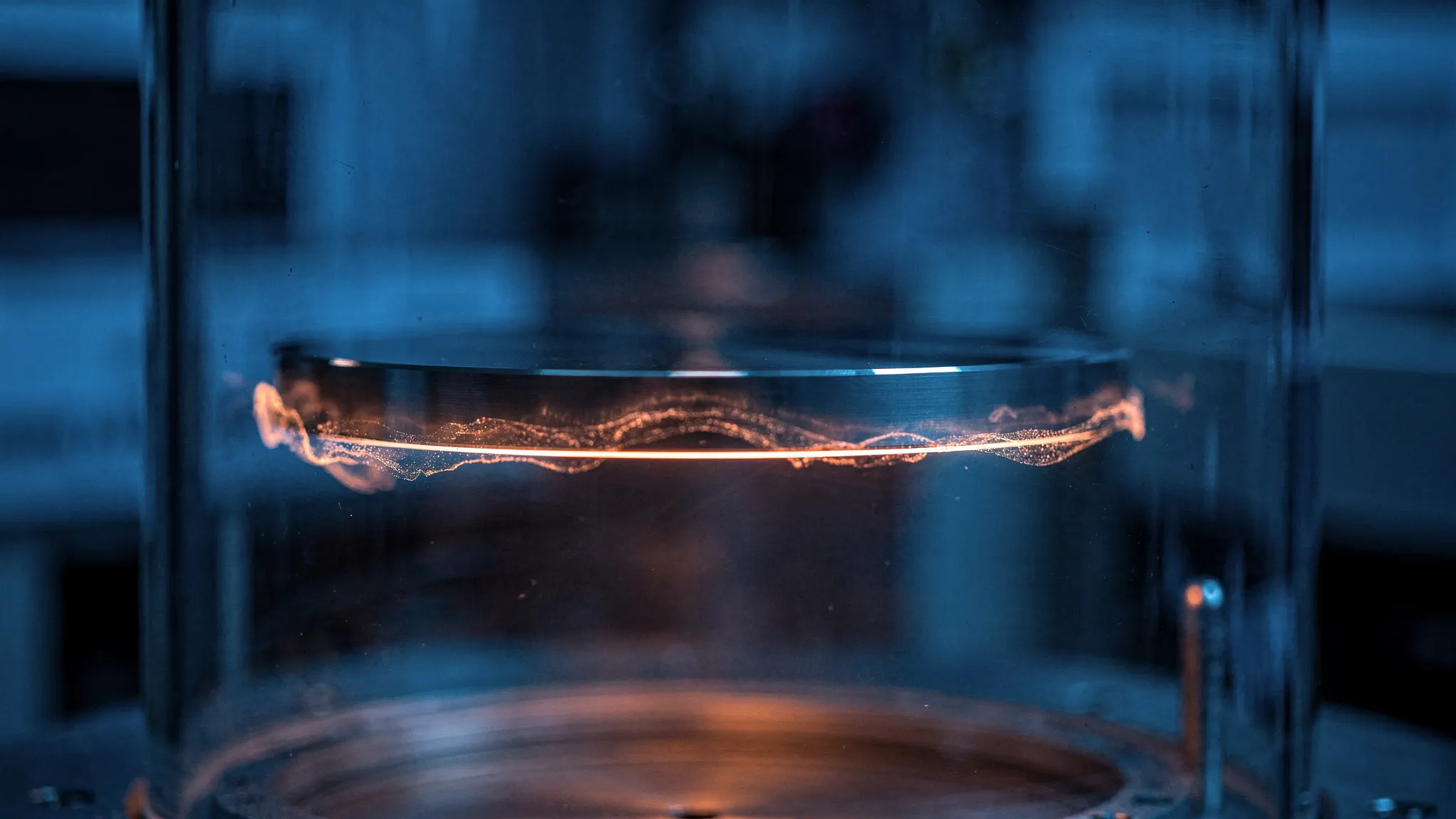
The Crookes radiometer, described by Crookes in 1874, is the classic example of what physicists call the radiometer effect. A thin vane whose two faces are at different temperatures, placed in a rarefied gas, feels a force and moves with its hotter side trailing. The explanation given by the authors: the hot face sends gas molecules back faster, on average, than the cold face does, so the gas pushes back harder on the hot side.
The effect is enjoying renewed interest for tiny fluid devices, for aerosols and for flight in the very thin air of the upper atmosphere. Its behaviour depends strongly on how rarefied the gas is, measured by the Knudsen number: the ratio between the mean free path — the average distance a molecule travels between collisions — and the size of the vane. In very thin gas the force is spread over the whole surface; in denser gas it concentrates near the edge.
The simplest vane
Takuma Tomita, Satoshi Taguchi and Tetsuro Tsuji, at Kyoto University’s Graduate School of Informatics, set out to describe this force across the whole range of rarefaction, with special attention to the edge. Their model vane is the simplest one that keeps an edge: an infinitely thin circular disk, free to move along its axis in an infinite gas, one face slightly warmer than the other.
They do not treat the gas as a fluid but as a population of molecules, using a simplified version of Boltzmann’s equation (the BGK model), linearised for small temperature differences and slow motion. The hard part is the sharp edge: it creates abrupt jumps in the distribution of molecular velocities, which spread into the gas and are especially tricky in three dimensions. The team uses a numerical method that follows molecules along straight paths and handles these jumps explicitly, run on Kyoto University’s supercomputer.
Thanks to linearity, the problem splits in pieces: the radiometric force on a disk with one hot face, and the drag on a moving disk. The disk’s terminal velocity is reached when the two balance.
What the calculation shows
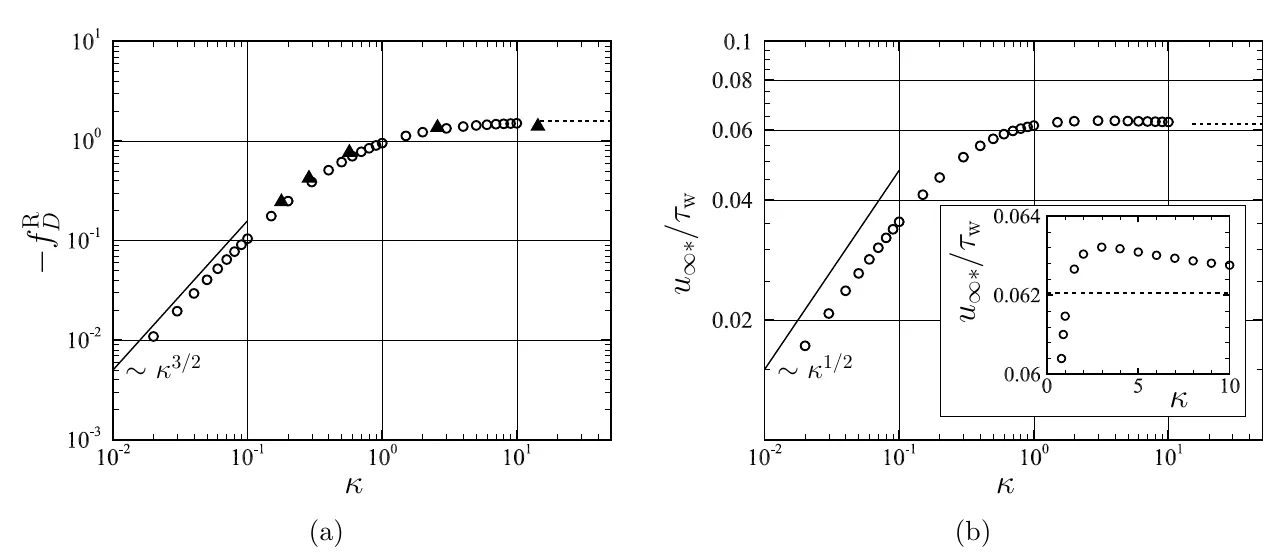
(a) Radiometric force against rarefaction (circles), with measurements on argon by Selden et al. (triangles); (b) terminal velocity of the disk, with a slight maximum (inset). — Figure 3, Tomita, Taguchi & Tsuji (2026), arXiv:2610.02896.
- In dimensionless form, the force grows steadily with rarefaction. In denser gas it scales as Kn^(3/2); in very thin gas it levels off at a constant value, −π/2.
- This explains why experiments, which usually vary the pressure, find the actual force largest at an intermediate pressure. Values deduced from measurements on argon by Selden and colleagues are plotted alongside the computations.
- The terminal velocity does not rise steadily: it peaks at an intermediate rarefaction, slightly above its value in the thinnest gas. Thinning the gas further does not always make the disk faster.
- Around the disk, the gas is warmer and less dense near the hot face, with a temperature jump between that face and the adjacent gas, a flow along the hot surface, and a strong flow concentrated in a narrow zone around the rim.
A rim that does the work
The most striking result concerns the pressure difference between the two faces. For a disk held still, the whole face pushes, more and more at the rim as the gas gets denser. For a disk moving freely at its terminal velocity in dense gas, the picture splits: a narrow band at the edge pushes the disk forward, while the rest of the face brakes it, and the two balance.
The width of that edge band grows in proportion to the mean free path, so in dense gas it is of the order of one molecular stride. The authors note that this is consistent with the assumption made by Einstein in a 1924 paper on radiometer forces, which recent estimates still use.
Checked another way
To test their numbers, the authors used a symmetry of Boltzmann’s equation linked to Onsager’s reciprocal relations: the radiometric force must equal a heat flow computed in a different problem, a moving disk at uniform temperature. The two agree to at least three significant figures for every case — which also supports this symmetry in the presence of sharp edges.
The model leaves out the thickness of real vanes and uses a simplified collision law. The authors see their tables as reference data for kinetic problems with sharp edges and for aerosol particles of non-spherical shape, and plan the full Boltzmann equation and disks of finite thickness next.