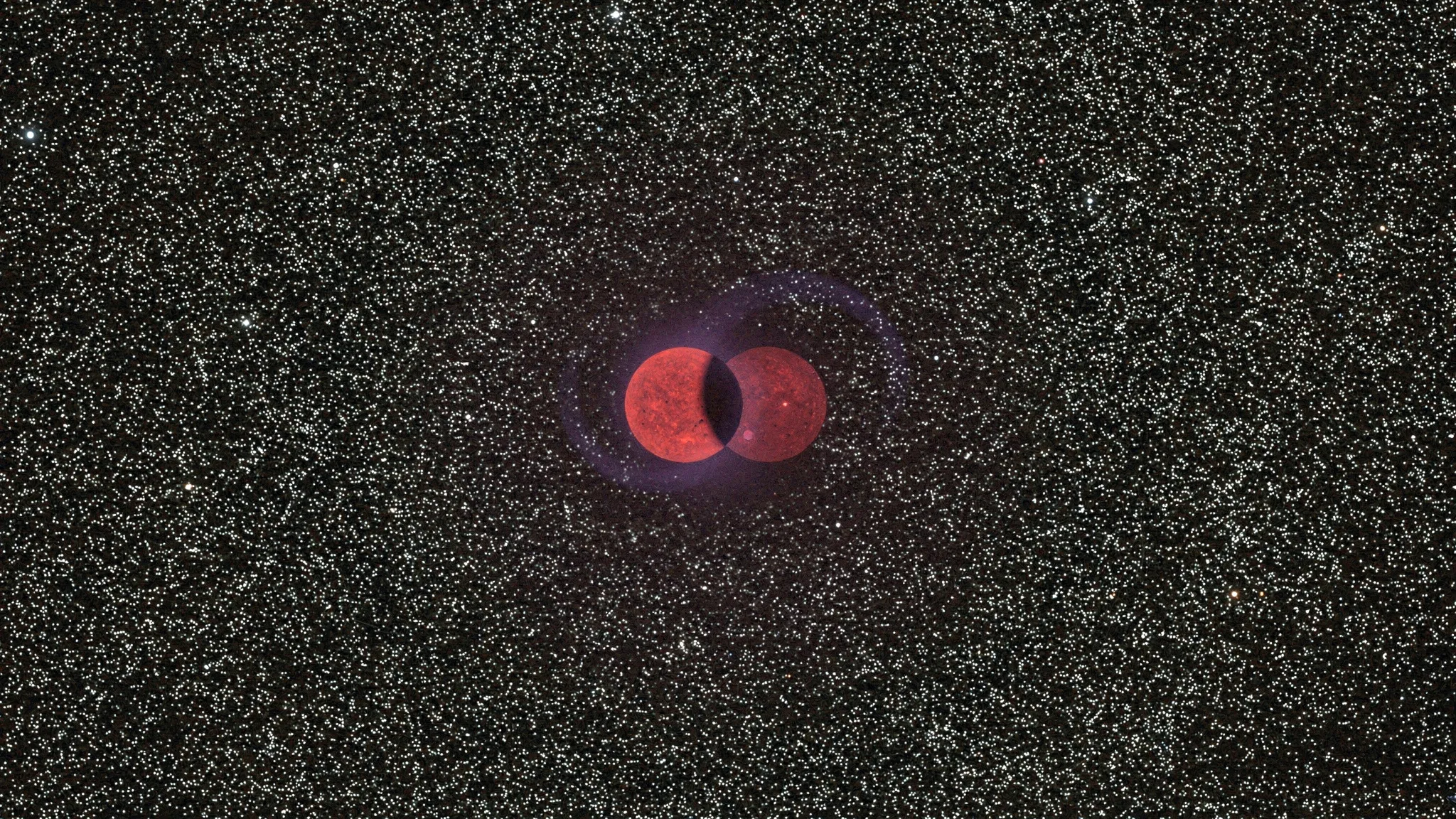
SMALL STARS DENY A JUMP IN GRAVITY
The universe is expanding, and its current rate of expansion is measured by a number called the Hubble constant. The trouble is that two families of measurements give different answers. Measurements based on nearby stars and supernovae — the “distance ladder” — disagree with the value inferred from the cosmic microwave background, the oldest light in the universe, at a level of about 5 sigma depending on the data. The microwave background gives the lower value. This is the Hubble tension, one of the most pressing problems in cosmology.
Some explanations blame hidden errors. Others call for new physics. One of the boldest proposals is the “G-step” model: Newton’s gravitational constant, G, which sets the strength of gravity, would have changed abruptly in the recent cosmic past.
A sudden change, 73 to 130 million years ago
The idea is that supernovae, which serve as cosmic yardsticks, shine with a brightness that depends on G. If G was different before a certain date, distant supernovae (seen as they were before the change) and nearby ones (after it) would not be the same yardstick, and the expansion rate would be misjudged. Two versions are tested here:
- the original model: gravity 11 percent stronger before a jump 130 million years ago;
- an extended model: 4 percent stronger before a jump 73 million years ago.
Stars with a long memory
Jeremy Sakstein, of the University of Hawai’i, and Harry Desmond, of the University of Portsmouth, found an unexpected witness: red dwarfs, the smallest stars, under about a third of the Sun’s mass. These stars are churned from core to surface and react to any disturbance with great sluggishness. The time it takes them to settle back after a change in their size is around 100 million years — similar to the time elapsed since the supposed jump.
The consequence, worked out with pen and paper and then with a stellar-evolution code: a red dwarf that lived under stronger gravity, then saw G drop to today’s value, swells quickly, then shrinks back only slowly. Today, it would still be slightly too big for its mass.
Eight stars on the scale
To check, the two physicists used eight red dwarfs in eclipsing binaries — pairs of stars that pass in front of each other as seen from Earth, which gives some of the most precise masses and radii known for any star. They selected stars of 0.1 to 0.31 solar masses, in pairs far enough apart to limit tidal effects.
One complication: starspots also inflate a star. The authors let the spot coverage of each star vary freely, from none to total, so that spots could absorb any swelling if possible.
No trace of a jump
For both dates, the best fit is gravity that never changed. The two proposed jumps are excluded:
- 4 percent, 73 million years ago: excluded at about 3.1 sigma;
- 11 percent, 130 million years ago: excluded at about 4.0 sigma.
Starspots cannot rescue the model: for these jumps, four of the eight stars already need zero spots, and a star cannot have fewer than none.
A heavy witness
The authors tested how fragile the result is. If the stellar models systematically overestimated radii by 1 percent, the exclusion would weaken but remain. They also point out that one star, J2343+29, carries much of the weight: without it, the exclusions fall to 2.45 and 1.90 sigma — still with no preference for any change in gravity.
The study does not resolve the Hubble tension. It narrows the field: these two versions of a recent jump in gravity are now in conflict with the stars of our own Galaxy.