HEAVY METHANOL, FOUND IN SPACE AT LAST
Deuterium is the heavy isotope of hydrogen. In our galaxy there are about 1.6 deuterium atoms for every 100,000 hydrogen atoms. Yet in the cold, dense cores of molecular clouds, where stars are born, molecules containing deuterium can be orders of magnitude more abundant than that ratio suggests. At such low temperatures, a few key reactions steadily funnel deuterium into molecules, and the effect grows over time. The amount of deuterium in a molecule can thus hint at when and where it formed.
The most common complex molecule
Methanol (CH₃OH) is the most abundant “complex organic molecule” — carbon-bearing molecules of six atoms or more — in regions where stars form. It mostly forms in the icy coats of dust grains during the cold phase before a star ignites, and it is a stepping stone towards more complex molecules.
Methanol has four hydrogen atoms: three on its carbon end, one on its oxygen end. Versions with one, two or three deuterium atoms on the carbon side had already been detected in space. The fully deuterated form, CD₃OD, in which all four are deuterium, had only been hinted at. Laboratory predictions of its radio signature have existed since 2023.
Ten lines from IRAS4A2
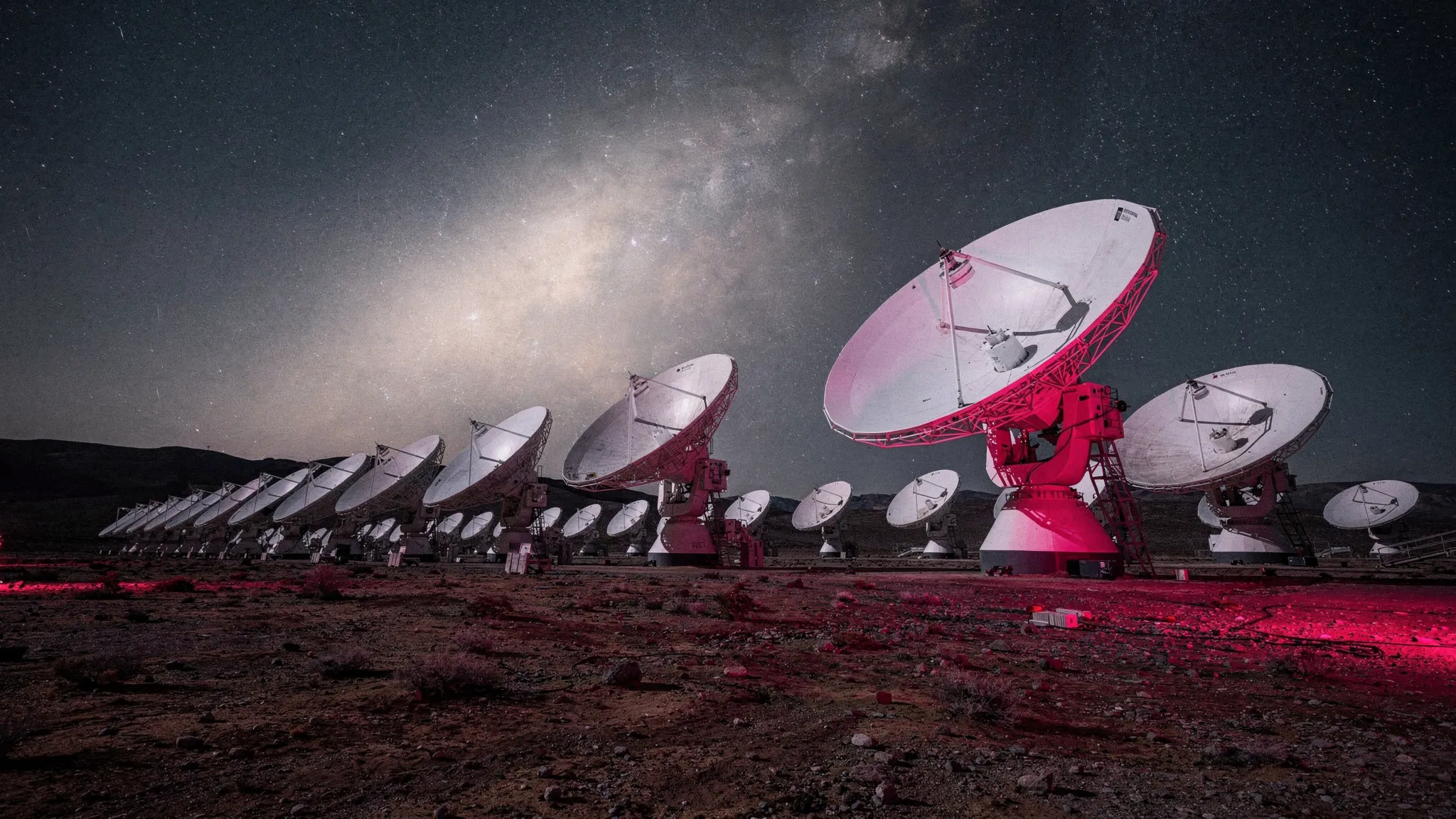
A. Belloche, of the Max Planck Institute for Radio Astronomy in Bonn, and colleagues from Europe, the United States and Asia used COMPASS, a large survey with the ALMA radio telescope array of eleven young, low-mass stars with “hot corinos” — warm, compact zones where icy molecules evaporate and glow at radio wavelengths. They focused on IRAS4A2, one star of a pair in the cloud NGC 1333, 290 parsecs away. It is also where fully deuterated ammonia was first identified around a young star.
Sweeping the sky frequencies from 279 to 312 gigahertz, the team modelled the emission of methanol and all its variants at a temperature of about 200 kelvins. Every methanol variant with a public radio fingerprint showed up. Among them: CD₃OD, with ten clearly detected lines. It is the first robust detection of fully deuterated methanol in space — and, the authors note, the first identification of any molecule carrying four deuterium atoms in the interstellar medium. It amounts to roughly 4 parts in 10,000 of the methanol there.
Methanol that hides
A puzzle came with it. Compared with its rare carbon-13 and oxygen-18 versions, ordinary methanol seemed far too scarce — about 7 to 11 times too little — while the rare versions compared sensibly with each other. The authors conclude that the amount of ordinary methanol is probably underestimated, perhaps because its emission comes from clumps rather than a smooth cloud. They therefore used the rare versions as stand-ins to compute deuterium ratios.
Deuterium piles up beyond chance
If deuterium simply replaced hydrogen at random with a fixed probability, each variant would point to the same deuterium-to-hydrogen ratio. Instead, the inferred ratio climbs with the number of deuterium atoms: about 1% for the singly deuterated forms, 9 to 23% for doubly and triply deuterated ones, and around 41% when comparing CD₃OD with CH₃OD. The pattern in IRAS4A2 is nearly identical to that of another young star, BHR71-IRS1, and similar to other low-mass protostars.
Models miss the heavy end
The team compared these ratios with five published chemical models of how methanol and its deuterated forms build up. All of them underestimate the multiply deuterated forms, typically by one to two orders of magnitude — and, for CD₃OD in one model, by about five orders of magnitude. The authors’ verdict: a key ingredient that promotes heavily deuterated methanol is missing from current models.
The detection also makes a prediction. Two remaining variants, CH₂DOD and CHD₂OD, should be easy to spot in IRAS4A2 as soon as laboratory spectroscopists provide their radio signatures. A sharper look at higher angular resolution could also reveal whether the methanol truly sits in clumps.