LEFT OR RIGHT: WHEN CHANCE PICKS LIFE'S HANDEDNESS
Many molecules come in two mirror-image versions that cannot be laid on top of each other, like a left and a right hand. Chemists call this chirality, and the two versions enantiomers. In living things, amino acids and sugars occur mostly in one of the two forms. How this asymmetry appeared, and why one hand was chosen, remains incompletely understood.
One idea is that it happened spontaneously, out of a racemic mixture — equal amounts of both hands — under conditions far from chemical equilibrium. Experiments have shown that a mirror-image balance can tip: in crystals of sodium chlorate grown while stirred, in a reaction known as the Soai reaction, or in small chains of amino acids formed by a prebiotic reaction.
Frank’s recipe for picking a side
The most influential theory dates back to F. C. Frank in 1953. It needs two ingredients:
- Autocatalysis: each molecule helps make more molecules of the same hand.
- Competition: a left and a right molecule meet and destroy each other.
Past a threshold, the 50/50 state becomes unstable and the mixture tips toward one hand. In the classic, deterministic version of the model, even a tiny initial excess decides the winner, every time.
But real chemistry happens one reaction at a time. When there are few molecules — as may have been the case in prebiotic settings — chance plays a role. Earlier simulations had hinted that the hand that starts in excess does not always win.
Putting numbers on chance
Leonardo Silva-Dias and Christoph Weber, of the University of Augsburg in Germany, took a standard version of Frank’s model (the Kondepudi–Nelson model) and worked out analytical formulas for the effect of its randomness. Their key simplification: the total amount of chiral molecules settles much faster than the balance between left and right, so the problem shrinks to a single variable — the chiral imbalance.
The picture that emerges is that of a marble rolling in a landscape with two valleys — one for each hand — separated by a hill, the 50/50 state. Random kicks push the marble around. They checked every formula against computer simulations of the reactions, averaged over 50,000 runs each.
Three effects of small numbers
1. The minority can win. The probability of ending in a given hand grows smoothly with the initial excess, from 0 to 1, crossing exactly one half when the start is balanced. There is always a chance that the initially rarer hand takes over. In small systems, that chance depends only on where the starting point sits between the two valleys. In larger ones, what matters is the excess compared with the typical size of random fluctuations, which shrink as the number of molecules grows.
2. Chance speeds things up. The time needed to pick a hand grows with the size of the system and drops when the initial excess grows. Random kicks help the marble leave the hilltop faster. For the origin of life, this matters: if the choice needs a sustained flow of energy, that flow must last at least as long as the selection time.
3. The choice can flip. When molecules are produced quickly from their raw material and competition between the two hands is weak, the marble can hop over the hill — the mixture switches hands. The hill’s height grows in proportion to the number of molecules, and the hopping rate falls exponentially with that height. So the switches fade away as systems grow.
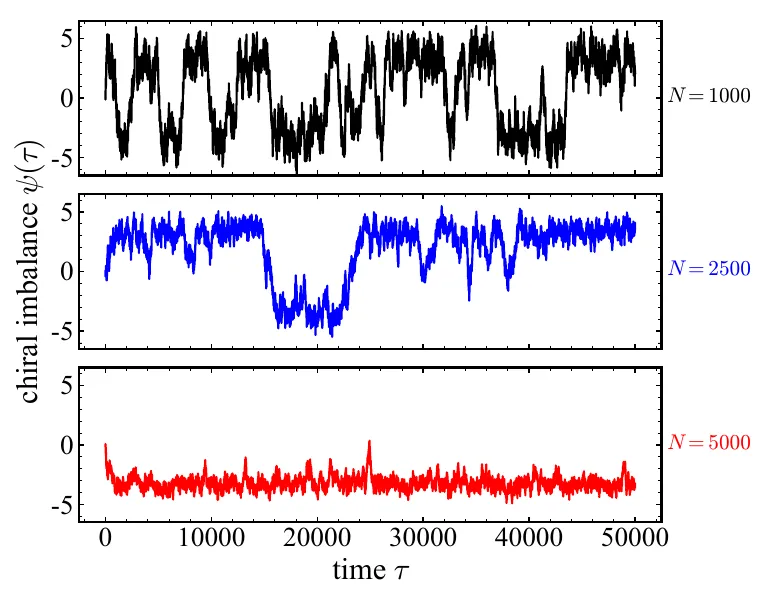
With 1,000 molecules the mixture flips hands again and again; with 2,500 it flips once; with 5,000 it stays put. — Figure 7, Silva-Dias & Weber (2026), arXiv:2610.13523.
A matter of scale
The authors conclude that fluctuations play two distinct roles: they shape which hand is first chosen and how fast, and they can later destabilise that choice. Their analysis also sets a constraint on origin-of-life scenarios: the selection has to happen while the out-of-equilibrium conditions last.
The work covers one reaction scheme, in a well-mixed system with no spatial structure. The authors point to other routes to chirality — for instance polymers that separate into droplets and form liquid-crystal states — and propose extending the approach to them.