A NEW KIND OF MAGNET WORKS AT ROOM TEMPERATURE
Electrons carry a charge, but also a spin, a tiny built-in magnet that points “up” or “down”. Spintronics aims to use that spin to store and process information. In recent years, physicists have found magnetic materials with a striking property: they have no overall magnetisation, yet their electrons’ energy still depends on their spin, in a way that changes with the direction they move. This “spin splitting” does not rely on relativistic effects, which makes it large.
In some of these materials, called altermagnets, the pattern is symmetric: an electron moving one way and one moving the opposite way see the same spin. In p-wave magnets, it is the reverse: flip the direction of motion and the spin flips too. Until now, the p-wave magnets reported only worked below the temperature of liquid nitrogen.
A spiral hidden in a familiar crystal
Kaiwen Shen, Xianzhe Chen, Libor Šmejkal and colleagues at Fudan University in Shanghai, two Max Planck Institutes in Dresden, and other institutions in China and the Czech Republic, turned to bismuth ferrite (BiFeO₃). It is one of the best-studied “multiferroics”, materials that are both magnetic and ferroelectric — they carry a built-in electric polarisation. It stays magnetically ordered up to about 640 kelvin (well above room temperature) and ferroelectric up to 1,100 kelvin.
Inside it, the magnetic moments of the iron atoms are not aligned: they rotate step by step along a spiral, called a cycloid. The team shows that this spiral, on its own, produces p-wave magnetism — a mechanism they describe as previously overlooked.
Theory, then a laser
- Calculations of the crystal’s electrons show a clean p-wave spin pattern, with a spin splitting of about 100 millielectronvolts. Adding relativistic effects barely changes it: the effect comes from the magnetic order itself.
- When the spiral turns the other way — left-handed instead of right-handed — the spin pattern reverses.
- In the lab, they grew a 100-nanometre film of bismuth ferrite and imaged its magnetic spiral with a diamond-tipped quantum sensor.
- To read the spins, they shone a circularly polarised laser on the film. Light that rotates one way excites electrons of one spin more than the other, producing a small electric current whose sign follows the spin direction. As they rotated the sample, the current peaked exactly in the direction predicted for the p-wave spin polarisation. All these measurements were done at room temperature, in open air.
Flipping spins with a voltage
The key feature: in bismuth ferrite, the handedness of the spiral is locked to the electric polarisation. Reverse one, and the other follows.
The team applied electric pulses of about 300 kilovolts per centimetre across the film. The polarisation rotated, the spiral changed handedness, and the laser-induced current changed sign: positive after one pulse, negative after the opposite one. Plotted against the applied field, the current traced a hysteresis loop that matched the switching of the crystal’s polarisation. The change is reversible and stays in place after the pulse.
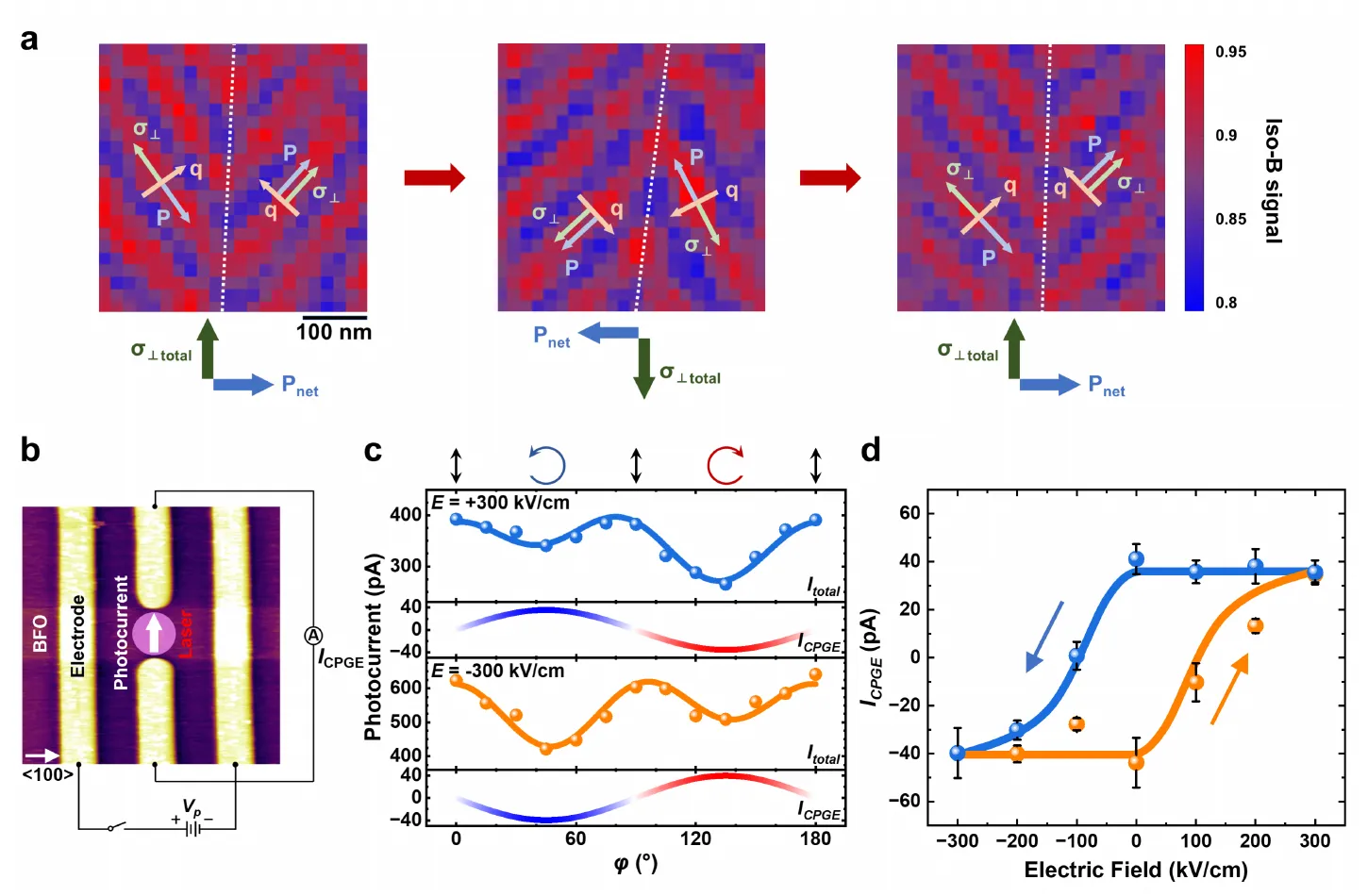
Electric pulses flip the polarisation and the spiral’s handedness (a); the device (b); the spin current reverses sign (c) and follows a hysteresis loop against the electric field (d). — Figure 3, Shen et al. (2026), arXiv:2610.12892.
From the cold to the desk
The authors present it as a magnet with odd-parity spin splitting that is controlled by a voltage at room temperature, and see it as a route toward spintronic devices that consume little power. The results come from thin films in a laboratory; no device beyond the switching of the measured signal is demonstrated yet.