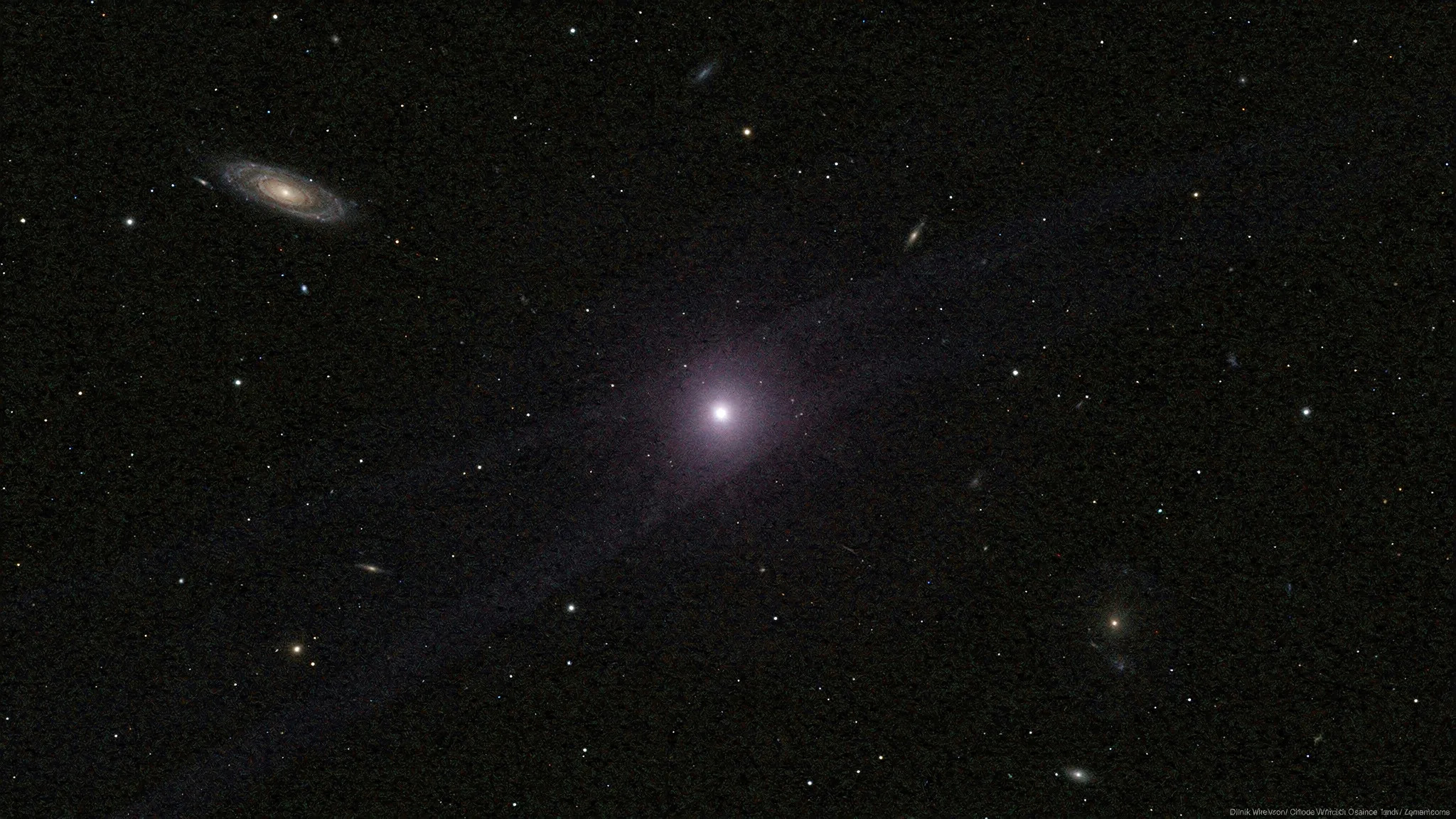
A GALAXY WITH ALMOST NO CARBON, 1 BILLION YEARS AFTER THE BIG BANG
Right after the Big Bang, ordinary matter was almost only hydrogen and helium. Every heavier element — carbon, oxygen, iron — was made later, inside stars, and scattered by their explosions.
That matters for how stars are born. A collapsing cloud of gas heats up as it shrinks, and it must shed that heat to fragment into stars. In today’s Universe, carbon and oxygen ions do most of the cooling, and clouds break up into stars of all sizes, many of them smaller than the Sun. Without those elements, the first clouds could only cool through hydrogen molecules. They broke into large chunks, and the stars they made were mostly massive.
How much carbon and oxygen is needed to switch to “normal” star formation? Very little: about 1/3,000 of the Sun’s share. That threshold was crossed so fast that every distant galaxy seen glowing so far, including by the James Webb Space Telescope, is already well above it by the time it is bright enough to be seen.
Reading a cloud in a quasar’s light
There is another way to find primitive gas: let it absorb the light of something brighter behind it. Sarah Bosman, of Heidelberg University, Frederick Davies, of the Max Planck Institute for Astronomy, and 23 colleagues are surveying the 30 brightest quasars at a redshift between 4.5 and 5.5 with GHOST, a spectrograph installed in 2024 on the Gemini South telescope in Chile, which they describe as the most sensitive high-resolution spectrograph ever built.
The light of the quasar J1941−4500 crosses a dense cloud of neutral hydrogen — a “damped Lyman-alpha absorber”, the kind of gas reservoir thought to sit within a few kiloparsecs of a galaxy’s star-forming regions. Each element in the cloud absorbs light at its own wavelengths. After 5.8 hours of exposure, the team could measure silicon, oxygen and carbon; iron was not detected at all.
The most pristine cloud yet
The cloud, named UMP-DLA-1, sits at a redshift of 5.14, about 1.1 billion years after the Big Bang. Its numbers:
- Carbon: 11,000 times less than in the Sun relative to hydrogen (about 16,000 times less with the most recent solar reference).
- Oxygen and silicon: about 5,000 times less than in the Sun.
- That is more than three times poorer in oxygen and silicon, and four times poorer in carbon, than any such cloud known before. It is also the poorest in iron.
- The total mass fraction of elements heavier than helium: 3.16 millionths.
The authors combine carbon and oxygen into a single number, the “transition discriminant”, that predicts whether a cloud can cool enough:
D_trans = log₁₀ (10^[C/H] + 0.3 × 10^[O/H])
Below −3.5, a cloud cannot collapse into stars smaller than about one solar mass. UMP-DLA-1 sits at −3.85. It is the first gas reservoir ever found below this line — so its low metal content alone guarantees that its stars were mostly heavy.
A late pocket of the early Universe
This means that star formation in nearly untouched gas, with mostly massive stars, was still possible long after the first stars appeared — and even after the end of the epoch of reionisation.
The cloud’s chemistry is also a sample of what those massive, metal-poor stars left behind when they exploded: slightly less carbon than oxygen, and oxygen and silicon in their solar proportions. On its own, this pattern cannot tell whether the stars were truly the first generation or an early second one. But it matches clouds found at later times that earlier work traced to just 1 to 30 supernovae of first-generation stars. The authors suggest that hunting for traces of the first stars in leftover pockets of pristine gas, at redshifts below 7, may be more fruitful than looking much further back, beyond redshift 20.
A few very old, very poor stars in small dwarf galaxies near the Milky Way share the same chemical signature. The authors say it is “entirely possible” that they are the last survivors among the small stars born in galaxies like this one.
Lucky, or common?
Finding such a cloud among only 30 quasars is surprising. Unless the survey was extraordinarily lucky, the authors write, more of these clouds may be hiding in existing spectra, buried in the dense hydrogen absorption of the early Universe. Future giant telescopes, such as the Extremely Large Telescope, pointed at the faint quasars that the Euclid mission will discover, should take a full census. For now, UMP-DLA-1 is a single object, measured under the assumption that its gas moves as one block — an assumption the authors support by the absence of saturated absorption lines.