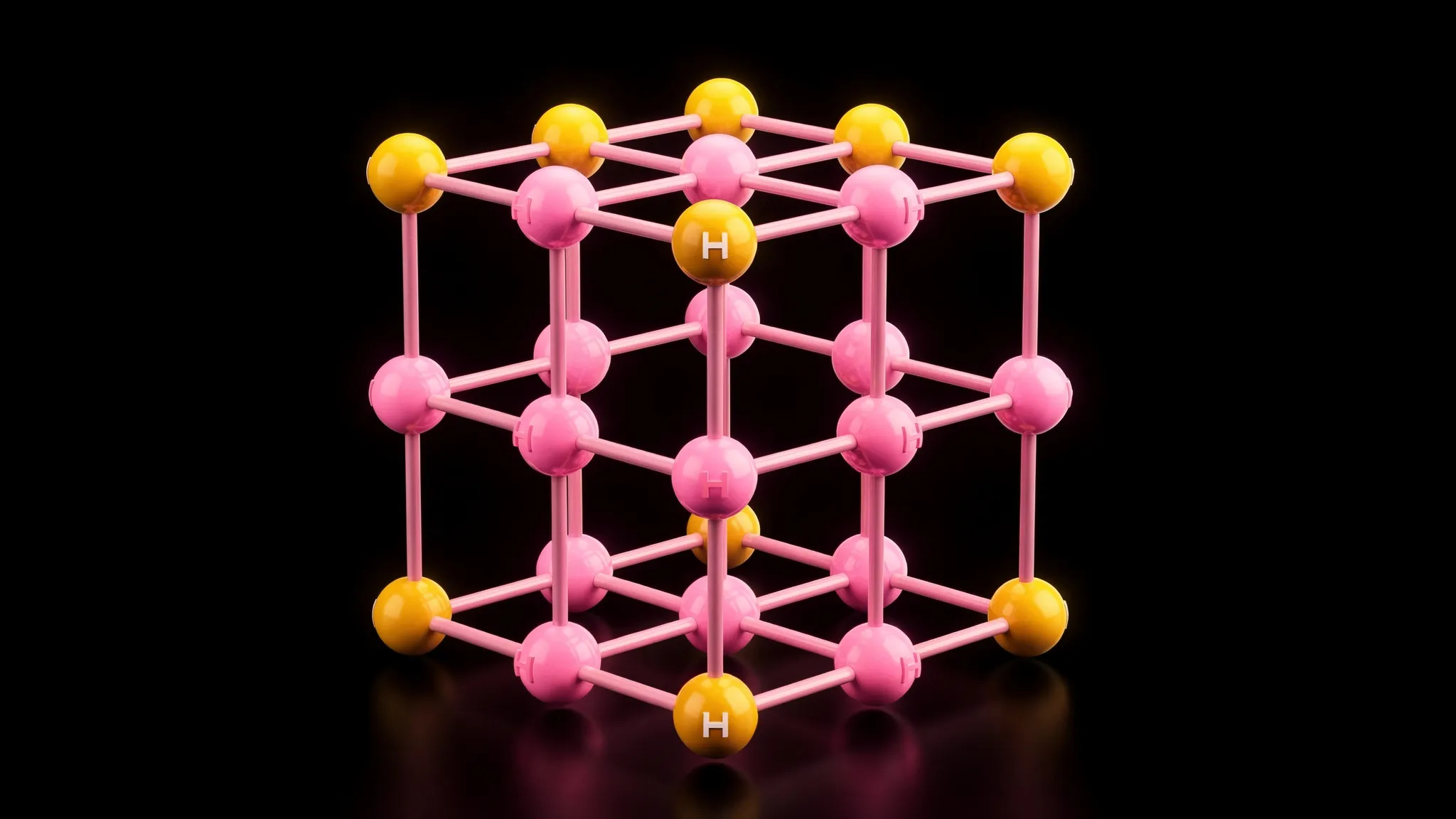
SODIUM AND HYDROGEN, A SUPERCONDUCTOR ON PAPER
A superconductor carries electric current with no resistance at all, below a critical temperature, Tc. For hydrogen-rich materials, the record numbers are spectacular: H₃S and LaH₁₀ superconduct above 200 kelvin. But they only do so squeezed at around a megabar, roughly a million times atmospheric pressure. The challenge is to get the same performance at lower pressure.
Hydrogen helps because it is light: its atoms vibrate at very high frequencies, and these vibrations can bind electrons into the pairs that carry the supercurrent. In many of the best hydrides, hydrogen no longer forms H₂ molecules. Compounds where hydrogen stays paired have long been considered poor candidates, because the strong bond within each pair pulls its electrons out of play.
A compound found by searching
Tianran Chen, of the University of Tennessee, and Taner Yildirim, of the NIST Center for Neutron Research, had already flagged sodium hexahydride, NaH6, in a computer search of more than 100,000 hydrogen-rich structures. An independent study had also predicted a high Tc for it. Here they examined it in depth — entirely by calculation:
- an evolutionary algorithm to find the most favourable crystal arrangements at each pressure;
- quantum-mechanical calculations of electrons, atomic vibrations and their coupling, giving Tc through a standard formula;
- molecular dynamics at 300 kelvin, to check that the structures hold together when atoms jiggle.
No sample was synthesised or measured.
Two crystals, two behaviours
The calculations reveal a crowded landscape: at 50 gigapascals, 15 different structures are stable, most of them close cousins of two main forms. In both, hydrogen sits in slightly stretched pairs.
- The cubic form is predicted to superconduct up to 230 kelvin at 50 gigapascals — about −43 °C at half a megabar — and still 215 kelvin at 200 gigapascals.
- The rhombohedral form stays stable down to 10 gigapascals, where its predicted Tc is 34 kelvin. Squeeze it and Tc climbs fast: 99 kelvin at 50 gigapascals, 157 at 90, about 1.6 kelvin per gigapascal.
There is a catch the authors spell out. At 50 gigapascals, the cubic 230-kelvin form is not the most stable arrangement: it sits slightly above the energy needed to break down into simpler sodium hydride and hydrogen. It becomes stable against that breakdown only above 60 gigapascals, and the two forms swap places near 114 gigapascals. In molecular dynamics at 300 kelvin, the cubic form stays intact — over a few trillionths of a second.
Paired hydrogen that helps
The most unusual finding is the mechanism. The pairs do not block superconductivity. Every vibration that couples strongly to the electrons is one that would show up in Raman spectroscopy, a common laboratory technique; the others barely couple at all. Checking 102 other hydrides at 200 gigapascals, the authors found the same pattern: Raman-active vibrations couple about 40 times more strongly on average than the rest.
In the rhombohedral form, pressure tilts the hydrogen pairs, from 4 degrees at 10 gigapascals to 21 degrees at 90. As they tilt, the key vibrations couple more strongly — in step with the rising Tc, while the electronic structure barely changes. A simple geometric model fits this trend, though the authors stress it is an interpretation, not a proof.
From the screen to the lab
These are predictions. The calculated temperatures depend on a standard but adjustable parameter, and 50 gigapascals is still about half a million atmospheres. If confirmed, NaH6 would show that the orientation of hydrogen pairs is a new dial for designing hydride superconductors. The next word belongs to experimenters.