THE LIGHT THAT KEEPS A NUCLEAR CLOCK TICKING
Optical clocks provide precise frequency references for measurement science and for tests of fundamental physics. A thorium-229 nucleus offers something stranger: its nucleus has a low-lying excited state, about 8.4 electronvolts above the ground state, that a laser can reach. A clock based on a nucleus would be especially sensitive to possible variations of the fundamental constants of nature. And with thorium embedded in a transparent crystal, it could become a solid-state nuclear clock.
The catch is the colour. That transition needs light at 148.4 nanometres, in the vacuum ultraviolet. Recent work has shown that such light can excite the nucleus and run nuclear clocks. To read a weak absorption, though, the source must deliver a steady stream of photons for hours, and its intensity drifts must be filtered out.
Conflict of interest. Some authors are employees or owners of Shanghai Precilasers Technology, a laser company. The authors declare no other conflicts.
Halving the wavelength three times
The team, from the University of Science and Technology of China, the Hefei National Laboratory, institutes of the Chinese Academy of Sciences and the company, starts from a continuous infrared laser at 1,187 nanometres. Three successive frequency-doubling stages halve its wavelength: 594, then 297, then 148.4 nanometres.
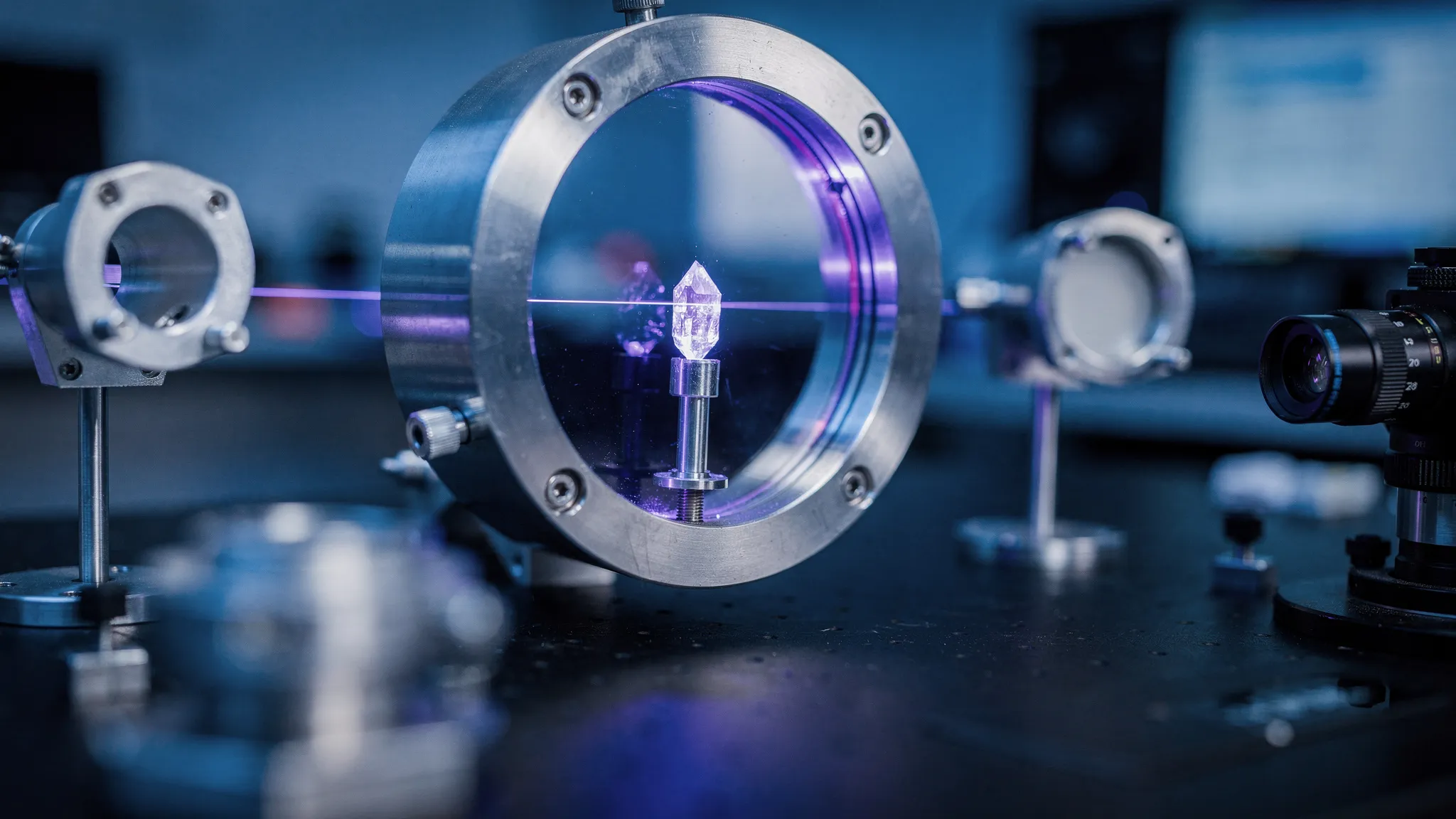
The last step takes place in a crystal of strontium tetraborate, a material transparent in the vacuum ultraviolet that can convert light to twice its frequency. The crystal sits in a sealed box, emptied and refilled with nitrogen purer than 99.9999%, since oxygen swallows this light. That property doubles as a test: let in a little oxygen and the 148.4-nanometre signal vanishes, leaving only background noise.
A few nanowatts, very clean
- At 920 milliwatts of 297-nanometre light going in, the source delivers an estimated 8.1 nanowatts at 148.4 nanometres.
- The signal is 38,000 times stronger than the background left after adding oxygen.
- That output is about six times the 1.3 nanowatts reported by an earlier team. But the authors stress it was obtained with much more pump power; per watt squared, the two conversions are comparable, so the crystal is not shown to be more efficient.
Crystals cut from the same block did not behave alike. One worked best near 30 °C, another near 45 and 48 °C depending on where the beam hit. Each piece needs its own tuning.
Thirty-three hours, and a trick against drift
The source ran for 33.3 hours while the team performed nuclear absorption measurements described in a companion paper. Its output slowly rose from about 5 to 8 million counts per second, while the pump stayed steady; the cause of the drift remains unresolved.
To beat such drifts, the team compared each millisecond of signal with the milliseconds just before and after. Over a separate three-hour run, this local referencing let the noise average down almost as well as photon statistics allow, reaching a fractional stability of 3.5 × 10⁻⁵ after 1,000 seconds. The authors present it as an offline test of averaging, not yet a measured detection limit for absorption.
Toward brighter sources
A mirror cavity around a thinner crystal could, on paper, raise the output to about 3.4 microwatts — a projection that assumes low losses and stable operation. Doping the crystal or controlling its internal structure are other routes. For now, the result is a practical, long-running source for listening to the faint absorption of a thorium nucleus.