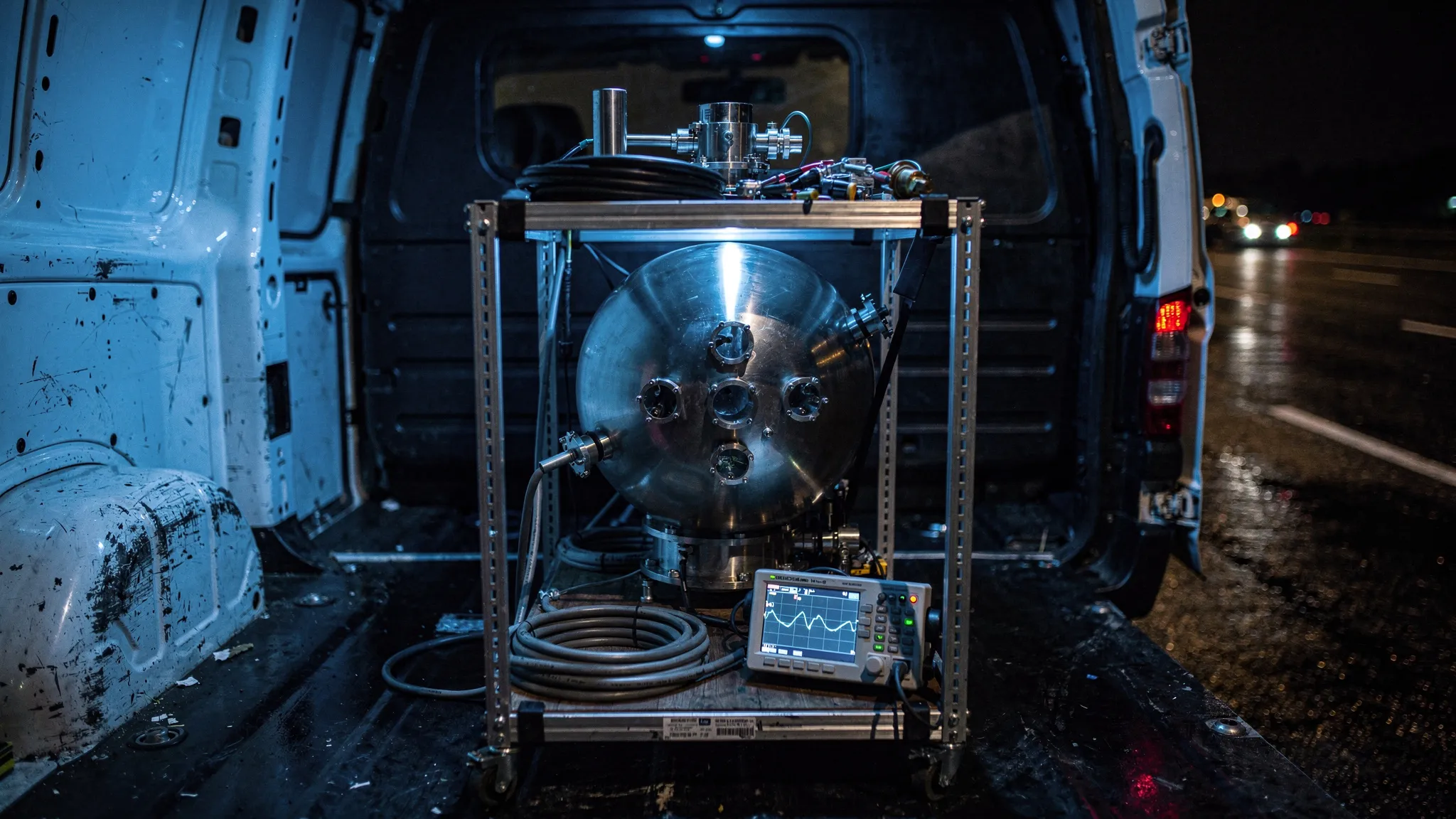
A QUANTUM LAB'S ION TRAP TAKES THE MOTORWAY
Electrically charged atoms, or ions, can be held floating in a vacuum by electric fields. Trapped this way, they become one of the leading platforms of quantum technology: the heart of some quantum computers, of nodes in quantum networks and of high-precision sensors. Some of these devices are called portable — transportable optical clocks, for example — but they generally cannot run while they are moving.
Only magnetic traps had travelled
Only two notable experiments had kept particles trapped on the move. More than thirty years ago, a portable trap carried electrons. More recently, protons and then antiprotons were transported. Both used Penning traps, which combine static electric fields with strong magnetic fields.
Yet most quantum labs use another design: the Paul trap, which holds ions with a rapidly oscillating radio-frequency field. Taking such a trap on the road raises its own challenges: an ultra-high vacuum to maintain, ions to keep for a long time, and optical access for future quantum operations.
A lab in a 1.8-metre rack
Sara Alfaro, Dipesh Bhanushali, Giovanni Cerchiari and colleagues at the universities of Innsbruck and Siegen, including Rainer Blatt and Thomas Monz (also affiliated with Alpine Quantum Technologies, Innsbruck), built a linear Paul trap with four rods 40 mm long, inside a vacuum chamber held below 3 × 10⁻¹¹ millibar. Everything — chamber, high-voltage supplies, radio-frequency electronics, oscilloscope — fits in a rack 180 cm high, 61 cm wide and 90 cm long, with no moving parts. On the road, two uninterruptible power supplies keep it running.
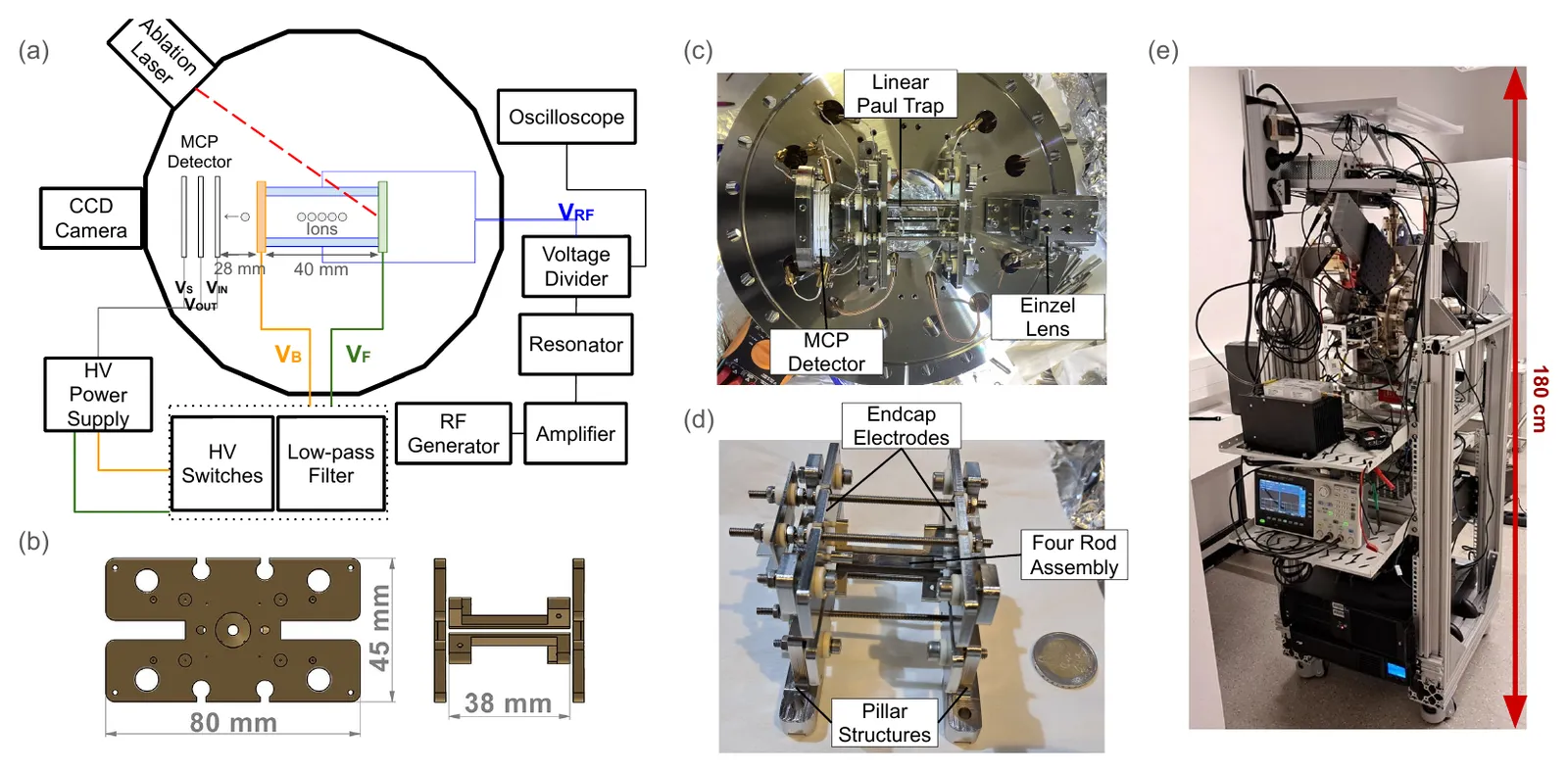
The apparatus: setup schematic (a), electrode design (b, d), trap mounted in its vacuum chamber (c), and the mobile rack, 180 cm tall (e). — Figure 1, Alfaro et al. (2026), arXiv:2610.20487.
Ions are made by firing a small green laser at one of the steel electrodes. The trapped ions have a mass-to-charge ratio of about 12, which the team attributes mostly to carbon ions torn from the stainless steel. To count them, the trap is opened and the ions are thrown onto a detector whose flashes are filmed. In the lab, the ions stay trapped with a lifetime of about 2,600 seconds, roughly 43 minutes.
Two trips on the motorway
For the road tests, the rack was loaded into a van with a forklift and strapped to the floor. Each time, ions were loaded with the van stopped, the van drove off along motorways with straight and curved sections, then stopped again to measure.
- First trip: loading at the Lanz-Brenner rest area, just after crossing the Austria–Italy border, then 18.6 km to Campo di Trens. After 15 minutes of storage, about 3,800 ions were detected, give or take 1,300.
- Second trip: loading near Bruchsal, in Germany, then 63.4 km to Zwingenberg. After 45 minutes, about 1,170 ions remained, give or take 390 — roughly 70% fewer.
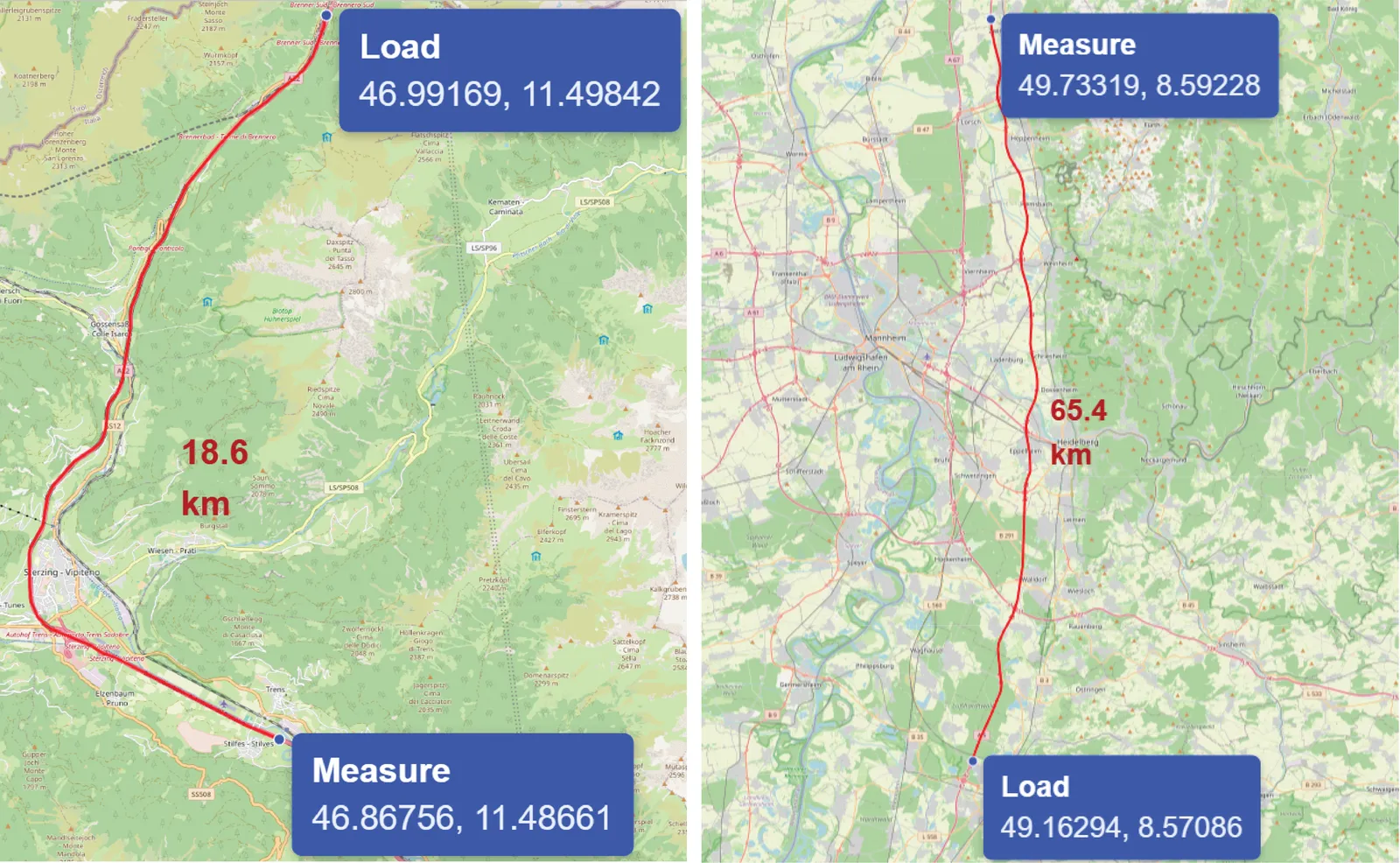
The two routes (a, b) and the number of ions detected after each trip (c), following an exponential decay. — Figure 3, Alfaro et al. (2026), arXiv:2610.20487.
That drop is exactly what one would expect from waiting: fitted together, the two trips give a storage lifetime of about 1,500 seconds, with an uncertainty that keeps it consistent with the lab value. The motorway, in other words, did not shake out more ions than time did. According to the authors, this is the first transport of ions confined in a linear Paul trap over several kilometres.
Quantum in name, for now
The title speaks of a quantum device, but nothing quantum happened in the van. The ions were not laser-cooled, and no qubit was written or read; they were simply kept. The count itself carries a large uncertainty, about a third, because ions pile up on the detector. And the measurements were made with the van parked.
The authors see this as a foundation. The next step is to cool and control the ions while the apparatus is moving. That could lead to quantum sensors that work in transit, quantum-network nodes that can be deployed, clocks that accelerate to test general relativity — and, through a valve built into the chamber, a way to carry exotic ions, perhaps one day antimatter, between laboratories without the strong magnets of Penning traps.