A MILLION ATMOSPHERES ON A LAB BENCH
A pressure of one megabar — 100 gigapascals, roughly a million times atmospheric pressure — rewrites the rules of matter. It can turn insulators into metals, amorphous solids into crystals, reactive substances into inert ones. Squeezing samples slowly between diamond anvils is within reach of a single university lab. Reaching the megabar with shock waves is another story: it relies mainly on kilojoule-class lasers or gas guns firing projectiles, in national laboratories and large facilities that manage a few shots per hour, or per day.
Rings of light that focus a shock
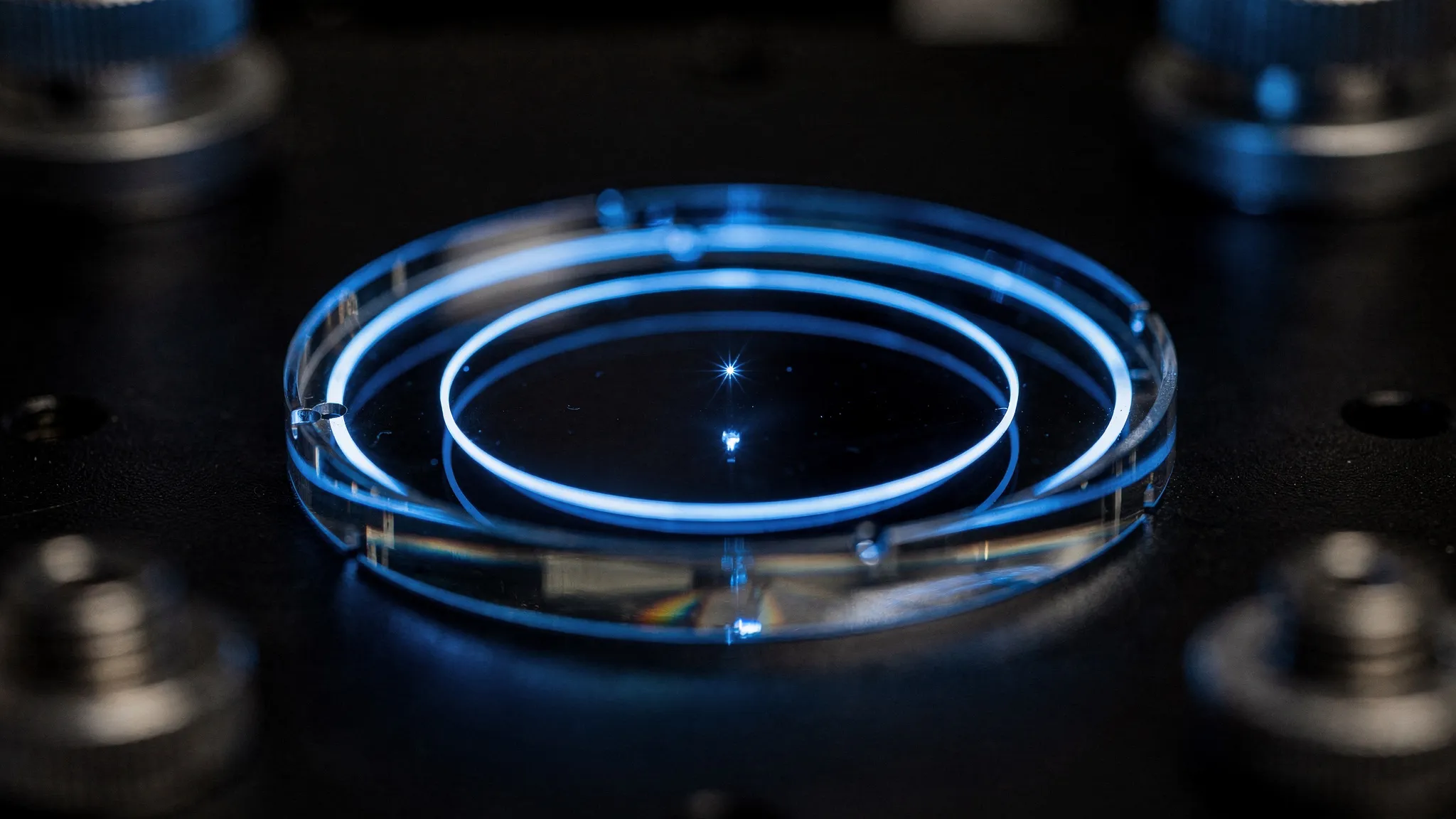
Keith Nelson’s group at the Massachusetts Institute of Technology, with colleagues at the Army Research Laboratory, the University of Rennes, the University of Massachusetts Amherst and Lawrence Livermore National Laboratory, started from a known trick. Shape a laser pulse into a ring with an axicon, a cone-shaped prism, and focus it on a liquid layer a few tens of microns thick. The lit ring vaporises and launches a shock wave that converges towards the centre. As it shrinks into a smaller and smaller volume, its pressure climbs steeply. On its own, this approach had reached tens of gigapascals.
The new idea is to fire several rings, one after the other: the widest first, then smaller ones, a few nanoseconds apart. Ring sizes and delays are tuned so that each new ring lights up exactly where the converging shock is passing — a “speed matching” condition. Each ring then adds its push to the same shock front instead of launching a separate one.
Four pulses from one laser
A single laser (1,064 nm, 200-picosecond pulses, 100 millijoules maximum) is split into four pulses delayed by about 10 nanoseconds each, and each passes through its own pair of axicons. On the sample, the rings have radii of 169, 134, 105 and 75 micrometres; the measured delays between them were 11.1, 10.7 and 9.2 nanoseconds. The target is a 25-micrometre layer of water darkened with 5% commercial black ink (carbon nanoparticles), squeezed between two sapphire windows.
A streak camera follows the shock along a line through the centre. With a single ring, it reaches the focus in about 62 nanoseconds. With each added ring, the trip over the last 160 or so micrometres gets shorter: the shock is moving faster, so it is stronger. The setup fired about one shot per minute, limited by moving the sample by hand; some 1,000 useful shots were taken.
400 gigapascals — computed, not yet measured
The pressure itself is not measured. The team ran hydrodynamic simulations with the same ring sizes and delays, adjusting a single parameter — the energy each ring actually deposits — until the simulated shock path matched the measured one. The best match came at about 2 millijoules per ring, for 4.5 incident. The simulation then gives the conditions near the focus: more than 400 gigapascals at 1 micrometre from the centre, a density of 4 grams per cubic centimetre and about 5,700 kelvin.
The gain is more than additive. In the simulations, the four rings fired separately would peak at pressures that add up to only 280 gigapascals; fired in sequence, they reach about 420. The authors fit the peak pressure versus number of rings with a phenomenological curve, P = a·exp(N/b) + c, and stress that it is a description over the small range explored, not a universal law.
A strange detail remains unexplained. Before the shock arrives, the centre of the sample darkens, about 30 nanoseconds after the laser fires — a speed that matches Rayleigh waves in sapphire. Its origin is left for future work.
The fine print
The authors spell out the limits themselves. The megabar claim relies on simulation, not a direct pressure diagnostic. The equations of state used for water and sapphire come from internal Livermore reports, not public peer-reviewed sources, so the absolute pressure scale cannot be checked independently. The fit uses one free parameter and the strongest shot, and the simulations assume perfect circular symmetry; the team estimates the real focal spot at under 5 micrometres, and the simulation still gives megabar pressures 5 micrometres from the centre.
The next step is to measure the focus directly, for example with X-rays that reveal the sample’s density. The authors also see room to grow: more rings, more energy, a smarter split of that energy between rings — and, by deliberately mistiming the rings, a series of gentler shocks that could compress matter while heating it less.