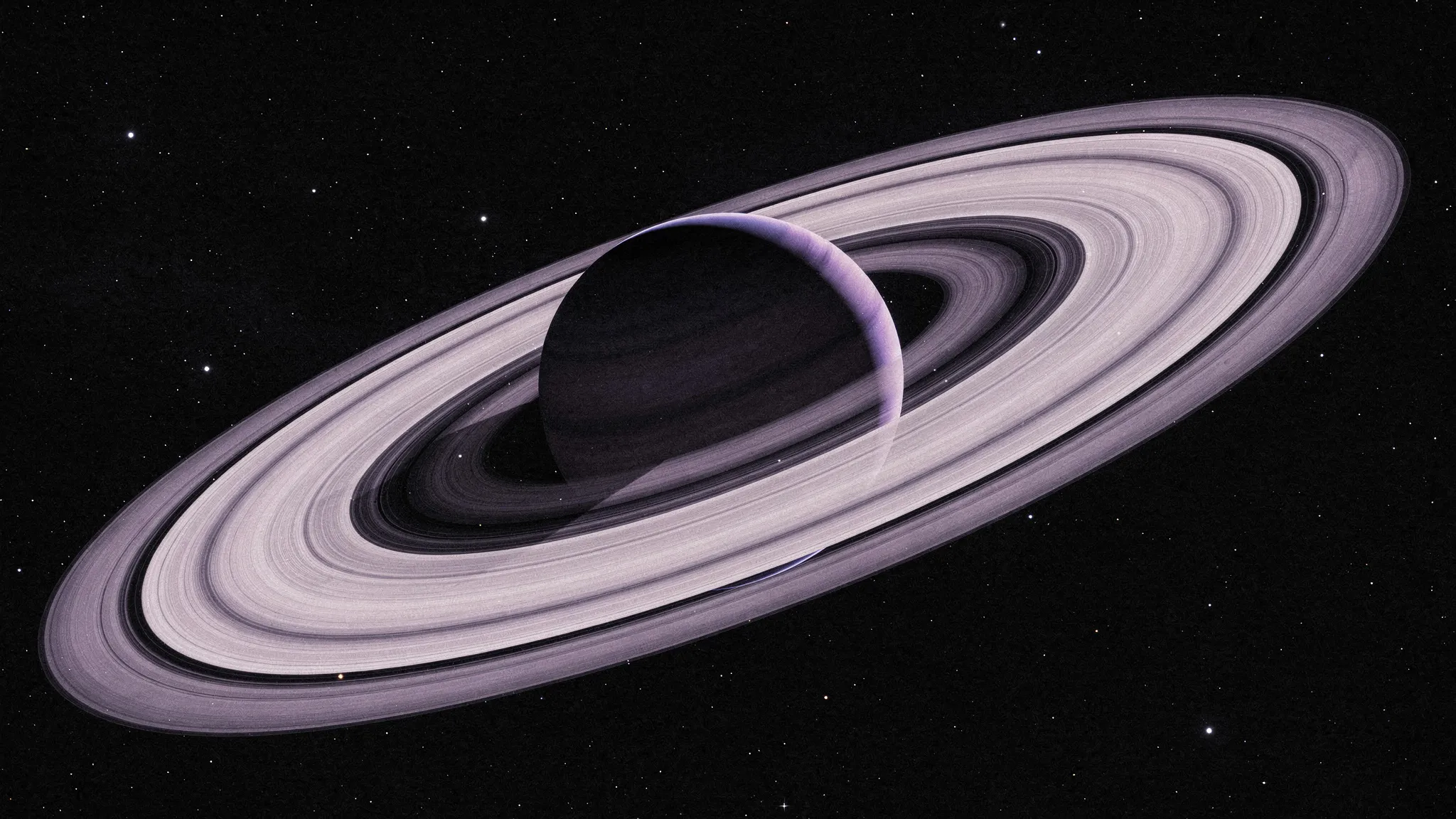
RINGS THAT OUTSHINE THEIR PLANET
In our Solar System, all four giant planets have rings. Around other stars, astronomers have found discs around young planets still forming, but not a single confirmed ring around a mature planet. Elizabeth Lane and colleagues at the University of Michigan, the Space Telescope Science Institute and Caltech think this says more about our telescopes than about the planets.
They point to Saturn as a hint of what could be within reach. Its rings outshine the planet at most viewing angles and wavelengths, and in the colours where methane absorbs light, they are more than a hundred times brighter than Saturn seen face-on.
A telescope that sees reflected light
The Nancy Grace Roman Space Telescope carries a coronagraph, an instrument that masks the glare of a star to reveal faint companions beside it. According to the authors, it will be the first able to detect mature giant planets directly in the visible light they reflect, down to a brightness ratio with their star of 10⁻⁸ or lower — a hundred-millionth.
Most known giant planets, found by the wobble they cause in their star, sit near that limit. But a planet and its ring would appear as a single dot. An unrecognised ring would make the planet look bigger or more reflective than it is.
Four peaks instead of two
The way out is to watch the dot over an orbit. As a planet circles its star, it shows us more or less of its lit side, like the phases of the Moon: its brightness rises and falls once, giving two extremes. The team built a new model of these phase curves for planets with and without rings, starting from earlier work by Arnold and Schneider.
A tilted ring changes the shape. It brightens once when its lit face turns towards us and reflects starlight, and a second time when we see it from the far side and starlight passes through it. In between, it turns edge-on to the star and almost vanishes. Result: four extremes instead of two, a pattern that repeated observations could confirm.
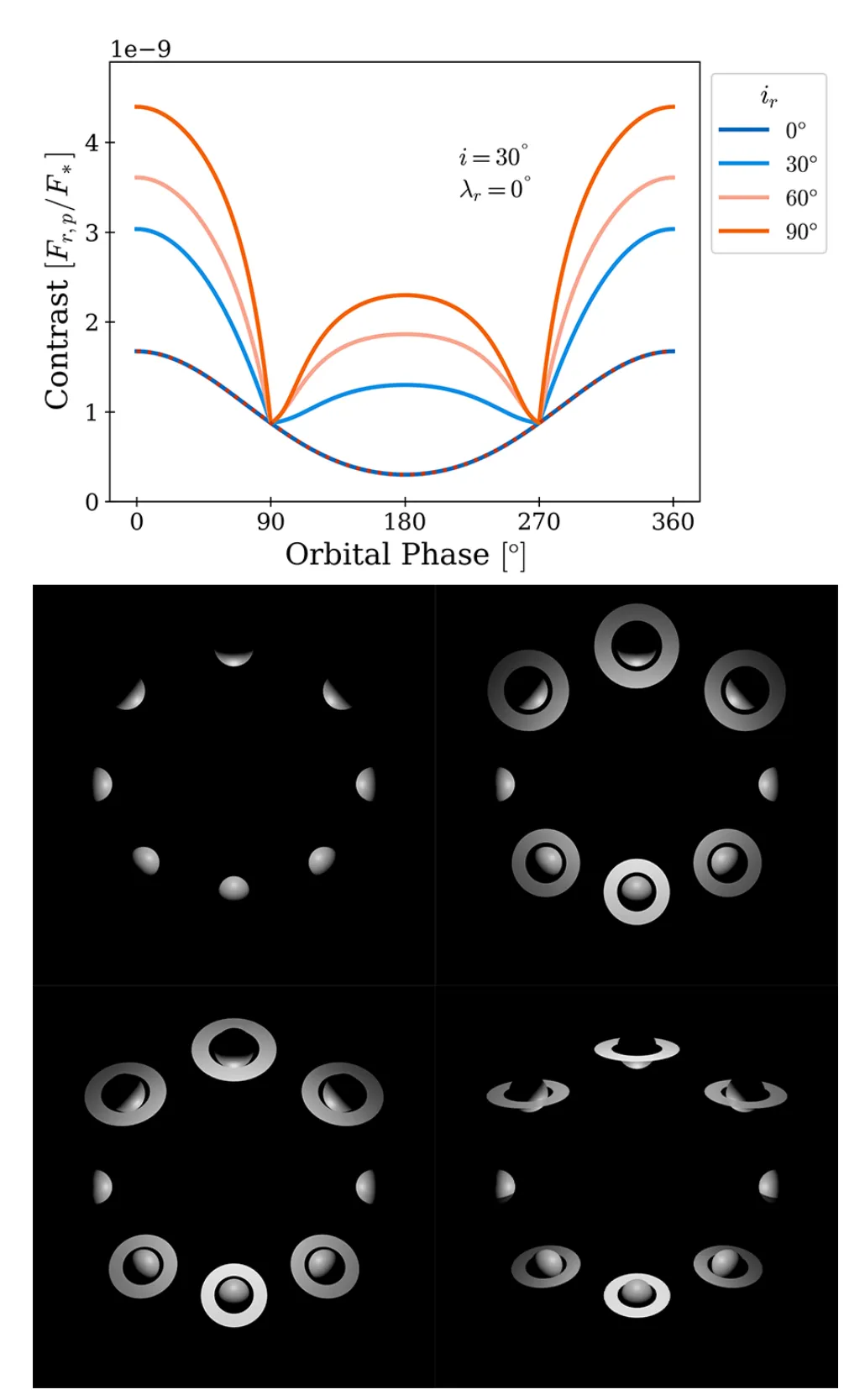
Model brightness of a ringed planet over one orbit for ring tilts of 0°, 30°, 60° and 90° (top), with qualitative 3D renderings of each case (bottom). Only an untilted ring leaves the planet’s curve unchanged. — Figure 3, Lane et al. (2026), arXiv:2610.23835, CC BY 4.0.
The tilt of the ring matters most: a ring lying in the plane of the orbit is always edge-on to the star and leaves no trace. A thick, opaque ring lets no light through, losing the second peak; the planet then looks merely larger or brighter, and the ring is hard to tell apart.
Epsilon Eridani b, with and without a ring
To test the idea, the team simulated Roman observations of Epsilon Eridani b, a planet about the mass of Jupiter orbiting 3.5 times farther from its star than Earth does from the Sun, and one of the coronagraph’s prime targets. Earlier searches could not get below a brightness ratio of 3 × 10⁻⁷, too coarse to see it.
- Without a ring, the planet only clears a solid detection when it is nearly fully lit. For years of its orbit, from 2031 to 2034 in the simulation, it sinks below the threshold.
- With a Saturn-like ring, it appears up to twice as bright, shows the four-extreme pattern, and stays detectable over almost its whole orbit, falling short only when the ring is edge-on to the star.
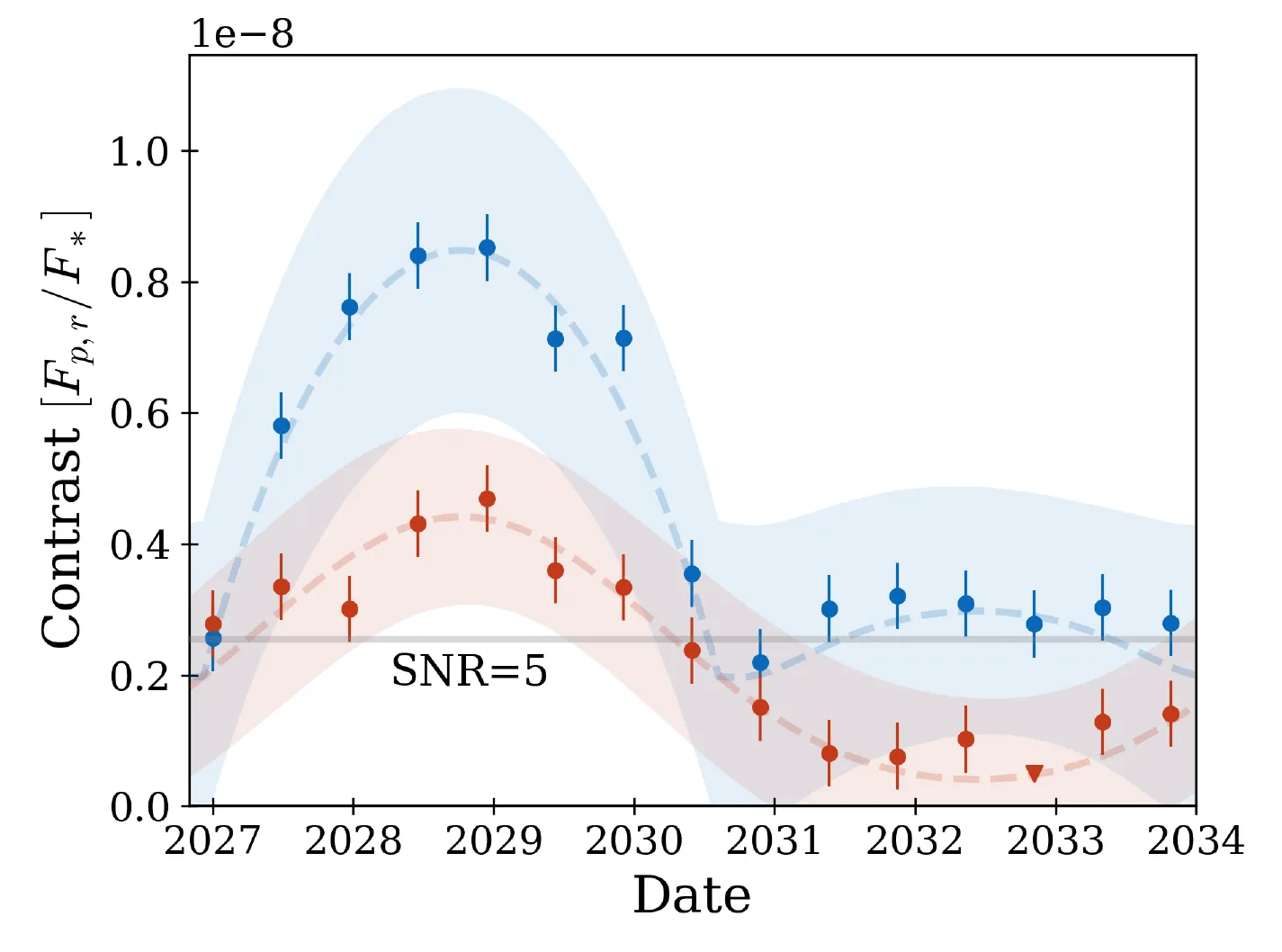
Simulated Roman measurements of Epsilon Eridani b with a ring (blue) and without (red), against the detection threshold (grey line). — Figure 7, Lane et al. (2026), arXiv:2610.23835, CC BY 4.0.
A census within reach
Rings may also widen Roman’s list of targets. In a rough, deliberately optimistic estimate, many known giant planets that are too faint on their own would become detectable with a Saturn-like ring. If a quarter of giant planets have rings, as in the Solar System, about twenty targets should yield about five detections — and finding none would rule out Solar System-like rates at the 2–3 sigma level.
The model is a first-order sketch: no shadows cast between ring and planet, no detailed ring particles, orbits assumed perfectly known. The authors plan a tool to fit planet-plus-ring curves to real data. Whatever it finds, they conclude, Roman is poised to give the first real constraint on how common Saturn’s kind of jewellery is.