
THE NEUTRON'S HIDDEN MAGNETISM, FINALLY SEEN
A neutron on its own does not last. It decays into a proton, an electron and an antineutrino: this is beta decay, the simplest version of a process found throughout nuclear physics. Because a free neutron has no nucleus around it, its decay is free of the messy corrections that complicate nuclear measurements.
A prediction from the 1950s
In the theory of the weak force, a principle called the conserved vector current links part of the weak interaction to electromagnetism. One of its hallmark predictions, introduced by Gell-Mann, is weak magnetism: the weak force carries a magnetic-like term, just as the electromagnetic current does. Its strength, written g_M, is fixed by the magnetic moments of the proton and the neutron. The predicted value is 4.71.
Weak magnetism has been seen in some nuclear decays, starting with a classic test by Lee, Mo and Wu. But in the decay of the free neutron, the cleanest case of all, it had never been measured directly.
Two unknowns, one measurement
The trouble is not precision. The most sensitive quantity is the beta asymmetry: the electrons do not fly out equally in every direction relative to the neutron’s spin. Weak magnetism shifts this asymmetry by about 1.4%, eight times the precision of the best experiment, PERKEO III.
But the asymmetry also depends on a second number, λ, the ratio of the two main couplings of the decay. A single measurement cannot tell the two apart. Experimenters therefore fixed weak magnetism at its predicted value and used the asymmetry to measure λ.
Breaking the deadlock
Miriam Camarasa-Domene, Martín González-Alonso (IFIC, Valencia) and Martín Novoa-Brunet (IFIC and IFAE, Barcelona) take λ from somewhere else. Two well-measured quantities fix it on their own:
- the neutron lifetime, 878.36 seconds in the selection of the Particle Data Group;
- the “Ft value” of special nuclear decays that run only through the vector part of the weak force, 3,070.01 seconds.
They are tied by the relation r_n τ_n (1 + 3λ²) = 2 Ft, which gives λ = −1.27598. With λ pinned down, the asymmetry measurements are free to reveal weak magnetism.
5.1 sigma
The result: g_M = 4.47 ± 0.87, in agreement with the prediction of 4.71. A world without weak magnetism (g_M = 0) is excluded at 5.1 sigma, above the 5-sigma threshold. The authors call it the first observation of weak magnetism in the decay of the free neutron.
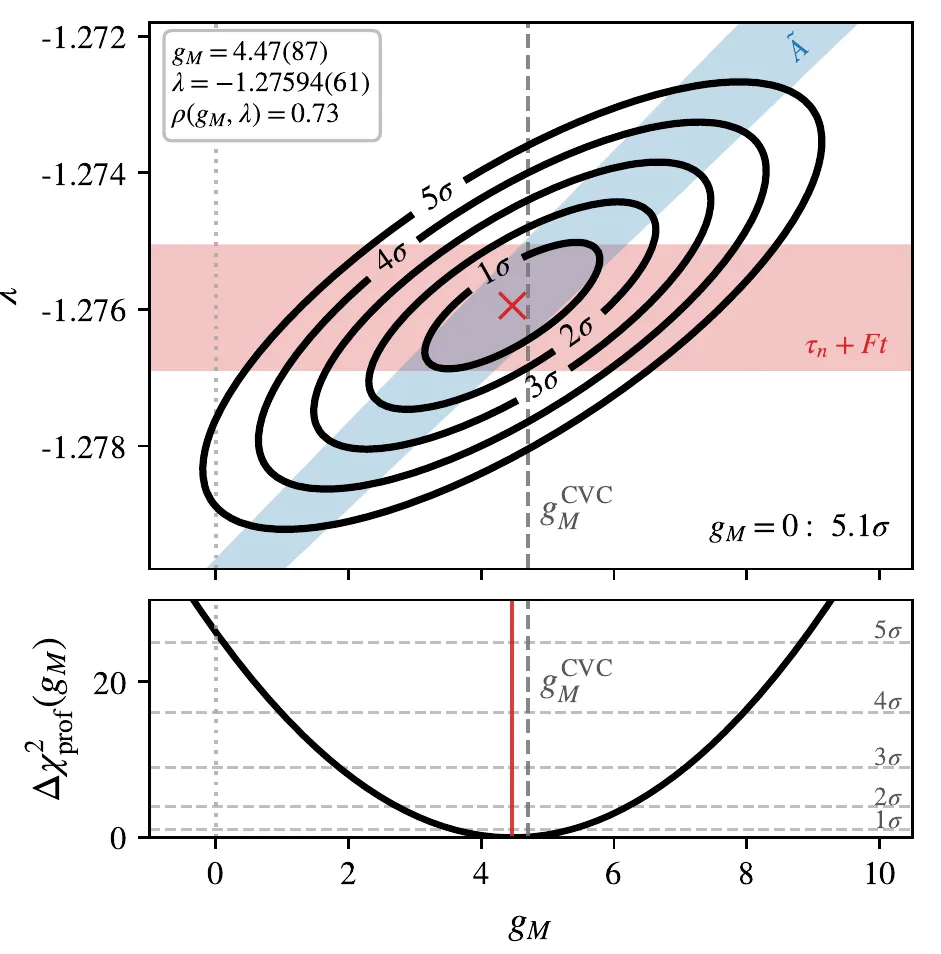
Combined constraints: the red band comes from the lifetime and Ft, the blue band from the asymmetry; their crossing fixes g_M, far from zero (dotted line) and close to the prediction (dashed line). — Figure 1, Camarasa-Domene, González-Alonso & Novoa-Brunet (2026), arXiv:2610.26792, CC BY 4.0.
Neutron data are known for internal disagreements, between old and new asymmetry measurements and between two ways of measuring the lifetime. The team therefore repeated the analysis with different choices of data. The significance stays between 5.0 and 6.1 sigma, and climbs to 6.1 when only the modern, mutually consistent asymmetry measurements are used. An earlier global fit, co-signed by one of the authors, had found a 3-sigma hint.
They also checked whether the energy dependence of the asymmetry could help. At present precision, it would improve the measurement by only a few per cent.
Three levers for the next step
The three inputs, asymmetry, lifetime and nuclear Ft values, contribute about equally to the remaining uncertainty. New measurements on any of the three, or better calculations of the nuclear corrections, would turn this first sighting into a precision test of the Standard Model. Work is already under way on all three fronts.