WHEN EARTH'S CORE SWALLOWED ITS ATMOSPHERE
Earth’s atmosphere is odd among the rocky planets. Venus and Mars, despite pressures that differ enormously, both have air made of about 95% carbon dioxide and a few percent nitrogen. Earth’s is poor in carbon dioxide and rich in oxygen. Part of the difference comes from billions of years of geology and life. But the planets may also have started with different supplies of the elements that make atmospheres and living things: hydrogen, carbon and nitrogen.
Vera Sparrman, of the University of Copenhagen, and Anders Johansen, of Copenhagen and Lund University in Sweden, went back to the very beginning: the time when the Earth was still growing, inside the disc of gas and dust around the young Sun.
A rain of iron through a sea of magma
At that stage, the heat released by incoming material kept the planet’s mantle molten. The growing Earth was wrapped in a global magma ocean. Every new piece of material brought rock, which joined the magma, and iron-nickel metal, which sank through it in droplets — falling about a metre per second — to build the core. Gases from the atmosphere dissolved into the magma, and some of them dissolved in turn into the falling metal. The iron rain could thus carry them all the way down.
The authors modelled this exchange between atmosphere, magma ocean and core layer by layer, from a seed 2% of Earth’s mass up to 64% — roughly the proto-Earth before the giant impact that formed the Moon. The total amounts of hydrogen, carbon and nitrogen were set to match estimates for today’s Earth, including those thought to be hidden in its core.
Two ways to build a planet
They compared two ways of growing:
- Pebble accretion: the Earth sweeps up millimetre- to centimetre-sized pebbles. As the planet’s surroundings heat up, these small grains lose their volatile ingredients before arriving. Hydrogen stops arriving almost at once; carbon and nitrogen stop around the mass of Mars. Volatiles come early.
- Planetesimal accretion: the Earth grows from bodies hundreds of metres across or more, which shield their volatiles inside. Delivery is continuous.
Early arrival, deep burial
Timing turned out to matter a lot. With early delivery, every bit of metal that rains down afterwards keeps scrubbing the magma. In the pebble scenario, about 70% of the hydrogen and 69% of the carbon end up in the core. With continuous delivery, the core takes at most about half, and the mantle and atmosphere keep roughly twice as much. These shares come from the set of lab measurements the authors take as their reference; as we will see, another set gives very different numbers.
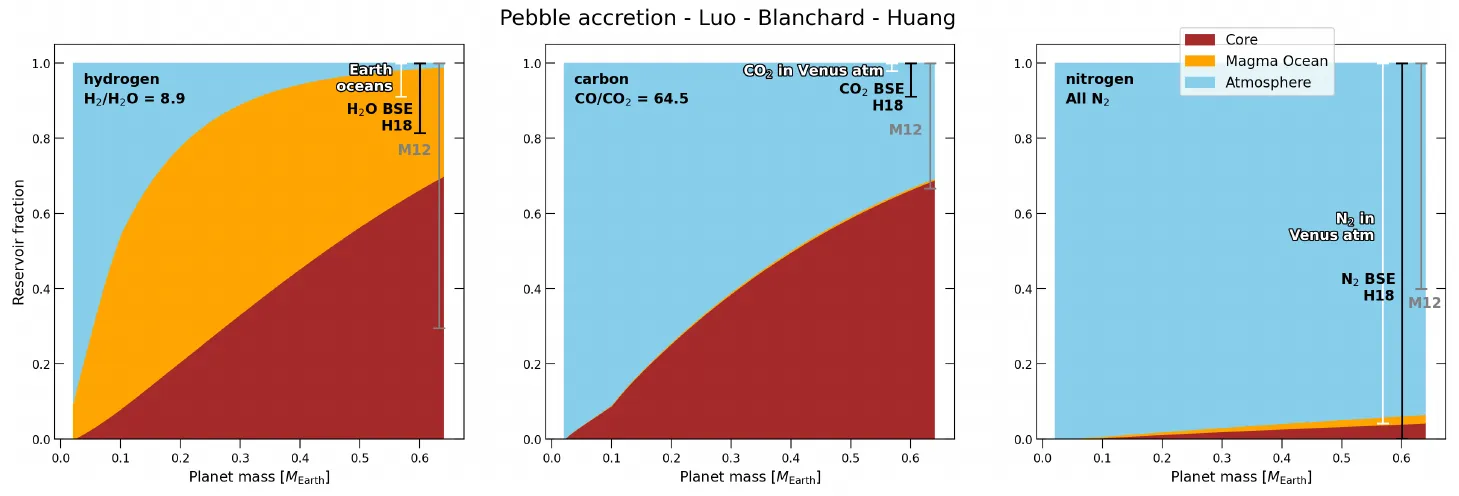
Where hydrogen, carbon and nitrogen end up as a pebble-built proto-Earth grows from 0.02 to 0.64 Earth masses: core (dark red), magma ocean (orange), atmosphere (blue). — Figure 4 (top row), Sparrman and Johansen (2026), arXiv:2610.27788.
Solubility — how much of a gas the magma can dissolve at a given pressure — decides who escapes: only what is dissolved in the magma can be picked up by the metal droplets falling through it. Water dissolves easily, so hydrogen is exposed to the iron rain and sinks efficiently. Carbon monoxide dissolves far less well, so at any moment most of the carbon stays up in the air; but all the metal arriving afterwards empties the dissolved share, which the atmosphere immediately replenishes, and in the end 69% of the carbon has gone down all the same. Nitrogen is the counter-example: it has more affinity for metal than hydrogen does, yet only 4% of it reaches the core — it dissolves so poorly that it is almost never where the iron rain passes, and 93% stays in the atmosphere. Insolubility protects.
A heavy sky of carbon monoxide
What is left at the end of the pebble scenario is a thick primitive atmosphere of about 760 bar — the air we breathe weighs 1 bar at sea level, and Venus’s air 92 bar. It is dominated by carbon, mostly as carbon monoxide (about 710 bar), with about 39 bar of hydrogen and 1.7 bar of nitrogen. The carbon that escaped the core and ended up in that atmosphere amounts to roughly 15 times the carbon dioxide in Venus’s atmosphere today; the nitrogen, to about as much as Venus’s nitrogen. The planetesimal scenario gives an even heavier sky, about 1,350 bar, of similar composition.
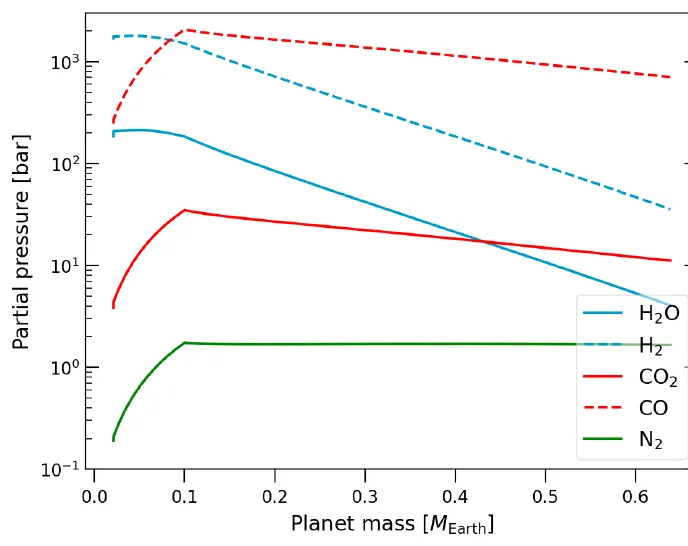
The atmosphere of the pebble-built proto-Earth as it grows: once delivery stops, the iron rain keeps draining hydrogen and carbon, and carbon monoxide (red dashes) dominates. — Figure 7 (top), Sparrman and Johansen (2026), arXiv:2610.27788.
After accretion ends, the authors expect the mantle to oxidise and the atmosphere to shift toward water and carbon dioxide, with oceans condensing. Extrapolated to Venus’s mass, the model gives a similar start, about 500 bar of carbon monoxide; the authors suggest that Earth’s plate tectonics, by burying carbon, rather than a different birth, could explain why the two planets diverged.
Which way did Earth grow?
In principle, the leftover amounts could reveal how Earth formed. The pebble model with the reference data is the only one that matches published estimates for all three elements in today’s mantle. But those estimates disagree with each other about as much as the models do, and lab measurements of how these elements split between metal and rock differ by several orders of magnitude — with another set, all the hydrogen ends up in the core. The solubility of carbon monoxide in magma is the single most influential and least known input. Better experiments, the authors conclude, could turn the composition of Earth’s interior into a record of how the planet was built.