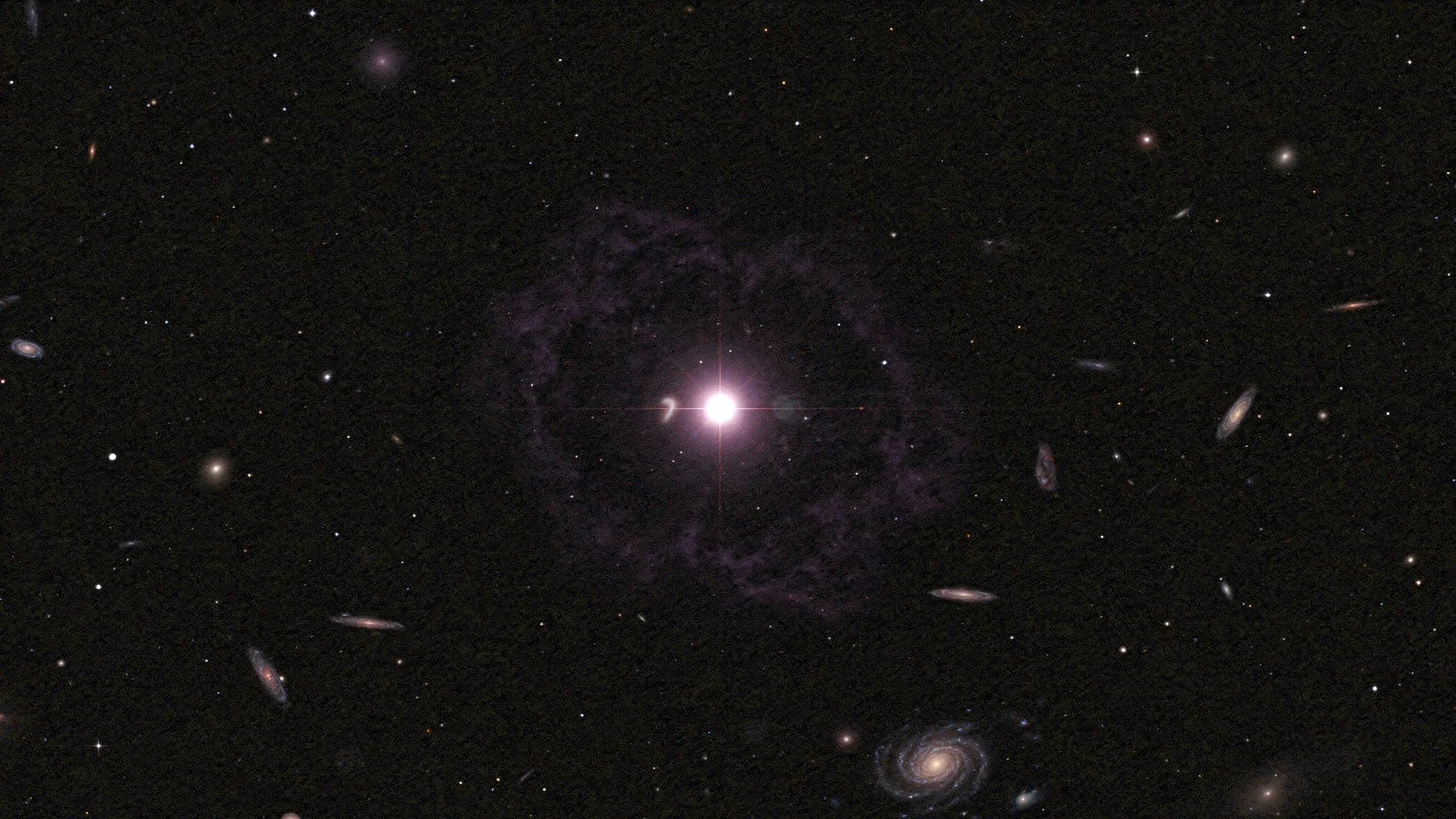
THE SUPERNOVA THAT TOOK 88 DAYS TO PEAK
Supernova 1987A taught astronomers that a star rich in hydrogen can explode and then take its time: instead of flaring up in a few days, it brightened slowly for about 100 days. It became the prototype of a small family, the “87A-like” supernovae — about 30 are known, roughly 1.4% of all collapsing stars.
In recent years, wide sky surveys have found a few extreme members of that family, far brighter and longer-lasting than the rest. They are hard to explain with the usual mechanism, in which neutrinos from the newborn neutron star blow the star apart.
A slow giant
On 11 May 2023, the Zwicky Transient Facility in California spotted a new source in a small galaxy at redshift 0.1020, that is about 485 megaparsecs away, or 1.6 billion light-years. Named SN 2023iop, it was followed for more than 600 days by an international team led by Steve Schulze, of the Weizmann Institute of Science in Israel, with telescopes from the ultraviolet to radio waves.
- It took at least 88 days to reach its peak — the true rise was longer, since it was caught already climbing.
- At peak it reached an absolute magnitude of −20.1: about 0.9 magnitude brighter than the previous record holder of its family, OGLE-73, and 3.7 to 4.0 magnitudes brighter than SN 1987A. On this scale, lower means brighter, and each magnitude is a factor of about 2.5.
- It radiated at least 4.3 × 10⁵⁰ erg, probably closer to 10⁵¹ — the erg is a tiny unit of energy, yet that is still what the Sun radiates over a few billion years.
- Its spectra look like those of an ordinary hydrogen-rich supernova — but they change extremely slowly. Almost a year after peak, SN 2023iop had not yet moved into the stage where the envelope turns transparent and lets the core’s lines show, a stage SN 1987A reached in about 100 days.
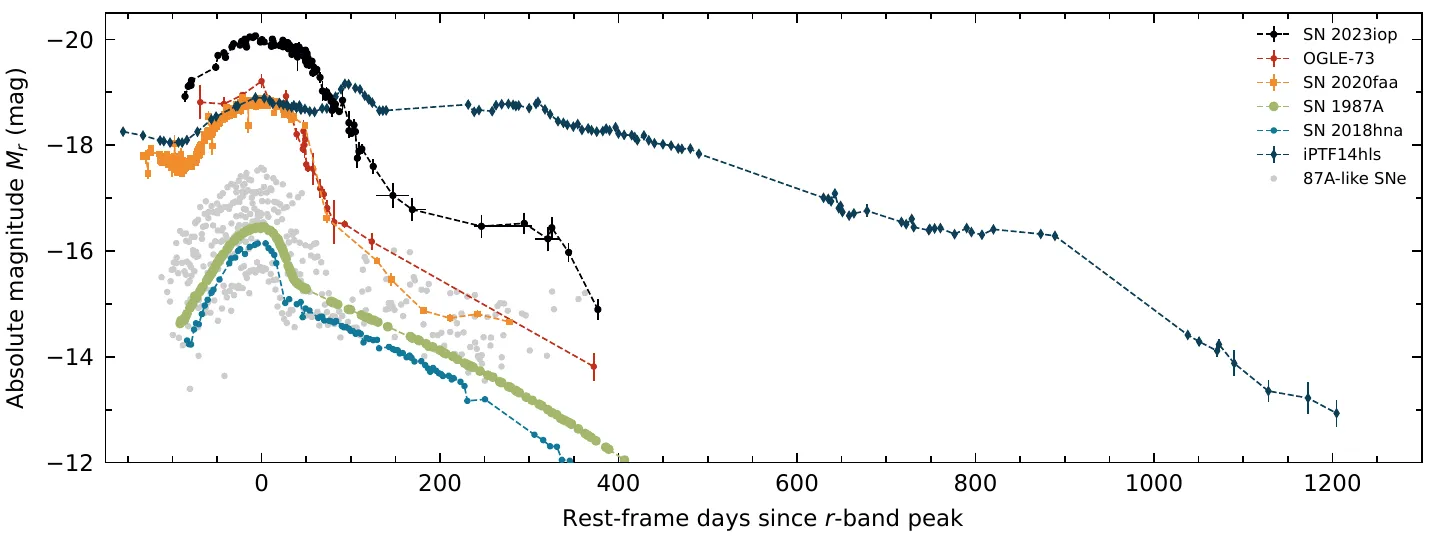
SN 2023iop (black) against SN 1987A, SN 2018hna, the extreme events OGLE-73 and SN 2020faa, and 87A-like supernovae from the ZTF survey (grey): brighter and broader than all of them. — Figure 18, Schulze et al. (2026), arXiv:2610.27312.
Too much energy for neutrinos
A neutrino-driven explosion has a fixed budget: the newborn neutron star releases about 3 × 10⁵³ erg, simulations turn about 1% of it into motion, and an ordinary supernova radiates only about 10⁴⁹ erg. To match SN 2023iop, the whole chain would have to be about 50 times more efficient — which would show up as faster ejecta or traces of collision with surrounding gas. Neither is seen.
The light curve gives two more clues. The slow rise implies more than 12 solar masses of ejected matter. And if the peak were powered by radioactive nickel-56, as in many supernovae, it would take about 2.2 solar masses of it — beyond what a neutrino-driven explosion can forge. The authors stress that this is an upper limit, valid only if radioactivity dominates.
A fingerprint of nickel
The most telling clue appeared late. By day 326 after peak, a second bump had grown in the spectrum near 7,300 ångströms, absent until day 140. The team tentatively identifies it as a line of stable nickel-58, implying about 0.017 solar masses of it if the gas is at 5,000 K — ten times more if it is at 3,000 K.
That matters because ordinary collapsing stars make about ten times less. Such amounts are reached only by models of pair-instability supernovae whose helium core exceeds a hundred suns. That channel opens for helium cores of 65 to 130 suns: pairs of electrons and positrons form there at the expense of the photons holding the core up; robbed of that pressure, it collapses, heats, and fusion runs away all at once, enough to disrupt the whole star. None of the comparison supernovae shows the bump.
What fits, and what does not
A published model of a pair-instability explosion of a red supergiant of 190 solar masses matches the rise, the peak and the spectra remarkably well — up to 150 days after peak. Then it fails: the model fades as cobalt-56 decays, about 1 magnitude per 100 days, while SN 2023iop faded by only 0.2 magnitude per 100 days, staying up to 3.5 magnitudes brighter than the model in the blue (0.7 in the red), and bluer than it.
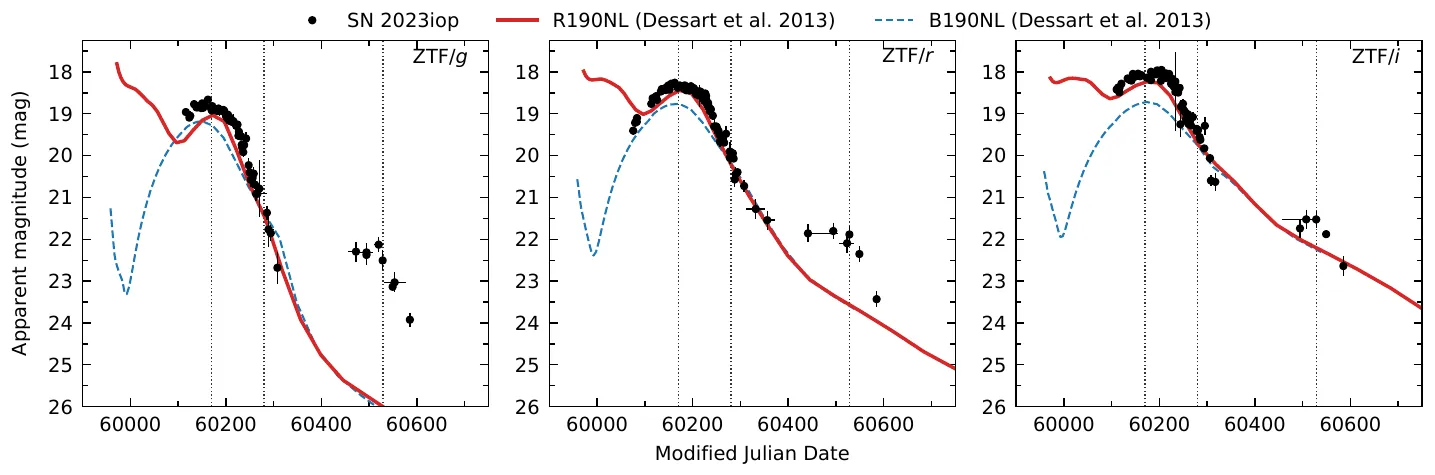
SN 2023iop (black dots) against two 190-solar-mass pair-instability models in three colours: the red-supergiant model (red line) follows the data up to about 150 days after peak, then drops below it. — Figure 13 (upper panels), Schulze et al. (2026), arXiv:2610.27312.
The team tested the alternatives. A light echo — dust reflecting the earlier peak — is ruled out by the smooth evolution of the spectra. Matter falling back onto a central black hole or neutron star gets the overall shape right but not the colours. A collision with gas shed by the star before it died, hidden in a disk, is energetically possible and could supply the late glow without leaving the usual narrow lines. Two other clues point to an unusual star: light polarised at 0.8–1.0%, a sign of a lopsided explosion, and a dwarf host galaxy of about 150 million solar masses, likely poor in heavy elements — a condition for a star to keep such a huge core.
A warning for the distant universe
The authors conclude that a pair-instability explosion is the most plausible scenario, with the late excess powered by hidden interaction. They are clear about the limits: the nickel identification rests on one spectral line and needs confirmation, and SN 2023iop “appears to require more than one” power source.
They also draw a lesson for future surveys. The odd late behaviour of SN 2023iop would be invisible at greater distances — below single images of the Rubin observatory beyond redshift 0.3, below James Webb survey limits beyond redshift 2 to 6. Seen from afar, it would have been labelled a pair-instability candidate “without reservation”. Distant candidates may therefore look cleaner than they are. Approved observations with the James Webb Space Telescope will search SN 2023iop for the dust and infrared lines that could tell the scenarios apart.