AN ATOMIC-CLOCK TRICK, AIMED AT THE SUN
To find a twin of the Earth around another star, astronomers watch the star wobble. An Earth-mass planet orbiting a Sun-like star at the Earth’s distance moves it by only 8.9 centimetres per second, over a year or more. That tiny motion shifts the star’s spectral lines by a few parts in ten billion.
The best planet-hunting instruments get close by spreading starlight over large gratings and averaging the shifts of hundreds or thousands of lines at once. Even calibrated with laser frequency combs, they still measure where light lands on a detector — a wavelength, not a frequency.
Borrowing from atomic clocks
Optical clocks, the most precise timekeepers, work differently. They lock a laser onto an atomic transition and count its frequency with a frequency comb, a laser whose light forms a ruler of evenly spaced frequencies. The catch: they need clean laboratory laser light, not the chaotic thermal glow of a star.
Connor Fredrick, Ryan K. Cole and colleagues at the University of Colorado Boulder and the US National Institute of Standards and Technology (NIST), with Scott Diddams leading the project, have now applied the clock recipe to sunlight. They call the result a solar optical clock.
One line, one laser
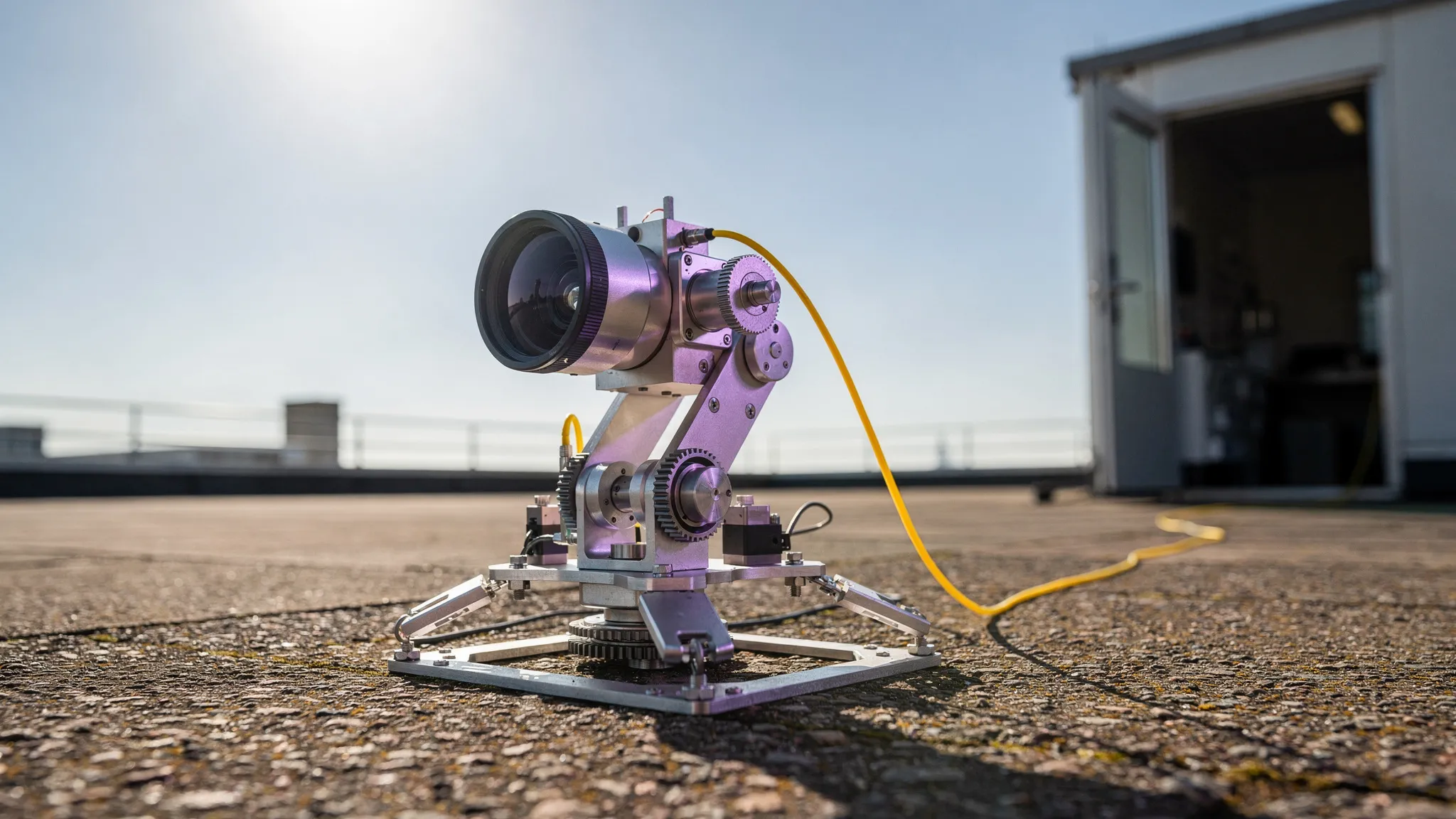
- A small solar tracker on a roof feeds light from the whole disk of the Sun into a single-mode optical fibre — the Sun is seen as if it were a distant star.
- In the lab, the sunlight is mixed with a laser on a detector. The laser’s frequency is wiggled back and forth, which produces a signal that falls to zero exactly at the centre of an iron absorption line near 1,565.28 nanometres, a line about 4.3 gigahertz wide. That width is not an instrument flaw: heat and the churning convection of the Sun’s gas smear the line out, and the centre has to be found inside that blurred band.
- A feedback loop keeps the laser locked there. Meanwhile, a frequency comb tied to a hydrogen maser — a hydrogen atomic clock, very stable over a few hours, used here as the time reference — calibrated by NIST counts the laser’s frequency continuously — a direct link to the official definition of the second.
A billionth of a frequency
In one second, the laser finds the line centre to about 3 megahertz, or one fourteen-hundredth of the line’s width. In speed, that is 4.7 metres per second: the Doppler effect shifts the light’s frequency in proportion to the source’s speed, and at this wavelength 1 metre per second is worth about 0.64 megahertz. Averaging over a few thousand seconds brings this down to about 200 kilohertz — about 30 centimetres per second, or one part in a billion of the light’s frequency.
The precision closely tracks the quantum limit expected from the random arrival of photons in this kind of measurement: no instrument noise visibly adds to it over the averaging times measured. Compared with the team’s earlier instrument, which slowly sweeps across the line, the locked laser is nearly ten times more precise.
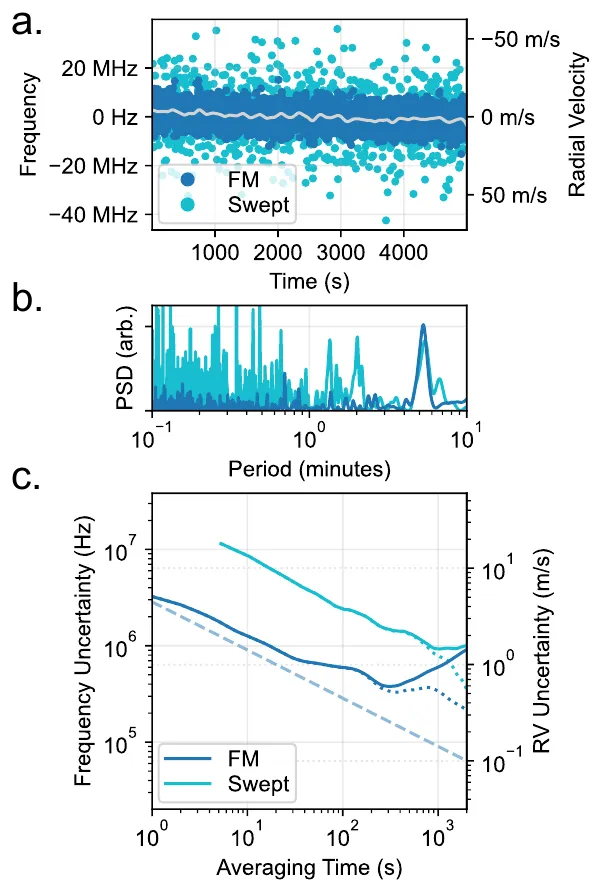
(a) Line-centre measurements over 5,000 seconds with the locked laser (dark blue) and the swept instrument (light blue); (b) the Sun’s oscillations show up as a peak near 5.5 minutes; (c) precision improves with averaging time, toward the quantum limit (dashed). — Figure 4, Fredrick, Cole et al. (2026), arXiv:2610.28485.
The Sun breathes, the Moon passes
The measurements reveal the Sun’s own motion. A clear peak at 5.5 minutes shows the acoustic oscillations of its surface, sound waves that probe its interior. They are also a nuisance: the precision only improves sharply once the averaging spans their five-minute period.
On 8 April 2024, the team observed the partial solar eclipse from Boulder, where the Moon covered about 80% of the Sun. Because the Sun rotates, one edge moves toward us and the other away. As the Moon hid one edge, then the other, the iron line shifted by up to about 500 metres per second — the Rossiter-McLaughlin effect, the same signature used to study planets crossing their stars.
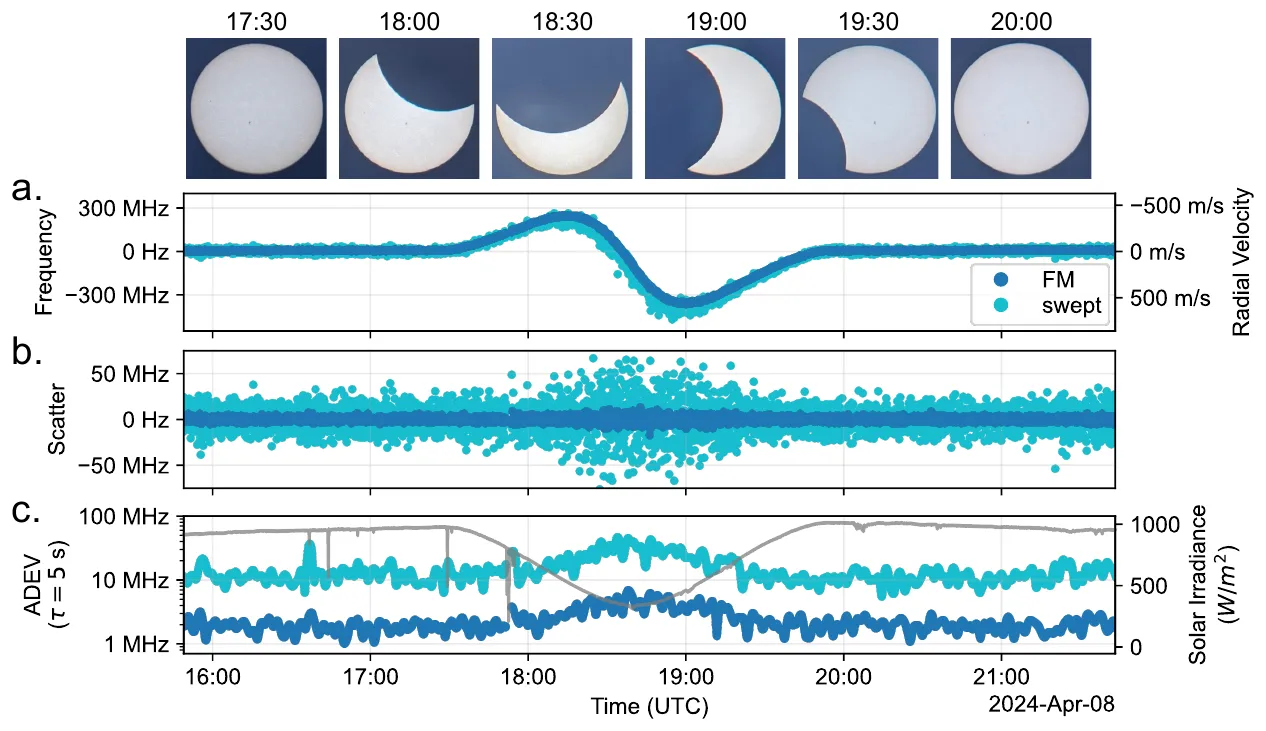
The eclipse of 8 April 2024 seen by both instruments: (a) the line shifts one way, then the other, as the Moon crosses the solar disk; (b, c) the locked laser (dark blue) scatters far less than the swept instrument (light blue). — Figure 5, Fredrick, Cole et al. (2026), arXiv:2610.28485.
From the Sun to other stars
The authors estimate that a 25- to 40-metre telescope with adaptive optics — the range of the Giant Magellan Telescope and the Extremely Large Telescope under construction — could bring this single-line precision to the nearest Sun-like stars in a few hours. Sharper modulation, longer averaging and several lines measured together could push toward 10 centimetres per second.
Stars set their own limit. Their boiling surface, the granulation, adds noise of several tens of centimetres per second even over an hour. Measuring lines one by one, each sensitive in its own way to magnetism and depth, is exactly what could help tell a star’s restlessness apart from the pull of an unseen planet.