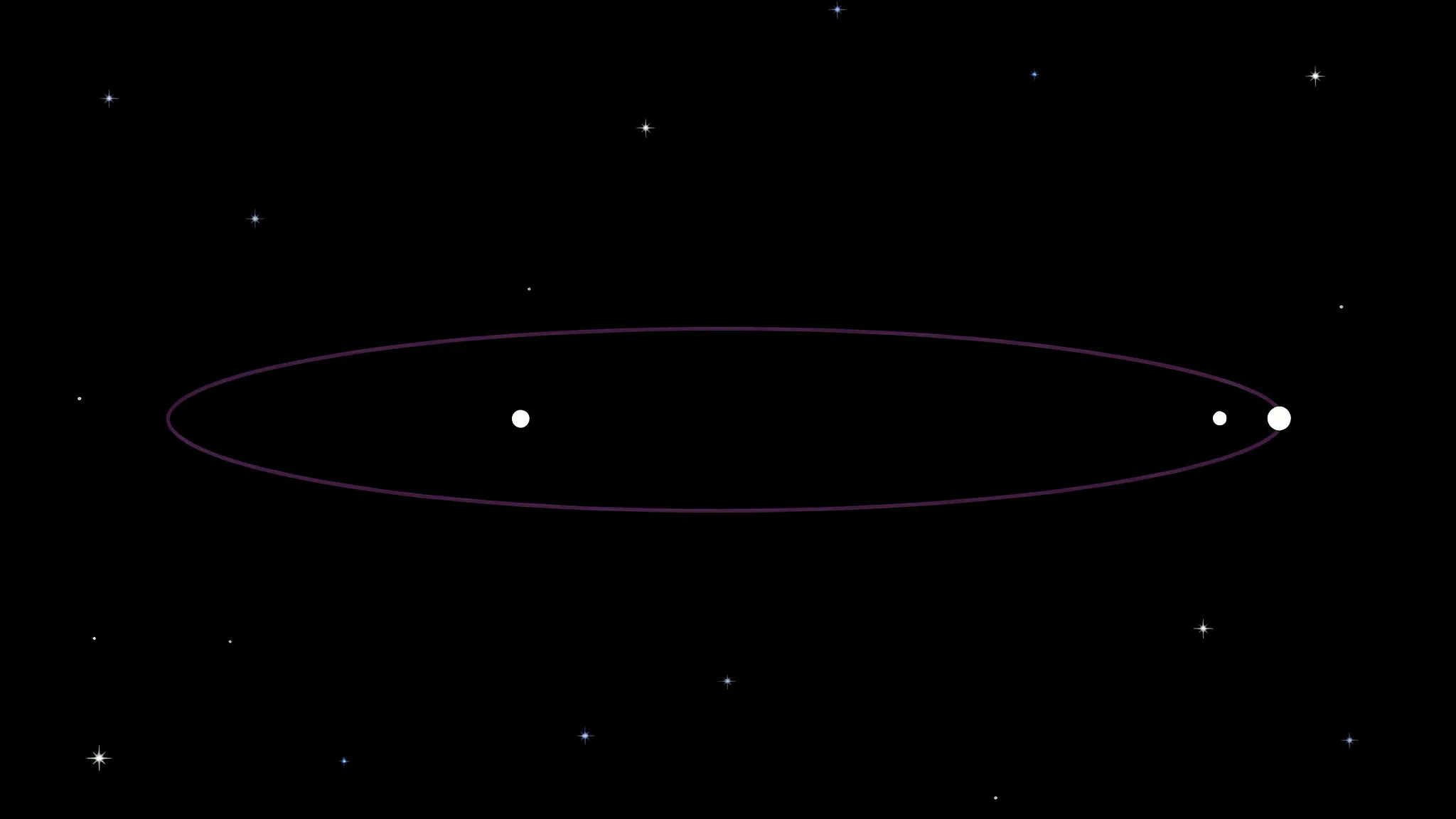
TWO DEAD STARS ON THE MOST STRETCHED ORBIT EVER SEEN
Pairs of neutron stars — the collapsed cores left by massive stars — orbit each other and slowly lose energy as gravitational waves. The first was found in 1974 (PSR B1913+16), and more than 30 are known today. Some eventually merge, producing events such as GW170817 and GW190425 detected by LIGO. How many such pairs survive in the Milky Way, and on which orbits, are basic questions for gravitational-wave astronomy and for the story of how double stars evolve.
A record orbit
PSR J0653+0443 is a pulsar — a neutron star whose radio beam sweeps past Earth like a lighthouse — spinning once every 47.5 milliseconds. It was first detected by China’s Five-hundred-meter Aperture Spherical radio Telescope (FAST) on 20 November 2022, and lies about 1 kiloparsec away (some 3,000 light-years), in the Perseus arm of the Galaxy.
By timing its pulses for more than two years, Z. L. Yang, J. L. Han and colleagues at the National Astronomical Observatories of China and partner universities found that it orbits another neutron star. The masses: 1.38 solar masses for the pulsar, 1.44 for its companion.
The orbit is extraordinary:
- a period of 79.084 days, the longest of all known double neutron stars;
- an eccentricity — 0 for a circle, close to 1 for an orbit stretched almost into an open curve — of 0.99238692 — the highest ever measured for any pair of stars; the previous record, for an ordinary double star, was 0.985;
- only 46 minutes to go from one side of the companion to the other, while most of the 79 days is spent far away;
- at closest approach, a separation of 0.83 solar radii, about 580,000 km — less than the Sun’s own radius —, and a relative speed of 1,140 kilometres per second, the largest of any known double neutron star.
FAST is a fixed dish: it sees only a band of sky above it, and closest approach does not always fall inside it. Between 2025 and 2028, only two passages fall within its view: 19 February 2025 and 21 April 2027. The team tracked the first one for two hours, one measurement per minute.
An eclipse and a wobbling ellipse
During that passage, the pulsar’s radio signal vanished for 85 seconds as it passed behind the magnetic environment of its companion. This means we see the orbit nearly edge-on. It is only the second eclipse ever seen in a double neutron star, after the famous double pulsar PSR J0737−3039A.
General relativity makes the ellipse slowly turn — the advance of periastron — the orbit’s point of closest approach slowly creeps round —, measured here at 0.017791 degrees per year, as predicted. But that advance is not uniform: it speeds up near closest approach. On this almost parabolic orbit, the orbit’s orientation shifts during the passage itself, moving the pulsar towards us then away from us and advancing then delaying its pulses by between −2.91 and +2.49 milliseconds, more than ten times more than in any other such system.
Born from a violent kick
Such pairs are thought to come from two massive stars that explode one after the other. According to the authors, the extreme eccentricity can only come from a large “kick” given to the second neutron star as the iron core of its parent star collapsed. Their simulations suggest a kick of more than about 400 kilometres per second.
They also simulated about a billion massive binaries. Among the surviving double neutron stars, those with an eccentricity above 0.95 and a period of 50 to 110 days make up less than 0.5%. Yet this one turned up among only 28 known outside globular clusters, in the Galactic disc. In the authors’ words, “either we are very lucky or the current binary evolution theory and current understanding of core-collapse supernovae need modifications”.
Bursts of gravitational waves
Because the two stars only come close once every 79 days, they emit gravitational waves in periodic bursts. The emission peaks near 0.357 millihertz, one cycle every 47 minutes — the length of the closest passage. That is too faint for the planned space gravitational-wave observatories LISA, Taiji and TianQin, but proposed future concepts such as LISAmax could detect it over ten years. The pair will merge in about 2.5 billion years, ending in an event like GW170817.