THE STEADIEST LASER EVER BUILT
The best atomic clocks count the vibrations of light absorbed by atoms. To do so, they need a laser whose frequency barely moves, so that it can probe extremely narrow atomic transitions. The steadiest lasers today are locked to a cryogenic silicon cavity: two mirrors held apart by a bar of single-crystal silicon, chilled far below room temperature. Light bouncing between the mirrors resonates only at very precise frequencies, and the laser is forced to follow them.
Such cavities already reach a fractional stability at the level of 10⁻¹⁷ — the frequency wanders by about a hundred-millionth of a billionth of its value. In many experiments, the laser is still one of the main sources of noise — so a steadier one improves the measurement straight away.
Jiggling mirrors
What limits the best silicon cavities is Brownian thermal noise in the mirror coatings: the thin reflective layers are never perfectly still, because heat makes their atoms jiggle. That tiny motion changes the length of the cavity, and with it the colour of the light.
Ben Lewis, Jun Ye and their colleagues at JILA (NIST and the University of Colorado, Boulder), with physicists from the Physikalisch-Technische Bundesanstalt (PTB) in Braunschweig, Germany, made two changes to earlier 21-centimetre silicon cavities:
- Colder. Earlier systems ran at 124 K, one of the temperatures at which silicon stops expanding or shrinking with heat. The new cavity, named Si7, runs either at 16 K, the other such temperature, or at 6 K, the coldest its cryostat can reach.
- A wider beam. Using a gentler curved mirror (radius of curvature 10.2 metres instead of 1 metre), the light spot on the mirrors grows from 480 to 850 micrometres in radius — enlarging the beam is one of the known ways to lower thermal noise.
Together, they cut the thermal noise three- to fivefold compared with the earlier systems.
Fighting vibrations in the cold
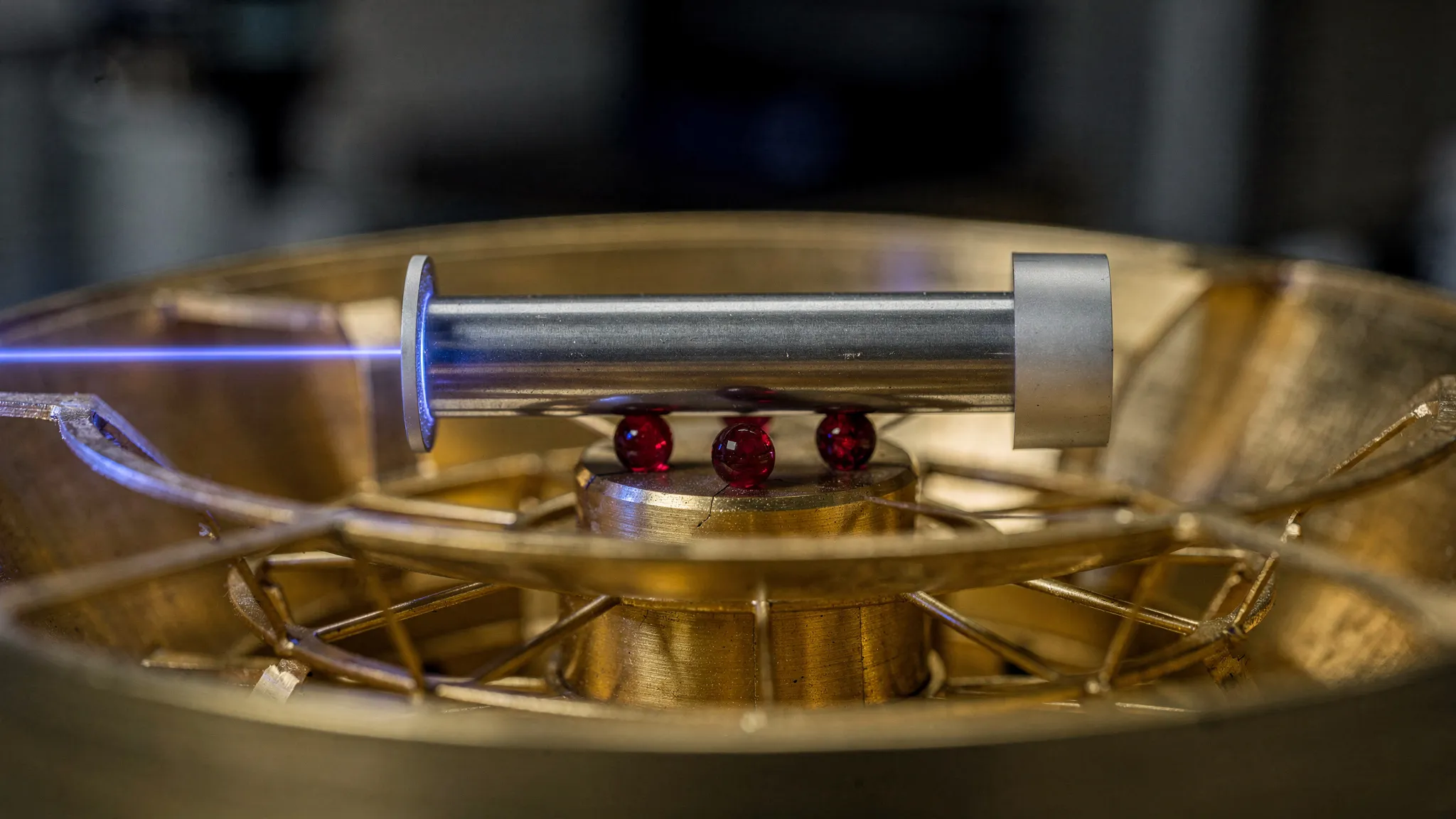
Both changes normally make a cavity more sensitive to vibrations, and reaching 6 or 16 K requires a helium cryocooler — a machine that shakes. The team placed the cryocooler on the floor beside the optical table, piping cold helium up to the experiment. The cavity, held at its middle by three ruby spheres 6 millimetres across, sits on an active vibration-isolation table.
Cold brings another problem: materials hold very little heat near absolute zero, so temperature swings are hard to dampen. The solution was erbium, which at 16 K stores 6 times more heat per volume than stainless steel and 13 times more than copper. Layers of shields and erbium masses slow any temperature change down to a time scale of about four days. The control sensor is held at 16.183 K, and an independent sensor stays within 100 millionths of a degree of its target.
The record
Compared against two other silicon cavities and a strontium atomic clock, the laser reaches:
- at 6 K, a fractional stability of 7 × 10⁻¹⁸ from 2 to 50 seconds of averaging — a new record: fluctuations of only about 1.4 thousandths of a hertz — and a linewidth (the spread of the laser’s own frequency) of 2.5 millihertz, on a light frequency of 194 terahertz;
- at 16 K, 9 × 10⁻¹⁸, a linewidth of 2.9 mHz, but better behaviour over days.
The noise drops when the cavity gets colder, which shows the laser has reached its intended limit: the thermal noise of the coatings, and not vibrations or electronics.
Over two runs of 14 and 7 days, the strontium clock tracked the cavity’s slow drift: less than 4 microhertz per second (about a third of a hertz per day), comparable to a hydrogen maser (the reference oscillator of time laboratories) and ten times less than silicon cavities run at 124 K. The cavity reached this low drift only nine months after cooling down; the 124 K cavities took a decade to settle to theirs.
Seconds-long looks at atoms
The laser is already at work. Driving the strontium lattice clock (atoms trapped in a grid of laser light), it lets the atoms be probed for more than 10 seconds — and the longer the probe, the narrower the atoms’ line, so the more precisely the clock can find its centre. After 12 seconds, the interference signal (Ramsey fringes) still keeps 75% of its contrast, and a single 12.4-second pulse gives a line just 64 millihertz wide. The excited state of strontium-87 used by the clock lives about 170 seconds — the next frontier for interrogation times.
Toward 10⁻¹⁸
The new laser will replace the previous JILA reference and, according to the authors, let all the optical clocks of the Boulder network reach a given precision up to ten times sooner. Crystalline mirror coatings could lower the thermal noise to about 1.5 × 10⁻¹⁸ at 6 K; colder, longer cavities or wider beams could push it to 1 × 10⁻¹⁸ or below. One mystery remains: extra noise beyond 100 seconds, whose source no sensor inside the cryostat can yet pin down.