ONE WATER ION AT A TIME: HYDROGEN BEATS DEUTERIUM IN THE COLD
Between the stars, in clouds where the temperature can drop to a few kelvin — a few degrees above absolute zero — chemistry runs mostly on reactions between charged and neutral molecules, which often need no energy to get going. A key player is the water cation (a positively charged water molecule), H₂O⁺, an intermediate on the road to water in interstellar gas. When it meets HD — a hydrogen molecule in which one atom is deuterium, the heavy form of hydrogen — it can steal either atom:
- take the H and become H₃O⁺, releasing a D;
- take the D and become H₂DO⁺, releasing an H.
Which way it goes shapes how deuterium is shared out among molecules in space, its “fractionation”. Earlier experiments showed that this balance depends strongly on the collision energy — so on the local temperature.
Labs stopped at 350 kelvin
Previous measurements covered collision energies from 0.03 to 10 electronvolts. The lowest, 0.03 eV, is the typical collision energy in a gas at about 350 kelvin: orders of magnitude warmer than cold molecular clouds. Extrapolating downward is risky, the authors argue: in the cold, quantum effects such as tunnelling can become decisive. The only low-temperature figure they know of, 57% versus 43% in favour of H₃O⁺, came from a trap that could reach 13 kelvin, but the exact temperature of that measurement was never reported.
One ion, one partner
Nanditha Sunil Kumar, Prerna Paliwal, Stefan Willitsch and colleagues at the University of Basel, with Anyang Li of Northwest University in Xi’an (China), Hua Guo of the University of New Mexico (USA) and others, built a way to watch the reaction one molecule at a time.
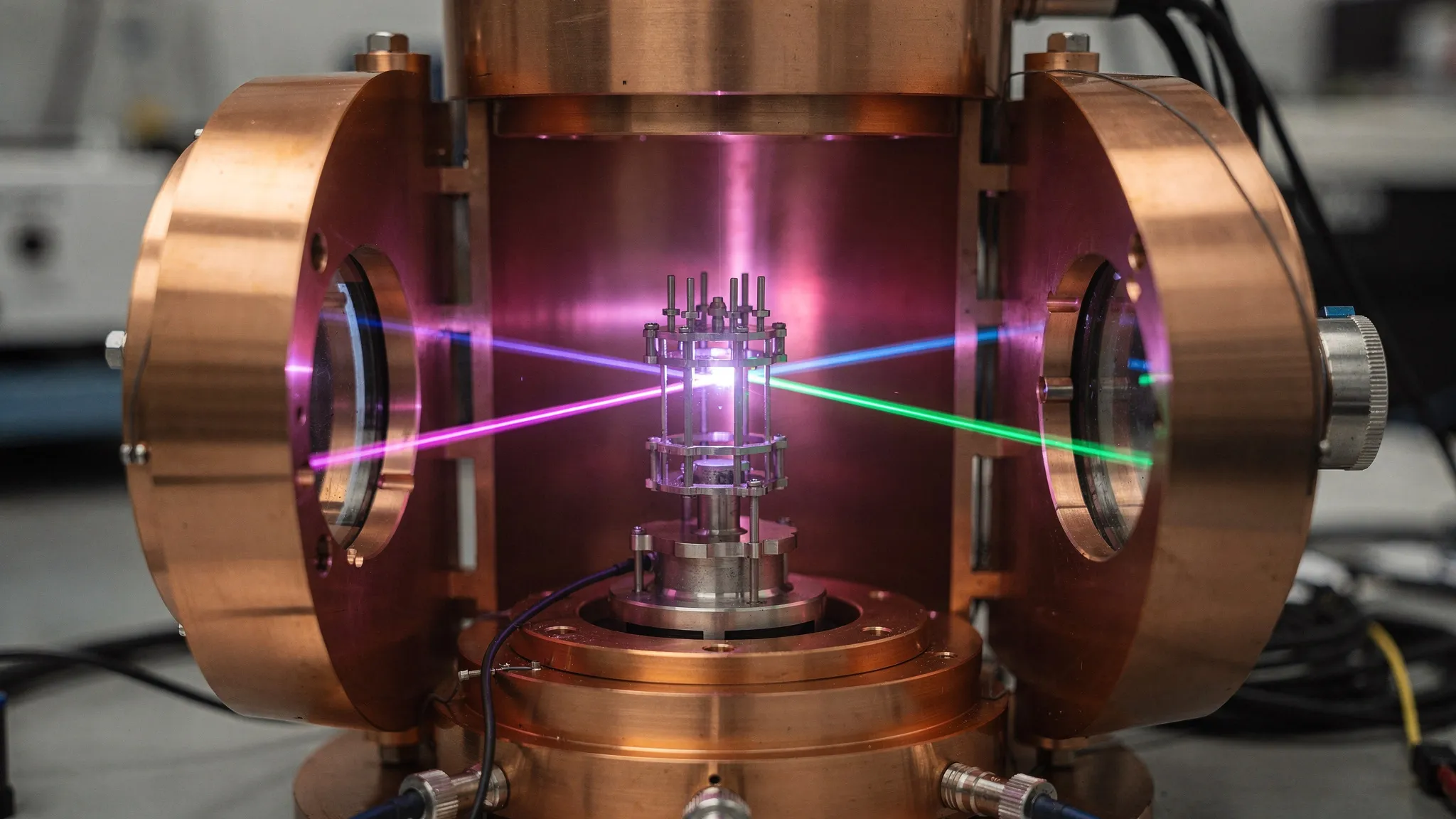
Their radiofrequency ion trap sits at 5.4 kelvin, inside two cold radiation shields, in a vacuum of about 4 × 10⁻¹⁴ millibar. Each cycle starts with a few tens of calcium ions, cooled by lasers until they freeze into an orderly pattern called a Coulomb crystal. A laser pulse then turns one molecule from a beam of water vapour into a single H₂O⁺ ion inside the crystal. The calcium ions glow under the lasers; the water ion does not, so it shows up as a dark spot. Just by interacting with the cold calcium ions, it is chilled to a few thousandths of a kelvin. The team then expels the calcium ions until only a pair remains: one calcium, one water ion.
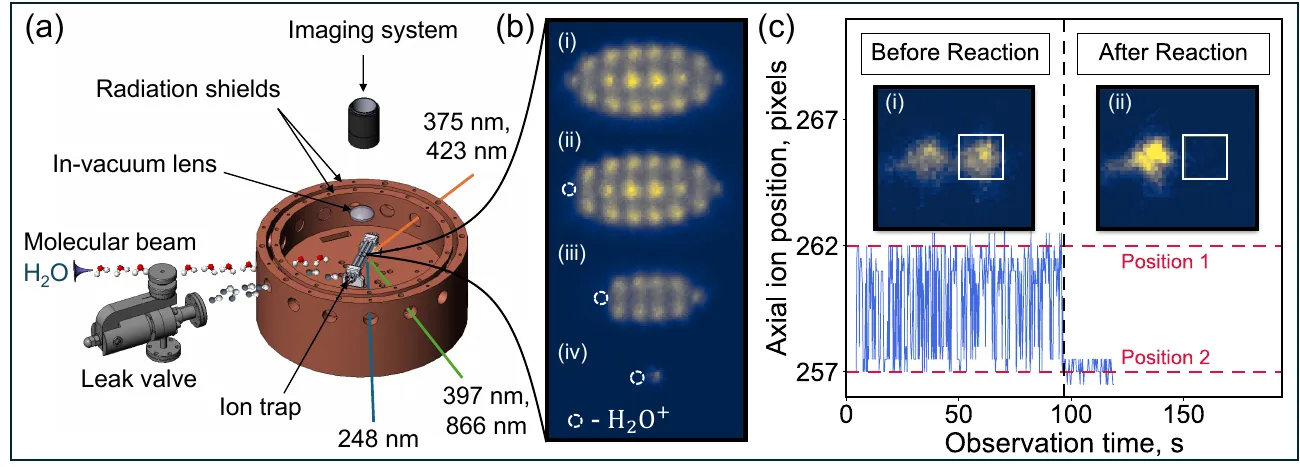
The set-up (left), the calcium crystal shrunk down to one calcium ion and the dark water ion (centre), and the moment of reaction: the calcium ion stops shaking (right). — Figure 1, Sunil Kumar et al. (2026), arXiv:2610.32904.
HD gas, about 97% pure, is leaked in. Before reaching the ion, its molecules bounce off and stick to the cold walls many times, until they settle at the walls’ 5.4 kelvin. The collision energy comes almost entirely from the HD molecules’ own motion, the ion adding very little: on average 0.6 millielectronvolt (an electronvolt is a unit of energy for single particles), which corresponds to about 7 kelvin on the same scale as the 350 kelvin above.
Weighing the product without touching it
How do you tell which product formed? By its mass. The pair of ions vibrates along the trap at a frequency that depends on the mass of the dark ion: 531.9 kilohertz with H₂O⁺, 529.2 with H₃O⁺, 526.4 with H₂DO⁺. The team shakes the pair at 531.9 kHz; the calcium ion’s image blurs. When the water ion reacts, its mass changes, the shaking stops working and the image sharpens. Trying the other two frequencies reveals the product.
A reaction typically comes after about 100 seconds. Leftover hydrogen in the vacuum can also turn the ion into H₃O⁺, but only after about 4.5 hours on average, so it barely affects the count.
271 to 170
Over 16 days, the team recorded 441 reactions: 271 H₃O⁺ and 170 H₂DO⁺. Because about 3% of the gas was ordinary hydrogen, H₂, which can only give H₃O⁺, they subtracted its expected share. The result: a ratio of 1.50 ± 0.15, about 60% H₃O⁺ against 40% H₂DO⁺. Hydrogen transfer wins in the cold, as it was seen to do at higher energies, though less strongly than at some of them.
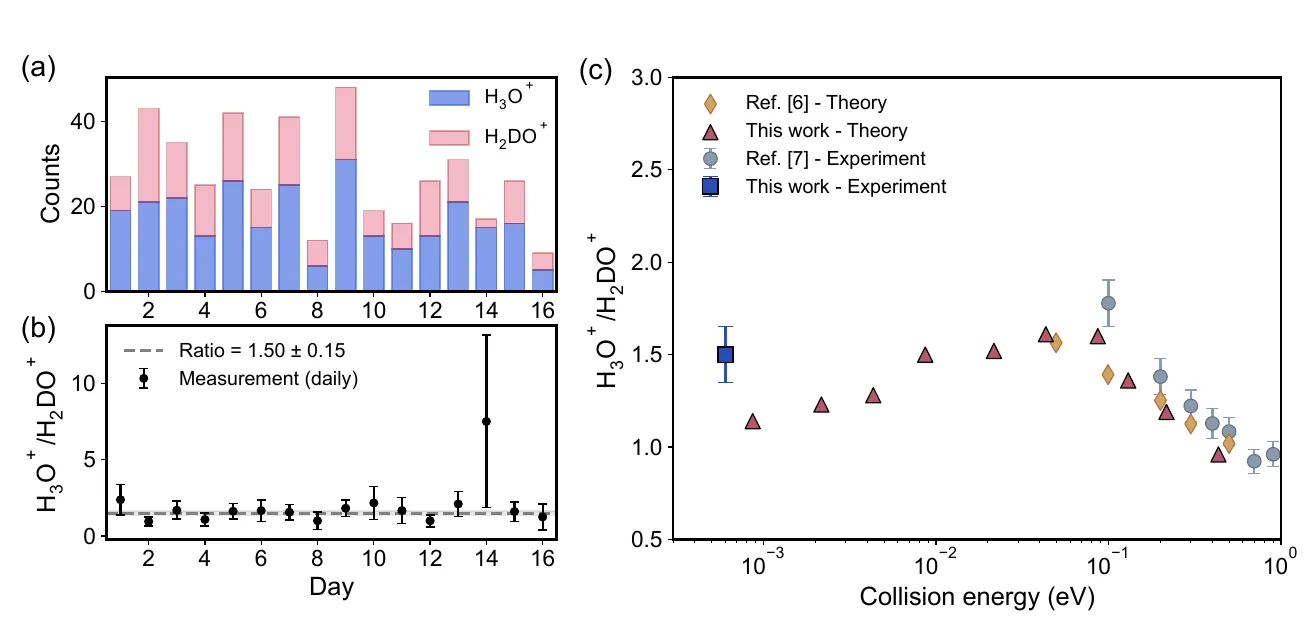
Left, the products counted on each of the 16 days and the daily ratio. Right, the ratio against collision energy: the new measurement (blue square) sits at far lower energy than earlier experiments (grey) and next to new simulations (red triangles). — Figure 2, Sunil Kumar et al. (2026), arXiv:2610.32904.
Caught in a well
To interpret the result, the team ran computer simulations of the collision: 20,000 simulated collisions (trajectories) at each collision energy, from 0.9 millielectronvolt to 0.9 electronvolt. The predicted ratio rises with energy, peaks around 40 to 80 millielectronvolts, then falls.
Two mechanisms compete. At high energy, the reaction is direct: the atom is snatched in a single quick pass, without the partners lingering together. At low energy, most collisions get trapped for a while in a dip of the energy landscape — held together by their mutual attraction, like a marble in a hollow — before reacting. There, the energy of the impact spreads into the vibrations of the temporary complex, and the preference for hydrogen fades. The longer the complex lives, the weaker the preference: in the simulations at about 10 kelvin, among the collisions that got trapped, the ratio drops from 1.35 for the shortest stays to 1.21 for the longest.
A gap left open
The simulations give 1.15 at 0.9 millielectronvolt (about 10 kelvin); the experiment gives 1.50. The authors call this qualitative agreement. The gap may come from quantum effects the simulations leave out, such as hydrogen tunnelling, or from errors in the calculated energy landscape. It may also come from the gas itself: below about 10 kelvin, H₂ and HD may stick differently to the walls and to the activated charcoal used to pump away stray gas; how the charcoal behaves at these temperatures is unknown. If more H₂ reaches the ion than the 3% assumed, the authors write, the measured ratio of 1.50 could be an overestimate.