THE MILKY WAY'S GAMMA GLOW: A SIGNAL, OR A BAD MOMENT?
The Fermi Large Area Telescope sees more gamma rays of around a gigaelectronvolt (GeV, an energy unit for particles) coming from the central 10 degrees or so of the Milky Way than known sources and models of the Galaxy’s diffuse glow can account for. Isabel Sands, of the Kavli Institute for Astrophysics and Space Research at MIT, and Philip Hopkins, of TAPIR at Caltech, call its origin an open question for nearly two decades. Some studies see this “galactic centre excess” as a smoking gun for dark matter particles annihilating each other and turning into gamma rays. Others credit unresolved point sources — a crowd too faint to be seen one by one — such as a new population of millisecond pulsars, dead stars that spin very fast.
Both camps have hit trouble. Some studies find that the excess traces the Galaxy’s central bulge of stars, which points to an astrophysical origin. And the centre seems to lack enough of the stellar systems that would give birth to the required pulsars.
A Galaxy frozen in time
The authors point to a weakness shared by nearly all past studies. To predict the “normal” gamma-ray glow, they rely on codes that treat cosmic rays — fast charged particles such as protons, electrons and heavier nuclei — as if they were in a steady state, spread evenly around the Galaxy’s axis. Such codes cannot follow anything that changes with time: galactic winds, gas tied to magnetic fields, turbulence.
In the simulations used here, cosmic rays are launched by supernovae. As they travel, they produce gamma rays in three ways, two of which depend on how much gas they run into. Model them as a calm, averaged fog, and any real unevenness is left over as an unexplained residual.
Two virtual Milky Ways
Sands and Hopkins took three simulated Milky Way-like galaxies from the FIRE-2 project, grown from the early universe with magnetic fields, gas and several kinds of cosmic-ray particles. One, m12i, was dropped because its disc is strongly warped, unlike ours. That left m12f, with a flatter disc, and m12m, with a more pronounced bulge. Neither includes dark matter emission or pulsars: the only gamma-ray glow comes from cosmic rays launched by supernovae.
For each galaxy, the team built a “calm” reference: the average of all snapshots — the simulated galaxy saved at successive moments — whose total gamma-ray brightness was below the median. They subtracted it from each snapshot between 460 and 20 million years ago, and studied what remained — the residuals — within 10 and 20 degrees of the centre.
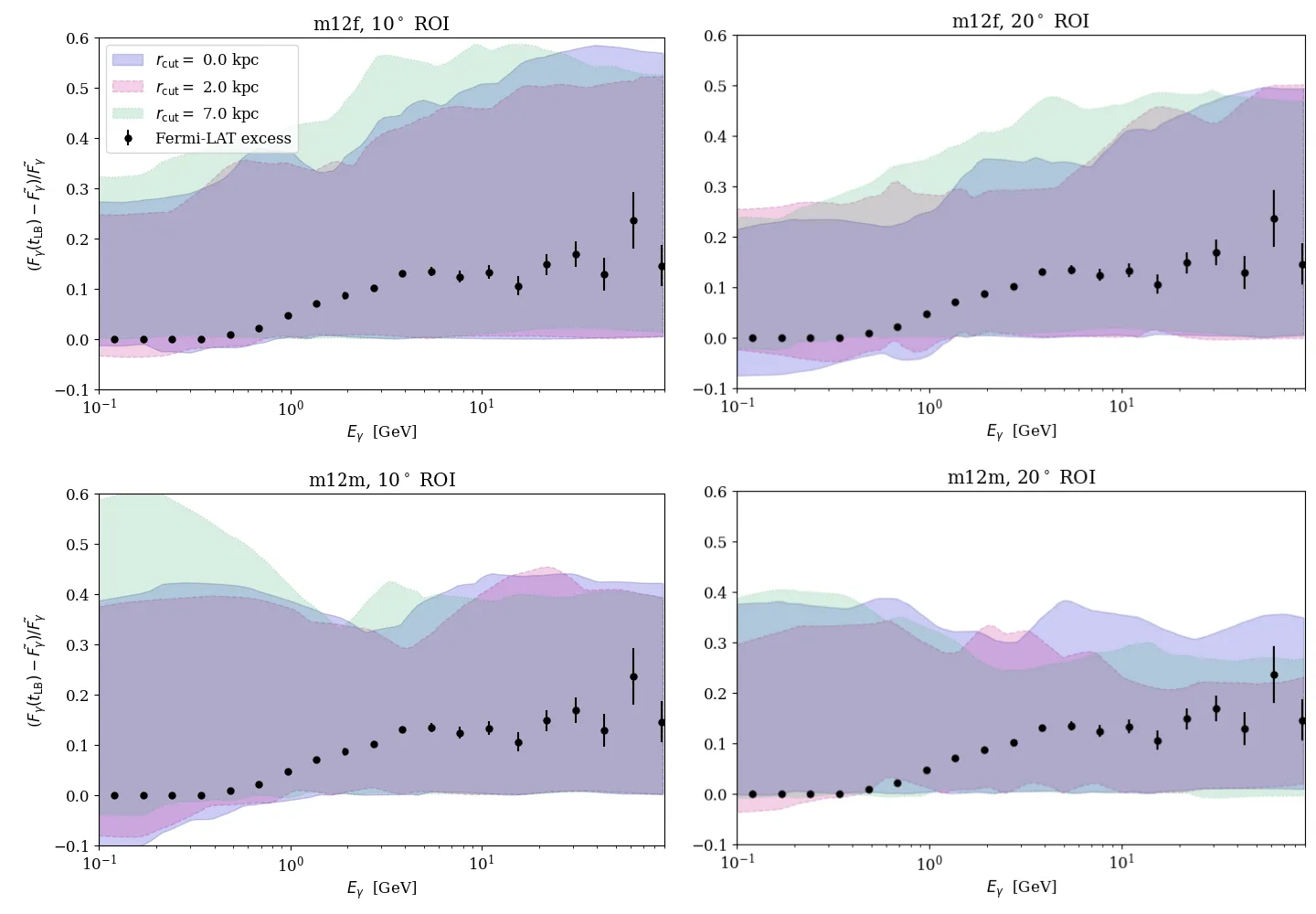
How far each simulated galactic centre strays from its calm average, by energy: the coloured bands span the middle half of all snapshots (three versions, counting the glow from different depths along our line of sight), and the black dots show the excess measured by Fermi, well inside them. — Figure 3, Sands & Hopkins (2026), arXiv:2610.32845.
Bumps that come and go
The residuals never sit still. Excesses from 1 degree to more than 10 degrees across appear wherever a supernova or a cluster of them has recently gone off, often much larger than the one Fermi measures. In every configuration tested, the real excess falls comfortably within the middle half of the simulated residuals (between their 25th and 75th percentiles). Next to each bright patch there is usually a dim one: the explosions push the surrounding gas away.
Then comes the case that gives the paper its point. In one snapshot of m12f, the residual is comparable to Fermi’s excess in both amplitude and shape, and roughly spherical within the central 10 degrees. It comes from at least three separate clusters of supernovae.
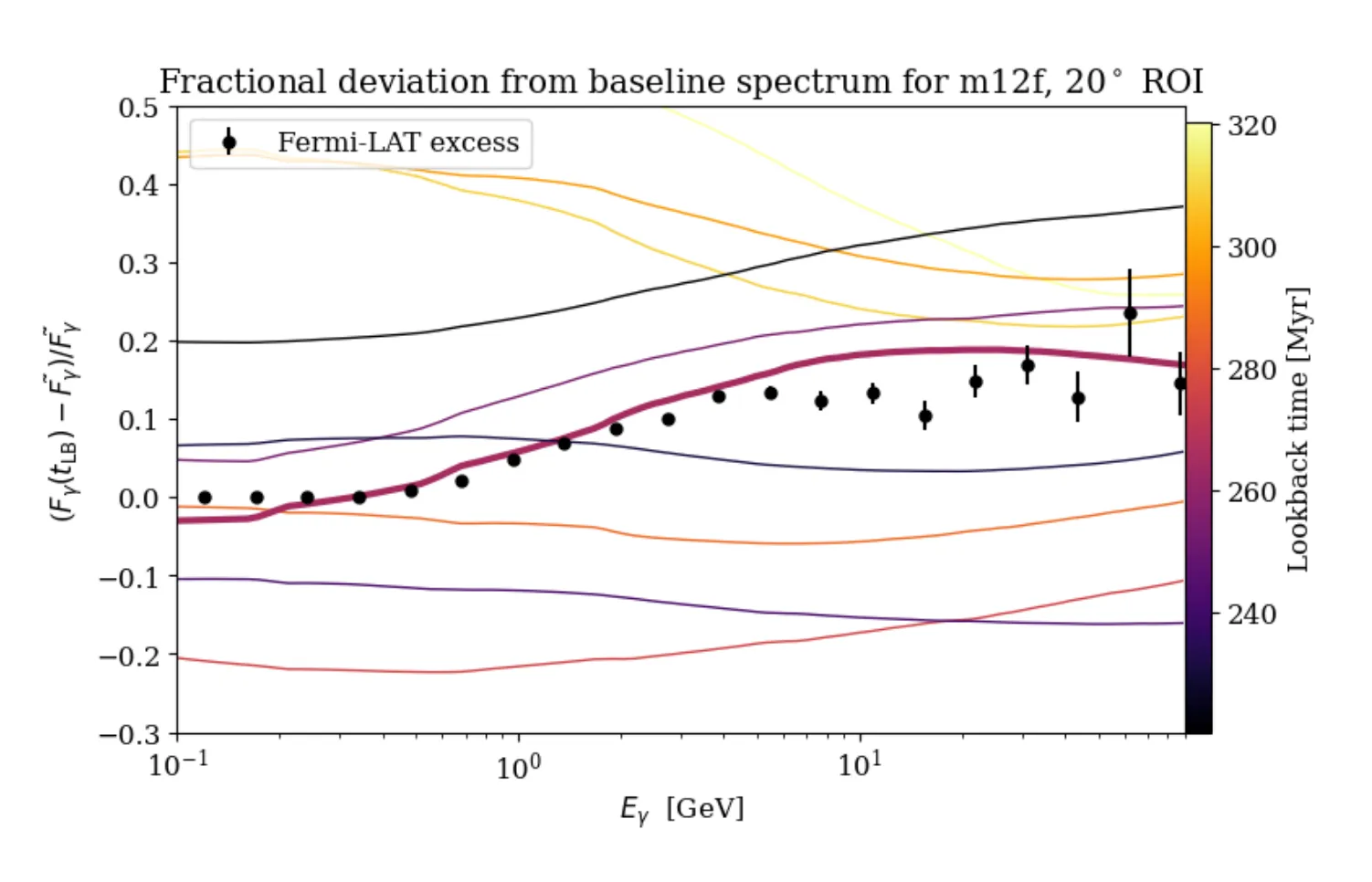
Ten snapshots of galaxy m12f over 100 million years, coloured by how long ago they occurred: the thick curve closely follows the excess measured by Fermi (black dots); the others rise and fall at every energy. — Figure 5, Sands & Hopkins (2026), arXiv:2610.32845.
The reason is timing. In the central kiloparsec (about 3,260 light-years), cosmic rays take about a million years to spread out — roughly as long as it takes the surrounding gas, and the gamma-ray spectrum, to change. They usually do not have time to spread evenly before the next disturbance.
Caught at an unlucky moment?
The Milky Way’s centre is the only galactic centre Fermi can observe in detail. It could be mere coincidence, the authors write, that its spectrum shows a 1–10 GeV excess right now. They call this the look-elsewhere effect: we may have caught our Galaxy at an inopportune moment.
They offer two readings. The cautious one: by assuming a steady state, past analyses significantly underestimated uncertainties from entirely mundane sources. The radical one: a temporary rise in the diffuse glow could explain the excess without dark matter or new pulsars. Either way, they argue, the models used to analyse Fermi data must be revisited.
What two galaxies cannot say
The paper gives no probability. With only two simulated galaxies, the authors cannot measure how often ordinary cosmic-ray physics produces a look-alike — which a rigorous statistical claim would require. Their galaxies form stars 10 to 100 times faster in the central kiloparsec than the Milky Way’s central zone, so they may be more violent. They include no central black hole and use one model of cosmic-ray transport among several; others would likely add even more small-scale variation.
They call the work a proof of concept, and propose a test. If other galactic centres had excesses at other energies, that would strongly favour a changing astrophysical source. If they all showed the same 1–10 GeV bump, it would make a compelling argument for dark matter.