SHINE THE RIGHT LIGHT, AND ALMOST NO ELECTRON COMES OUT
When light hits matter, it can knock electrons loose: once a photon brings more energy than the energy binding an electron, the electron can leave, and above that threshold the yield generally stays above zero. Yet more than six decades ago, J. W. Cooper predicted that at certain energies this yield can be suppressed. The dip is now called the Cooper minimum.
A dip that never reaches zero
The escaping electron is described as a wave, and its chance of escape depends on how this outgoing wave overlaps with the orbital it starts from. That overlap adds up positive and negative pieces. At one particular speed of the departing electron, the total changes sign — passing through zero on the way.
Beyond atoms, Cooper minima have been seen in only a few systems, all still rather atom-like, and there the yield only dips. The electron leaves through several channels, called partial waves, and it is highly unlikely that all of them cross zero at the same energy.
There is one exception. An electron in an atomic s orbital, which is perfectly round, can leave through only one channel, a “p-wave”, because of the rules governing how light is absorbed. One channel, one sum: when it crosses zero, nothing comes out. According to the authors, this “zero photoemission” is extremely rare even in atoms and had never been reported outside them.
An atom made of 13 atoms
Yuta Suzuki, Mamoru Tanaka, Akira Terasaki and Takuya Horio at Kyushu University, with Yoshi-ichi Suzuki of the Health Sciences University of Hokkaido, built such a round orbital on purpose, inside a superatom: a cluster of atoms that mimics a single atom. Its electrons fill shells labelled 1S, 1P, 1D, 2S, by analogy with the 1s, 2s, 2p of ordinary atoms.
Their candidate was Ag12W⁻: twelve silver atoms forming an icosahedral cage (a 20-faced shape) — the most symmetric arrangement a finite cluster can have — around one tungsten atom, with one extra electron. The group had previously found that such cages built around vanadium, niobium or tantalum have completely filled shells. Tungsten, from the next column of the periodic table, adds one more electron. It sits alone in a 2S shell: round, like an atom’s s orbital, but spread over the whole cluster.
Calculations confirmed that the icosahedron is the most stable shape. Electrons pulled from Ag12W⁻ form a single sharp energy peak, close to the instrument’s resolution: the cage barely rearranges when the electron leaves (had it reshaped, part of the energy would have gone into shaking it, smearing the peak). Their pattern looks strikingly like that of a lone silver ion, Ag⁻, whose outer electron sits in a round s orbital.
Fifty-five pictures, and a gap
The team made the clusters in a gas, sorted them by mass and fired a tunable laser at them, catching the escaping electrons on a camera. They recorded 55 images, with photon energies from 1.46 electronvolts (a unit of energy suited to single particles), the detachment threshold, up to 4.00.
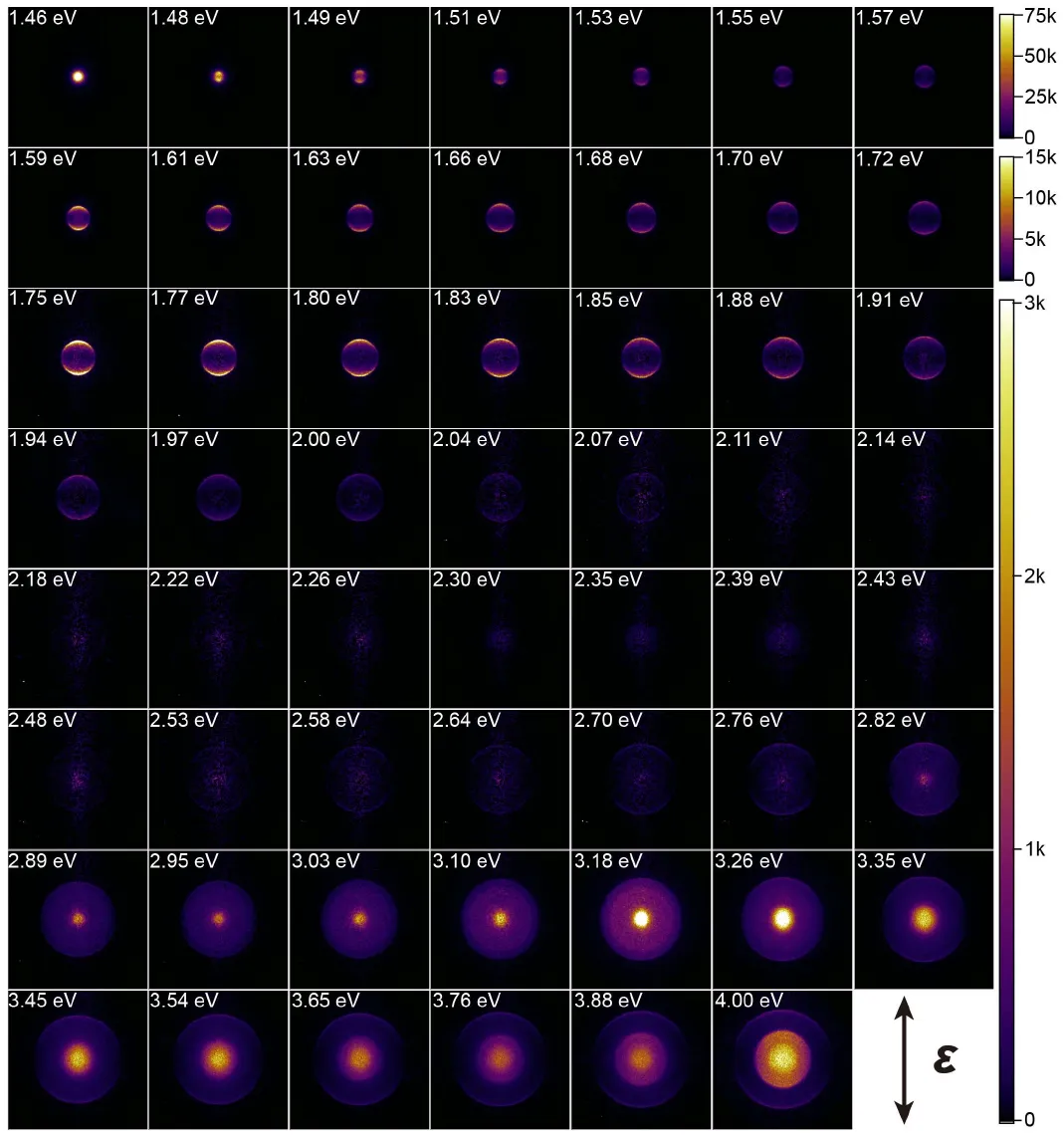
Electrons escaping from Ag12W⁻ as the laser energy rises: the ring fades out between about 2.11 and 2.48 eV, then returns. The first two rows each have their own brightness scale; the rows below share a third. — Figure 3, Suzuki et al. (2026), arXiv:2610.32031.
As the energy climbs, a ring of electrons grows. Then, from 2.11 to 2.48 electronvolts, it becomes almost invisible. An independent experiment, counting how many clusters survive the laser in an ion trap, agrees: detachment becomes almost zero between 2.0 and 2.5 electronvolts. The gap is centred near 2.3 electronvolts, where the escaping electron would carry about 0.85 electronvolt of kinetic energy (2.3 minus the 1.46 spent to detach it).
Two halves that cancel
The authors computed the overlap at the heart of the process: the cluster’s orbital, times the outgoing wave, times the cube of the distance from the centre. At 0.85 electronvolt, the positive and negative parts of this product “exactly cancel, yielding a zero integral”.
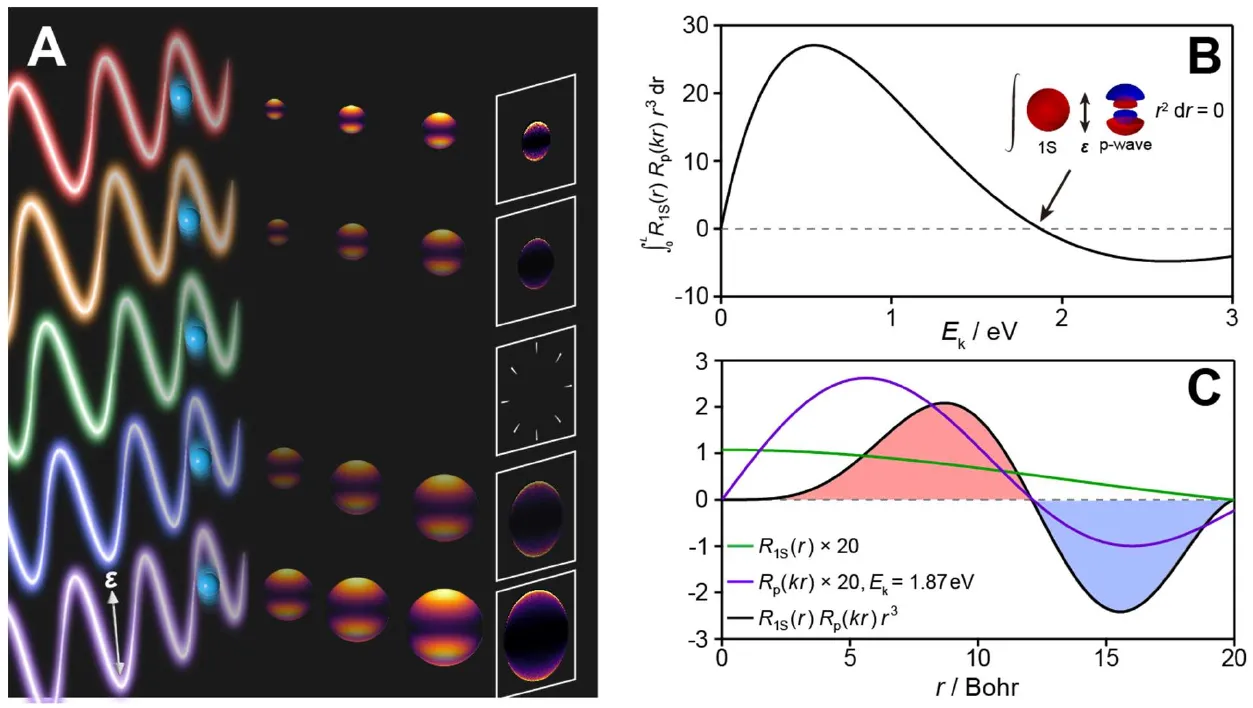
The principle, shown on an idealised sphere rather than the real cluster: at one electron energy (1.87 eV in this simple model), the positive (red) and negative (blue) parts of the overlap cancel, and emission vanishes. — Figure 1, Suzuki et al. (2026), arXiv:2610.32031.
A second clue is the direction in which electrons fly out, summed up by a number, β, which is 0 when electrons fly out equally in all directions and 2 when they leave mostly along the direction in which the laser light’s electric field oscillates. It reaches 2, the limit expected for an atom, around 2.7 electronvolts and from 3.3 to 4.0; a less symmetric sodium cluster, Na19⁻, stays at or below 1.7. In the gap, β drops to nearly zero: with the main channel silenced, an extremely weak wave that normally stays hidden, a fingerprint of the icosahedral shape, takes over.
The molybdenum twin
The simulations suggested that such cancellations could be common in nearly spherical clusters. The team tested this with Ag12Mo⁻, in which molybdenum replaces tungsten with the same number of electrons. Again a single sharp peak; again a near-total gap, at about 2.1 electronvolts — once more about 0.87 electronvolt above the threshold. Since superatoms can be tuned in size and recipe, the authors see a route toward actively controlling photoemission.
A charge tuned to fit
The theory has limits the authors spell out. The exact orbital was too costly to compute, so they used an approximation. A simple outgoing wave failed to match the data; instead, the departing electron is modelled as feeling a weak pull back from the cluster, an effective charge of +0.37 elementary charges (the size of the electron’s charge, with a positive sign), adjusted to fit — an approach they call phenomenological. And Ag12Mo⁻ could not be fully separated by mass from Ag13⁻ clusters, so its spectrum is clean only up to 2.81 electronvolts.