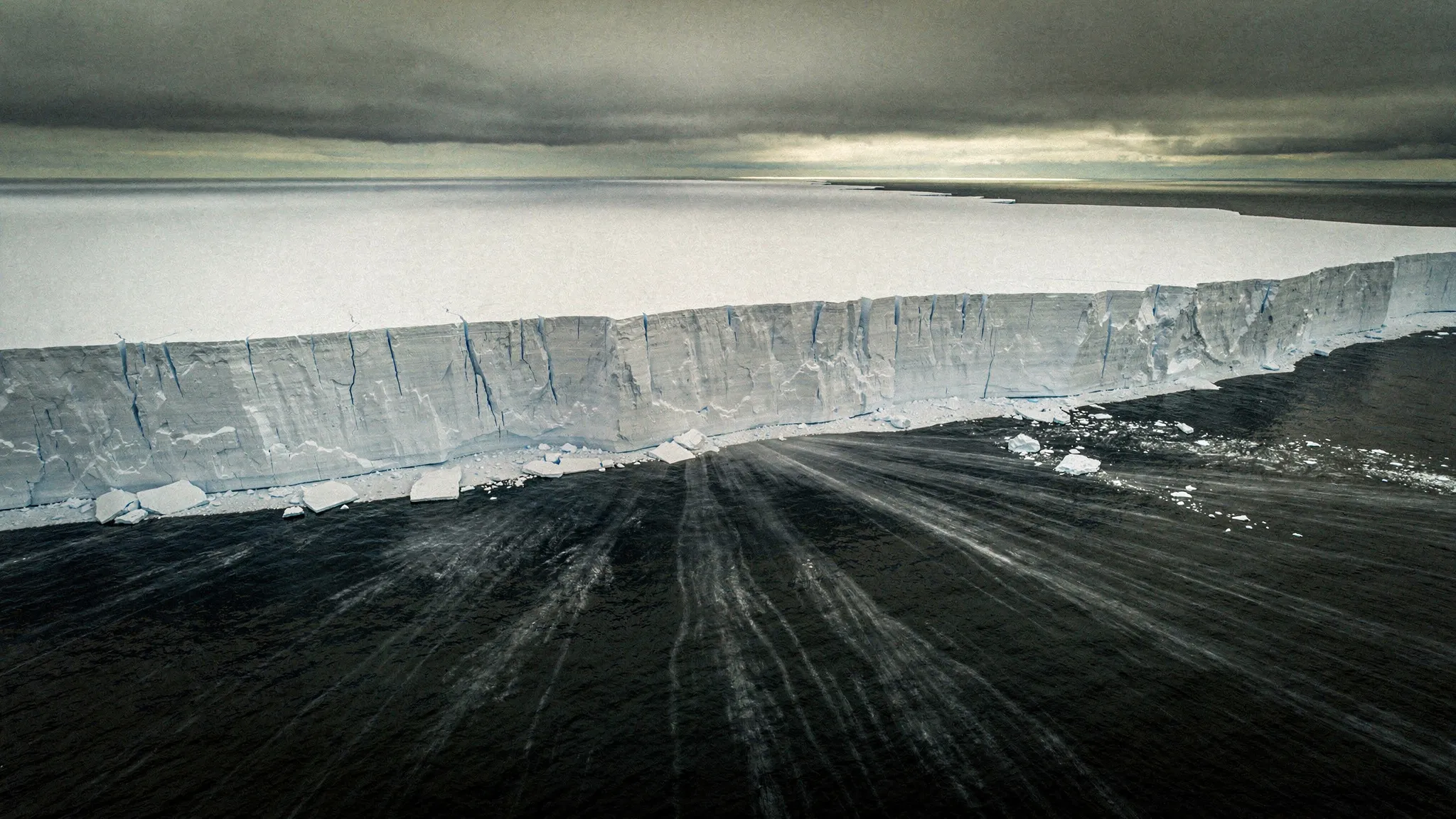
AN ICE SHELF WITH A MEMORY
Around Antarctica, the ice sheet does not stop at the coast. It flows out over the sea as floating platforms, the ice shelves, which the ocean eats from below. According to the authors, thinner ice shelves can let the grounded ice behind them slide faster into the ocean, adding to sea-level rise.
What fills the space beneath an ice shelf, its cavity, makes all the difference. Some cavities hold cold water, around −2 °C (salt water freezes below 0 °C), made at the sea surface at the freezing point: their ice melts slowly. Others are invaded by warm deep water, around 1 °C, flowing in from the open ocean: there, melting is fast. Whether a cavity can flip from cold to warm, and back, is debated: some studies found such flips permanent, others reversible.
The salt factory at the ice front
The cold water comes from coastal polynyas: stretches of open sea, free of sea ice, right in front of an ice shelf. Winds push the sea ice offshore, the exposed water loses heat to the freezing air, and new sea ice forms there faster than anywhere else. Freezing seawater leaves its salt behind. The surface water grows heavier and, if this is intense enough, sinks and stirs the water down to the seabed: this deep convection sends cold water into the cavity.
A model ice shelf in a 250-kilometre channel
Louis Saddier and colleagues, in Lyon and Canberra, did not model any real ice shelf. With the NEMO ocean code, they built an idealised one: a channel 250 km long and 50 km wide, a flat seabed 600 m deep, a 100-km ice shelf with a straight sloping base and, at the far end, an open ocean held at fixed temperature and salinity. Just in front of the ice, the sea surface receives salt, mimicking a polynya. That salt flux is the main knob.
Simplicity buys time. From a warm cavity, the team raised the salt flux by 0.005 grams per square metre per second — by the authors’ conversion, the salt left by roughly 5 metres of new sea ice a year — every 10 years, from zero to 0.075. From a cold cavity, they lowered it the same way. Each path covers 16 steps and 160 simulated years. The top value is deliberately extreme: the most active polynya the authors cite, Cape Darnley, reaches about 0.03 (some 30 metres of sea ice a year).
Same polynya, two possible oceans
When the offshore deep water is at 0 °C or colder, melting changes smoothly and the way up matches the way down. At 1 °C or 2 °C, the cavity flips abruptly, within a few years, and the two paths no longer match:
- At 1 °C, a warm cavity turns cold once the salt flux reaches about 0.04. A cold cavity turns warm again only when the flux falls to about 0.02, half as much.
- At 2 °C, the switch to cold waits until about 0.06, while the way back still happens near 0.02. The window, the range of salt flux where either state can hold, widens.
- In between, the same polynya can hold either state, with an average melt rate several times higher in the warm one. Physicists call this bistability; the fact that the way back differs from the way out is hysteresis.
Meltwater that locks the door
Why does the ocean remember? Through its own meltwater. A warm cavity melts a lot of ice. The light, fresh meltwater spreads near the surface and keeps the polynya water from sinking, so the cavity stays warm even as the salt rises. A cold cavity melts little, convection comes easily, and it stays cold even as the salt drops.
This feedback needs a trap. In the model, a gyre, a slowly rotating current, holds the meltwater in front of the ice. Make the channel’s side walls frictionless and that gyre gives way to a single large one that carries the meltwater off to the open ocean: the switch becomes gradual and fully reversible. A more strongly layered offshore ocean also shrinks the window until it vanishes. Raising or lowering the horizontal viscosity fivefold, an internal friction that modellers set with few constraints, also narrows the window. According to the authors, this may explain why earlier studies disagreed.
Watch the thermocline, not the melt
The switch has a clear marker: the thermocline, the boundary between the stirred cold layer above and the warmer layer below. The cavity turns cold exactly when the stirred layer reaches the seabed, and warm again when the thermocline lifts off it. Before the switch to cold, the thermocline’s depth wobbles more and more; before the switch back to warm, warm deep water slips in more and more often. The melt rate itself gave no useful warning.
Melting even follows two laws: roughly the square of the offshore water’s excess over the local freezing point (−2.33 °C) in the warm state, simple proportion in the cold one. The square-law formulas commonly used to estimate melting from offshore conditions may not always apply.
No wind, no real seabed
The channel leaves out seabed troughs, winds, the coupling with sea ice, the edge of the continental shelf and meltwater from neighbouring ice shelves. The authors note that real ice shelves such as Pine Island, Amery and Filchner have gyres near their fronts, which may make them more prone to irreversible switches. In the model, ten-year steps were enough for a complete switch; how long a real cavity would take, the study leaves open.