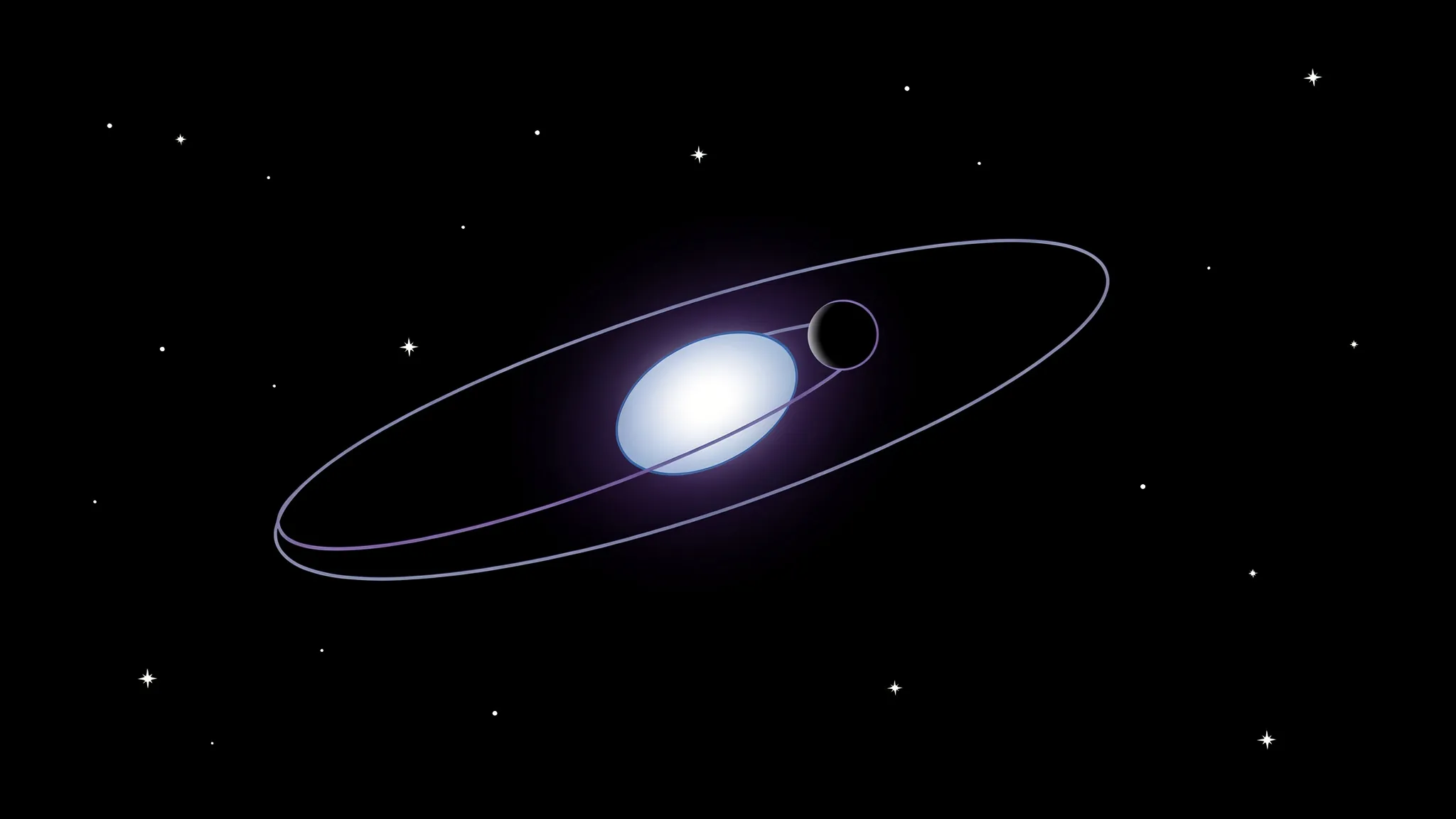
A STRIPPED STAR, A HIDDEN PARTNER, A 4.2-HOUR ORBIT
A small, very hot star in the Small Magellanic Cloud, outside the Milky Way, completes one lap every 4 hours and 10 minutes around a partner that gives off no light. Its name is DGL-3, and its hidden partner is most probably a neutron star, the ultra-dense collapsed core left when a massive star explodes.
A star with its outer layers peeled away
DGL-3 is a stripped star: it has lost its hydrogen-rich outer envelope in an interaction with a companion. What remains is compact, hot, poor in hydrogen, and burns helium at its centre.
- Mass: about 3.4 times the Sun’s, estimated from its brightness, with a very lopsided margin (2.96 to 7.72 solar masses).
- Radius: about 0.77 times the Sun’s; surface temperature: about 71,000 kelvin; hydrogen: only 10% of its surface.
Stars of this “intermediate” mass are heavy enough for their core to collapse into a neutron star, but not heavy enough to make a black hole. In current models, neutron-star pairs tight enough to merge, spiralling together as they emit gravitational waves, first pass through exactly this stage: a neutron star orbiting a stripped star. That stage had never been observed directly, and predicted merger rates span several orders of magnitude.
Weighing a partner that does not shine
The team collected 38 spectra with the 6.5-metre Magellan telescope in Chile between 2019 and 2022. The star’s spectral lines — dark lines at precise colours in its light — shift towards blue when it approaches us and towards red when it recedes (the Doppler effect); they show it swinging towards and away from us at up to 151.4 km/s, on a circular orbit completed every 4.1693 hours.
Period and speed give the mass function, which links the partner’s mass to the star’s own mass and to the tilt of the orbit seen from Earth (its inclination). An orbit seen exactly edge-on gives the lightest partner the orbit allows; taking the star’s uncertain mass into account, the typical value of that minimum is 1.38 ± 0.25 solar masses, just under the 1.4 a white dwarf can reach (see below). The orbit alone therefore cannot rule out a white dwarf.
- Not an ordinary star: one that massive would be too large to fit inside such a tight orbit.
- Not a second stripped star: fake stripped companions slipped into the real spectra were detected every time, yet the real data show no trace.
What is left is a compact object: a white dwarf (the dense leftover core of a lighter star), a neutron star or a black hole.
99.4% from a 2.5% wobble
On 18 December 2022, a fast camera on a 3.5-metre telescope at La Silla imaged DGL-3 every 20 seconds for about 3.4 hours. Its brightness rises and falls by about 2.5%, twice per orbit: the partner’s gravity slightly stretches the star into an egg shape, whose long side we see twice per lap, by an amount that depends on the partner’s mass and on the inclination.
The team ran 500,000 models of this light curve and weighted each one by how well it matches the data. For the partner’s mass:
- the most probable value is 1.58 solar masses;
- only 0.6% of the probability lies below 1.4 solar masses, the Chandrasekhar limit that rules out a white dwarf: hence a 99.4% probability that the partner is too massive to be one;
- only 3.4% lies in the range of confirmed black holes; the rest of the heavy tail falls in the gap between neutron stars and black holes.
A neutron star is therefore the most probable partner: a probability, not a proof. X-ray telescopes detected nothing; a neutron star swallowing gas from its partner would glow in X-rays, but the authors find the silence compatible with a neutron star fed by a weak stellar wind.
A future written by a computer model
The team then evolved the system with the stellar evolution code MESA: a stripped star of 3.6 solar masses, a neutron star of 1.4, a 4.2-hour orbit. What follows is a prediction, not an observation.
- The star burns helium in its core for another 1.4 million years, then swells. In so tight an orbit, growing by just half a solar radius makes it overflow and pour gas onto its partner.
- Over 26,000 years, 1.2 solar masses escape into space. The neutron star swallows only 0.00072 solar masses, enough to spin it up to one turn every 79 milliseconds. The orbit shrinks to 1.9 hours.
- Stripped of all its hydrogen, the star explodes as a supernova and leaves a second neutron star. With an orbital speed of nearly 800 km/s, only an unusually large kick — a recoil the explosion can give the newborn neutron star — could break the pair apart.
- The explosion blows away about one solar mass of gas. Two neutron stars remain, on a wider, elongated 4.4-hour orbit, and merge 220 million years later.
Where the forecast could break
The weakest link, according to the authors, is how much angular momentum, the orbit’s “amount of rotation”, the escaping gas carries away. In one of seven model variants, the lost gas forms a disc around both stars, and the pair merges before the second supernova. In the six others, two neutron stars form and eventually merge, between 175 million and 7.9 billion years later.
DGL-3 lies about 60,600 parsecs away — some 200,000 light-years (one parsec is about 3.26 light-years). Were it 60 to 600 times closer, within 100 to 1,000 parsecs, low-frequency gravitational-wave observatories such as LISA would detect it, the authors note.