A GIANT CRASH CAN SAVE A PLANET'S ATMOSPHERE
Measure the sizes of small exoplanets and they fall into two groups: one peak at about 1.3 times Earth’s radius, another at about 2.4 times, with a dip at 1.75 Earth radii. The small ones are thought to be bare rocky planets — super-Earths. The large ones, sub-Neptunes, would be rocky planets still wrapped in their primordial atmosphere (gas captured from the disc around their young star), rich in hydrogen. So some planets must have lost a lot of hydrogen. But which ones, and how?
The usual suspect
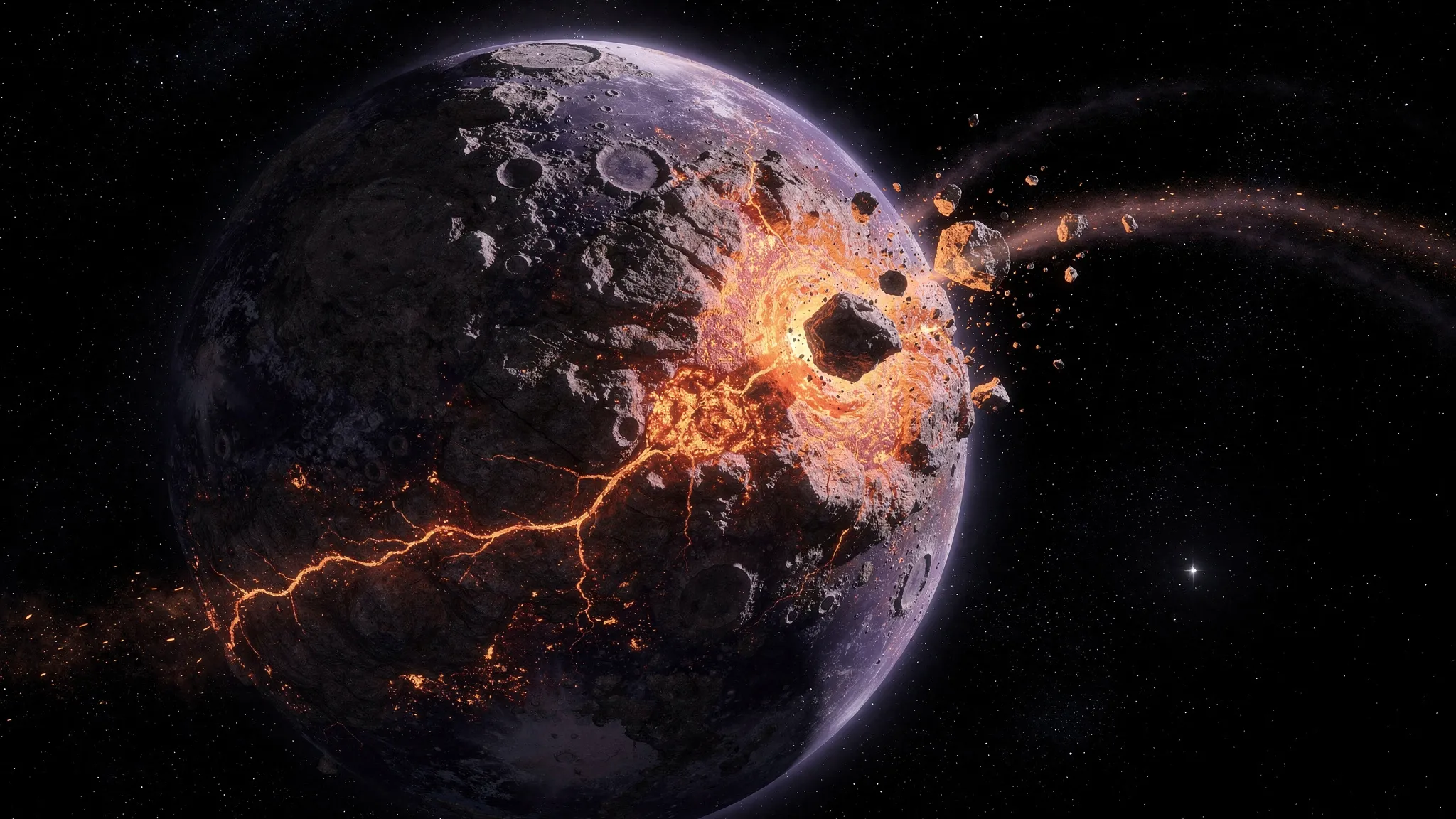
Rocky planets the size of Earth or larger are expected to suffer one or more giant impacts at the end of their formation, some of them after the disc of gas around the young star has dispersed. A popular explanation for the two groups blames those late crashes: the shock heats the planet’s mantle (the thick rocky layer between its metal core and its surface), the scorching surface drives the gas to escape, and an atmosphere-bearing planet turns into a super-Earth.
Darius Modirrousta-Galian, of Shanghai Jiao Tong University, and Jun Korenaga, of Yale University, argue that this picture leaves out half of the ledger. Their study has been accepted in the journal Nature Astronomy.
The other side of the ledger
A collision does not only heat a planet. It also adds mass, and all of that mass deepens the gravitational well that holds the atmosphere. Meanwhile, only part of the impact energy actually warms the mantle:
- the metal core of the impactor plunges through the mantle, giving up little energy on the way, and ends up deep inside, still superheated;
- melting rock absorbs energy as latent heat, without raising the temperature;
- what heat reaches the surface is damped high in the atmosphere. The temperature in the layers that control escape is set by the light of the star, not by the hot ground below.
For a planet whose metal core makes up 30% of its mass, about 84% of the impact energy goes into the mantle, in line with detailed collision simulations. The gas torn away directly by the impactor is small; the shock wave typically removes around 10 to 20% of the atmosphere. Overall, the authors find, the planet’s gravitational grip grows more than its mantle heats up: after the crash, the atmosphere is held more tightly than before.
A hundred million planets
To test this on a whole population, the team simulated 100 million planets with realistic spreads of masses, temperatures, metal cores and atmospheres. In each run, every planet has a 52, 63 or 74% chance, depending on the run, of a giant impact after the gas disc is gone — values taken from simulations of planet formation — with an impactor of up to half the final mass. The model then follows the molten mantle as it cools and the atmosphere as it leaks, over 5 billion years.
The result reproduces the two observed peaks, at about 1.3 and 2.4 Earth radii with a dip at 1.75, for every impact recipe tested. Two control runs show why. Without any late impacts, too many planets end up bare. With an impact for every planet, too many keep their hydrogen. The crashes set the balance by pushing planets across a mass threshold above which hydrogen stays put.
The bigger the crash, the safer the atmosphere
The chance of losing the whole atmosphere falls as the planet’s starting mass and the impactor’s share grow. The authors fit a simple curve for the impactor share at which only 1% of planets lose everything: χ = 0.58 − 0.0188 (M/M⊕)^1.794, where χ is the impactor’s mass divided by the final mass and M the starting mass in Earth masses. For a planet that starts at 5 Earth masses, that is an impactor of about a quarter of the final mass; above the curve, planets almost always keep their primordial atmosphere.
Heavier hearts for sub-Neptunes
If crashes help planets keep their hydrogen, then sub-Neptunes probably grew through more collisions and hold more massive rocky interiors than super-Earths. Measured planets already point that way: sub-Neptunes weigh more than about 4 to 5 Earth masses, super-Earths less. The authors list the instruments that can test the idea — JWST, Ariel and Twinkle searching for hydrogen in the bigger planets’ atmospheres, PLATO and JUST weighing them, and the Nancy Grace Roman Space Telescope reaching smaller, more distant worlds.