WHY THE SMALLER GRAIN TAKES THE CHARGE
Shake a powder, pour sand, grind coffee: the grains knock into each other and come away electrically charged. The effect, called tribocharging, plays a part in volcanic eruptions, dust storms and lightning, and in industry, from electrophotography and spray coating to the making of medicines. Yet, the authors write, its mechanism “remains elusive”.
Same sand, opposite charges
Two observations make it a puzzle. First, grains of the same material still charge each other, and their size decides which way: the common belief is that small grains turn negative and large ones positive. Second, that polarity reverses from one material to another.
Earlier explanations stumbled on one or the other. High-energy electrons trapped at the surface were proposed, but measurements found too few of them to carry the charge. A transfer of ions from thin layers of hydroxide ions (OH⁻) stuck to the grain surface was proposed next, but it cannot say why chemically identical grains sort themselves by size alone. Since 2018, according to the paper, the question has been wide open.
The heat of the impact
Donggeun Kang, Yong-Hyun Kim and colleagues at KAIST in South Korea, with Suranaree University of Technology in Thailand, start from the simplest consequence of friction: heat. When two grains collide, they assume the impact deposits the same amount of heat on both surfaces. What differs is where that heat goes. In a small grain, the curved surface concentrates it, and there is less material to soak it up. The smaller grain ends up hotter.
A temperature difference between two materials in contact produces a voltage: the Seebeck effect, the principle of a thermocouple. Here, ΔV = −SΔT, where S, the material’s Seebeck coefficient, is the voltage it produces per degree of temperature difference. That voltage pushes charges from one grain to the other. The sign of S decides the direction: positive carriers flow towards the hotter grain when S is positive; electrons do when it is negative. So with S negative, as in quartz, the smaller grains end up negative; with S positive, as in nylon, the polarity reverses.
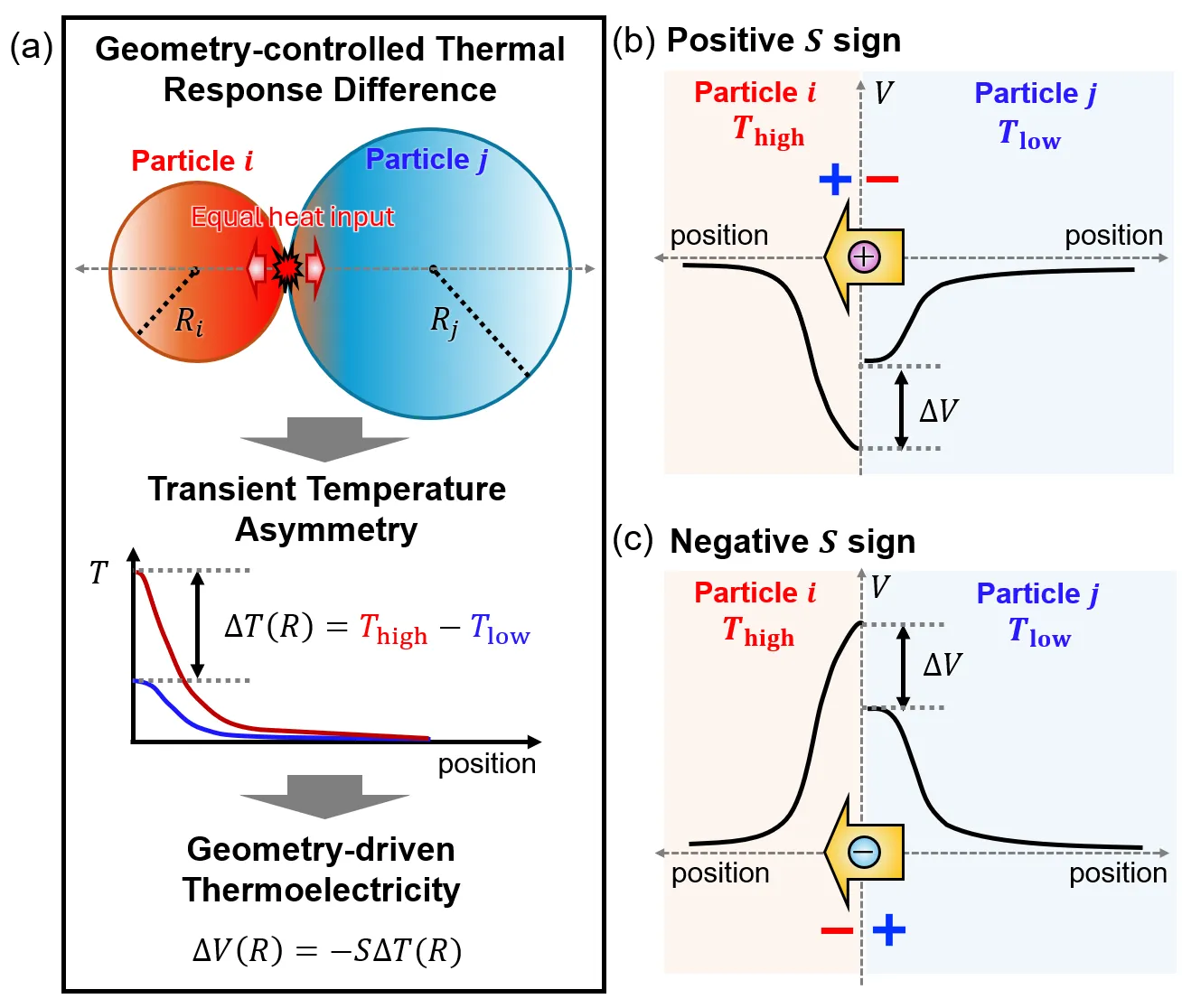
Equal heat, unequal warming: the temperature gap ΔT creates a voltage ΔV = −SΔT, and the sign of the Seebeck coefficient S sets which way the charge flows. — Figure 1, Kang et al. (2026), arXiv:2610.36757.
Thousandths of a degree
The team solved the heat equation inside spherical grains during a collision lasting a ten-thousandth of a second, for twelve materials, from nylon and silk to quartz and PVC.
- Between two grains of the same radius (100 micrometres), the material alone changes the outcome: the contact warms by about 0.6 degrees for nylon against about 0.17 for quartz, and the voltages have opposite signs. The ordering of materials predicted this way agrees with a published triboelectric series — the list that ranks materials by the charge they take — in 83% of cases.
- Between two quartz grains, one of radius 100 micrometres against a larger one, the gap grows with the size difference: 4.4 thousandths of a degree against a grain of radius 200 micrometres, 10.5 against one of radius 800 micrometres.
Ten thousand collisions
A single impact is not the whole story: real powders collide again and again. Over many collisions, each grain warms according to its heat capacity, which grows with the cube of its radius. The voltage between a small and a large grain then scales as the difference of the inverse cubes of their radii, R_s⁻³ − R_l⁻³.
The authors then simulated a mixture of 600 small grains (radii from 50 to 150 micrometres) and 400 large ones (100 to 400 micrometres) over 10,000 collisions. For quartz, whose Seebeck coefficient is negative, the small grains end up negative and the large ones positive: the classic pattern. For nylon, whose coefficient is positive, the pattern flips. Both trends match what experiments have reported for these materials.
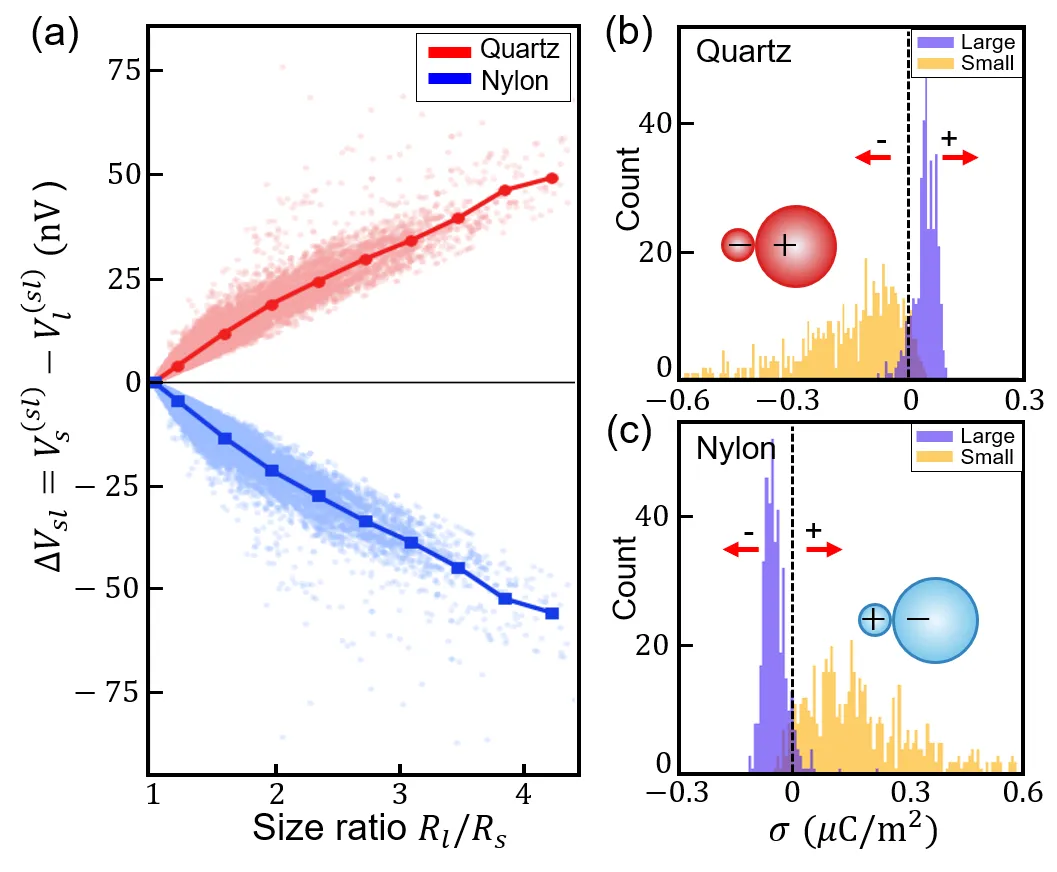
The pairwise voltage grows with the size ratio, with opposite signs for quartz (red) and nylon (blue); small and large grains end up with opposite charges, and the polarity flips between the two materials. — Figure 4, Kang et al. (2026), arXiv:2610.36757.
What the model takes for granted
This is a theory paper, without a new experiment. It assumes the heat of each impact splits equally between the two grains; the authors note that grains of different hardness or elasticity could split it unequally, an open question. Grains are ideal spheres, and several parameters, such as the share of the collision energy turned into heat, are fixed by hand.
In their model, geometry decides which grain runs hotter, and the material decides which way the charge goes. The authors see in it “a general strategy for controlling contact-induced charge transfer”.